
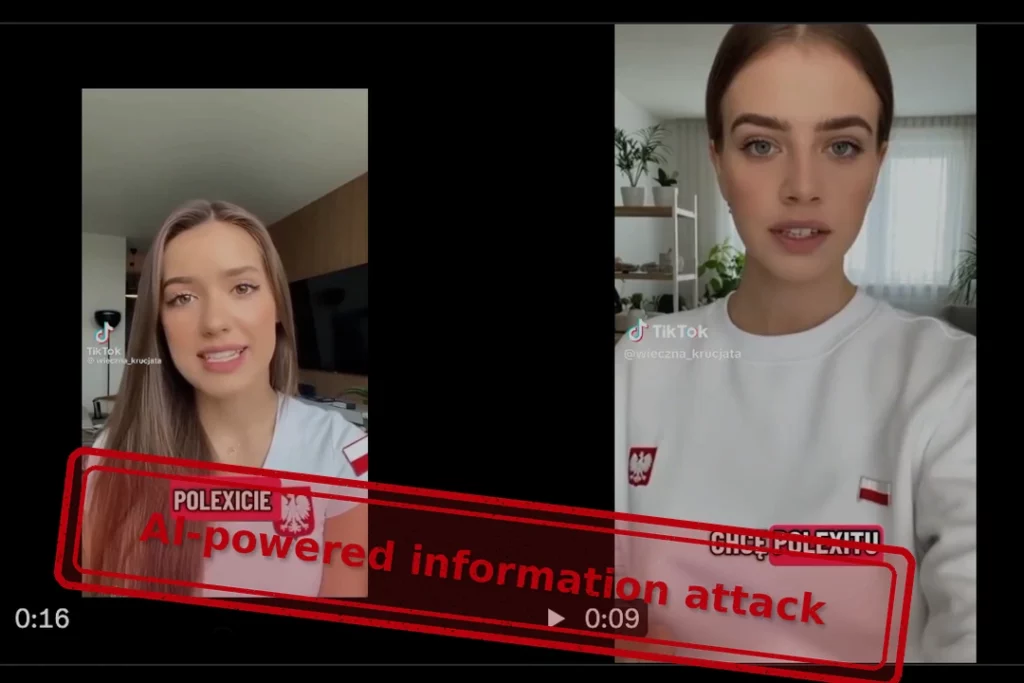
An AI-powered information attack on Poland is no longer a warning buried in expert reports; it is happening in plain sight, on phones, in kitchens, and on late-night sofas.
Polish authorities have warned that TikTok has enabled the mass spread of AI-generated political content, showing what appear to be beautiful Polish girls calmly calling for Polexit.
The Polish-language segment of TikTok has been flooded with videos generated by artificial intelligence that promote far-right and anti-European narratives. The Polish government has stated that this content bears the hallmarks of a coordinated Russian information operation and fully meets Moscow’s interests, and the videos show signs of Russian syntax.
Polish Government spokesman Adam Szłapka announced that TikTok videos criticising the European Union and featuring “young Polish women” are Russian disinformation generated by artificial intelligence.
Szłapka addressed the matter during a press conference following the government meeting. The recordings had previously been reported by, among others, the European Analytical Collective Res Futura.
How AI-Generated Videos Are Shaping Political Emotion
Scroll through the Polish-language side of TikTok, and you will notice a pattern, although not immediately. The women look real, almost too real, wearing T-shirts with Polish national symbols, speaking softly about sovereignty, frustration, and pride.
Then the message lands: criticism of the European Union, hostility towards the Polish government, and a quiet insistence that leaving the EU is the only rational choice.
When language gives itself away
According to Polish officials, the speech patterns in these videos contain linguistic fingerprints. The syntax feels foreign and oddly structured, a rhythm that resembles Russian phrasing rather than natural Polish flow.
Government spokesman Adam Szłapka stated openly that there is no doubt this content is Russian disinformation, generated using artificial intelligence and aligned entirely with Moscow’s interests.
It is unsettling, even a little fascinating, how convincing it can be. AI can now produce thousands of such clips in hours, each one slightly altered, each one slipping through moderation cracks before anyone has had their morning coffee.
Poland Pushes Back Under the Digital Services Act
The Polish government has responded with rare speed. It has formally asked the European Commission to initiate proceedings against TikTok for failing to meet its duties as a massive online platform under the Digital Services Act.
Why regulators are losing patience
Deputy Minister of Digital Affairs Dariusz Standerski submitted a request to Commission Vice-President Henna Virkkunen, calling for supervisory action. His argument is direct and uncomfortable: TikTok did not adequately detect, label, or remove coordinated AI-generated political manipulation that threatens democratic order in Poland and across the EU.
Poland has asked the platform to clarify:
- How much of this AI-generated PolExit content circulated, and how far it reached
- What moderation measures were actually applied, if any
- Whether TikTok assessed the systemic risks as required by the DSA
That single list already says enough.
Russian Hybrid Warfare in a New Costume
Polish authorities describe the campaign as part of Russia’s broader hybrid war against Europe. The objective is not subtle, yet it remains effective.
Divide the EU from within, weaken trust in European institutions, and quietly erode support for Ukraine in the context of Russia’s ongoing full-scale war. AI simply makes the old playbook faster, cheaper, and emotionally sharper.
State services, alongside NASK, have been tasked with addressing the threat. Citizens are also being urged to report suspicious content. That human layer still matters. Algorithms miss things; people sense tone, rhythm, and intent and that strange feeling when a video looks right but feels wrong.
Independent analysts, including Insight News, observed a spike in pro-Kremlin, anti-Ukrainian, and anti-EU narratives in Poland ahead of Christmas and during sensitive diplomatic moments. Timing, as always, is part of the strategy.
The Future of EU Information Security
This AI-powered information attack on Poland exposes a fragile truth. Technology evolves faster than trust and far faster than regulation. The Digital Services Act was designed for precisely these moments, but enforcement will determine whether it becomes a shield or just another policy document.
For businesses, policymakers, and digital risk professionals, the message is blunt. AI-driven influence operations are operational today, not theoretical. If your organisation relies on social platforms or operates in regulated digital environments, now is the time to reassess exposure and resilience.
