
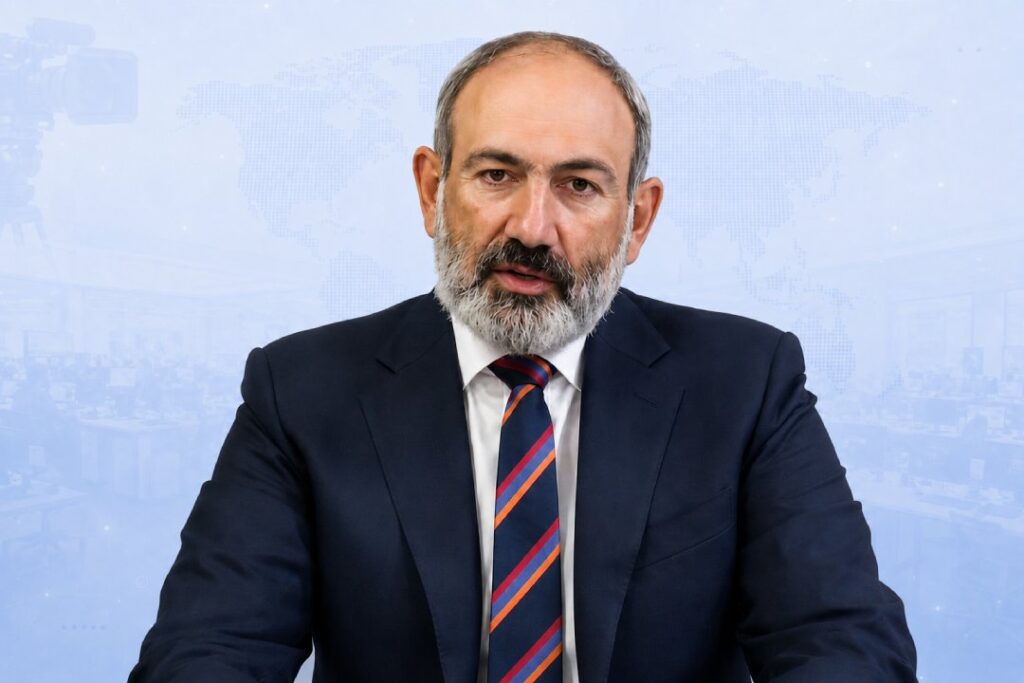
Prime Minister Nikol Pashinyan’s Civil Contract party won Armenia’s parliamentary election with just under half the vote, giving him a renewed mandate to pursue closer ties with Europe, peace talks with Azerbaijan, and a reduced dependence on Russia. The result came after multiple reports of Russia-linked disinformation and pressure campaigns targeting the vote.
Armenian Prime Minister Nikol Pashinyan has secured a renewed parliamentary mandate after his Civil Contract party won 49.81 percent of the vote in the June 7 election, according to the source materials provided. The result places Pashinyan in a strong position to continue Armenia’s shift toward Europe, pursue normalization with Azerbaijan and Türkiye, and reduce the country’s reliance on Russia.
The election also exposed the scale of the geopolitical contest over Armenia’s future. Several supplied reports describe Russia-linked disinformation campaigns, economic pressure, and political messaging aimed at weakening Pashinyan’s position before the vote. Moscow, meanwhile, rejected the framing and accused Armenian authorities of repressing pro-Russian opposition forces after their defeat.
Civil Contract Wins, But Falls Short of Constitutional Power
According to France 24, Civil Contract won roughly 49.8 percent of the vote, while the pro-Russian Strong Armenia alliance, led by Russian-Armenian billionaire Samvel Karapetyan, received about 23 percent. Other opposition forces, including the Armenia Alliance and Prosperous Armenia, also entered parliament.
Media cite estimates ranging from 58 to 61 seats for Civil Contract in a 105-member National Assembly. Those differences appear to reflect seat-allocation mechanisms and preliminary calculations rather than disagreement over the overall outcome: Pashinyan’s party is expected to govern alone.
The victory does not, however, give Pashinyan full constitutional freedom. Several supplied sources note that Civil Contract lacks the two-thirds majority required to initiate or pass major constitutional changes on its own. That matters because constitutional reform is tied to Armenia’s peace process with Azerbaijan and to Pashinyan’s broader plan to redefine the country’s post-Karabakh political settlement.
A Vote on Armenia’s Strategic Direction
The election was widely framed in the supplied sources as a referendum on Armenia’s foreign-policy direction. Pashinyan has sought closer relations with the European Union and Western partners while distancing Armenia from Moscow, its traditional security patron.
That shift accelerated after Azerbaijan retook Nagorno-Karabakh in 2023. Multiple sources say many Armenians reassessed Russia’s role after Moscow failed to prevent the loss of the region despite Armenia’s long-standing security ties with Russia. Reports also note that Armenia remains economically and militarily linked to Russia, including through Moscow-led institutions and the presence of a Russian military base.
Pashinyan’s platform links Armenia’s pro-European course to peace with Azerbaijan, normalization with Türkiye and regional economic integration. According to United24 Media, Pashinyan said after the election: “My message to Turkish and Azerbaijani societies: the people of Armenia voted for peace and regional cooperation.”
Russia-Linked Disinformation Becomes a Central Election Issue
Several reports describe extensive Russia-linked disinformation activity ahead of the vote. France 24 cited Armenian fact-checkers who said Russian influence efforts targeted not only Pashinyan but also the EU and France. Ani Grigoryan of CivilNet told France 24 that narratives had circulated for months claiming France would help Pashinyan falsify election results.
The Record, citing researchers from Antibot4Navalny and the Institute for Strategic Dialogue, reported that Russia-aligned networks used fabricated news reports, manipulated videos, bot activity, fake media websites, and impersonation of journalists or legitimate outlets.
According to that reporting, the Matryoshka campaign portrayed Pashinyan’s re-election as a route toward confrontation with Russia and warned of a Ukraine-style outcome if Armenia moved closer to Europe.
France 24 also reported that leaked documents attributed to the Kremlin-linked Social Design Agency were analyzed by several media outlets, including France 24, and appeared to show part of Russia’s influence strategy in Armenia. The campaign also targeted the Armenian diaspora, which one Armenian fact-checker described as a special focus of Russian influence efforts.
Nagorno-Karabakh Trauma Was Used as a Campaign Weapon
The loss of Nagorno-Karabakh remained one of the campaign’s most sensitive issues. Thus, the disinformation around Armenia’s relations with Azerbaijan included false claims about the imminent arrival of hundreds of thousands of Azerbaijanis in Armenia.
Disinfo campaign allegedly pushed similar fears through AI-generated videos showing buses filled with Azerbaijanis arriving in Yerevan. Pashinyan rejected the allegations and said the issue “was never on the agenda” in talks with Azerbaijan or on Armenia’s international agenda.
The issue was politically powerful because Pashinyan has faced accusations from opponents that he abandoned Nagorno-Karabakh. Analysts suggest he instead framed peace with Azerbaijan as necessary for Armenia’s sovereignty, security, and economic future.
Moscow’s Reaction: Accusations of Repression
Russia’s response, the Russian Foreign Ministry statement, was sharply critical.
Russian Foreign Ministry spokeswoman Maria Zakharova accused Armenian authorities of severe repression against the opposition and violations of democratic procedures after pro-Russian parties lost the vote.
Zakharova argued that pressure had been directed at forces advocating closer ties with Russia, Eurasian integration, and rejection of Armenia’s European course.
These Russian government claims are contested by European sources, which emphasize Russia-linked interference and pressure on Armenia’s election.
The Russian allegations indicate that Moscow views the result as a strategic setback.
Democratic Concerns Also Targeted Pashinyan’s Camp
France 24 reported that CivilNet revealed a mysterious influential site, MediaNews, had been created by a member of Pashinyan’s team. It quoted Nane Manasyan of the Fact Investigative Platform saying that “every political party” was trying to use information tools to influence voters and that “everyone is disseminating fake news” and AI-generated fake videos.
Human Rights Watch, according to France 24, raised election-related concerns before the vote, including misuse of administrative resources, pressure on public-sector employees, campaign finance risks, alleged vote-buying, polarized rhetoric, and weak accountability mechanisms.
That means the election cannot be reduced to a simple contest between democratic purity and foreign interference. The evidence points to a heavily contested information environment in which both domestic political manipulation and foreign-linked influence operations were concerns.
Peace With Azerbaijan and Türkiye Now Moves to the Foreground
Pashinyan’s victory is likely to strengthen the continuity of peace talks with Azerbaijan and normalization efforts with Türkiye. Daily Sabah’s analysis argues that the election result favors regional integration, open borders, trade, and the further development of transit links across the South Caucasus.
The most difficult obstacle remains constitutional reform. The Daily Sabah material says Armenia’s 2015 Constitution refers in its preamble to the 1990 Declaration of Independence, which includes language tied to Nagorno-Karabakh and symbolic claims that Azerbaijan and Türkiye view as obstacles to normalization.
Because Civil Contract does not hold a two-thirds majority, Pashinyan will likely need opposition support or a broader political bargain to advance constitutional changes. He may seek a new constitutional draft and referendum in 2027, but that process remains politically uncertain.
Election Outcome
The election result gives Pashinyan a strategic victory, but not an unchecked mandate. Civil Contract won enough support to govern independently, yet not enough to impose constitutional reform without wider political cooperation.
The vote also shows that Russia’s influence in Armenia is under pressure. The analysts connect the result to public disappointment with Moscow after Nagorno-Karabakh, Armenia’s search for new security partners, and Pashinyan’s effort to frame European alignment as a path to sovereignty rather than dependency.
At the same time, the evidence base does not allow a clean conclusion that Russian-linked interference failed because Armenian voters consciously rejected it. The more cautious assessment is that Pashinyan won despite extensive reported pressure, disinformation, and domestic polarization.
The election’s deeper significance lies in what comes next. If Pashinyan can convert the mandate into constitutional reform, peace with Azerbaijan and normalized ties with Türkiye, Armenia’s geopolitical orientation may shift more durably away from Russia. If he cannot, the unresolved constitutional issue, opposition resistance, and potential Russian pressure could slow or destabilize that process.
Conclusion
Armenia’s 2026 parliamentary election has strengthened Nikol Pashinyan’s pro-European government and weakened the immediate prospects of pro-Russian forces returning to power. The result supports his agenda of peace, regional normalization and reduced reliance on Moscow.
But the mandate is incomplete. Civil Contract can govern, yet it lacks the supermajority needed for major constitutional changes. The next phase will test whether Pashinyan can build enough domestic consensus to turn an electoral victory into a lasting strategic realignment. However, the hardest political decisions are still ahead.
