
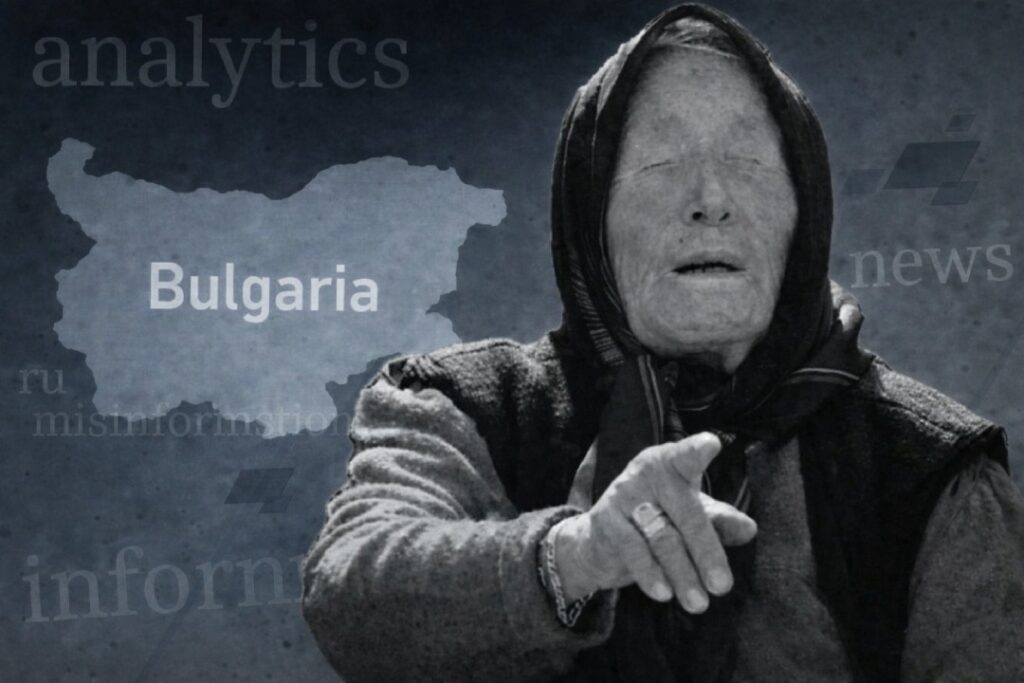
The name of a Bulgarian mystic who died three decades ago has become one of the most versatile instruments of geopolitical disinformation in the digital age.
The phrase “Baba Vanga prophecies” appears frequently in viral headlines, predicting everything from global wars to alien contact. Yet historians and researchers increasingly warn that most of these claims were never recorded by the Bulgarian mystic herself. Over time, her name has become a powerful symbol used to spread conspiracy theories, sensational media stories, and even geopolitical propaganda.
Today, the legend of Baba Vanga illustrates how historical figures can be transformed into tools of modern information warfare.
Who was Baba Vanga and why her legend endures
From local healer to international mystical figure
Baba Vanga, born Vangeliya Pandeva Gushterova in 1911 in Strumica, a city in what is now North Macedonia, then under Ottoman rule, spent most of her life in the Bulgarian town of Petrich. As a teenager, she was said to have been thrown into a field by a tornado, leading to the gradual loss of her eyesight. From that point, her followers believed she gained prophetic abilities.
During the Second World War, people began visiting her to ask whether relatives serving on the front lines would return home. Her reputation spread quickly across Bulgaria, and, by the 1960s, thousands of visitors travelled to Petrich seeking advice, arriving from Russia, Romania, Greece and beyond.
According to Ivan Dramov of the Bulgaria-based Baba Vanga Foundation, most of her statements were personal guidance rather than sweeping predictions about global disasters. “Vanga dealt mainly with people’s health problems, not with upcoming cataclysms in the world,” Dramov said, as The Guardian reported in its investigation into the Vanga disinformation ecosystem. His organisation was launched by Vanga’s followers and was chaired by Vanga herself in the years before her death.
Researchers say this detail is systematically forgotten in modern media coverage.
How “Baba Vanga predictions” became Internet sensations
In recent years, social media has transformed Baba Vanga into a global online phenomenon. Posts frequently claim she predicted the September 11 attacks, the Covid-19 pandemic, Russia’s invasion of Ukraine, the start of a third world war, and humanity’s first contact with alien life.
These stories circulate widely on TikTok, YouTube and sensational news websites. Yet experts say there is little historical evidence that Vanga actually made most of these predictions.
The problem of documentation
One key issue is that no audio recordings or written documents of Vanga’s prophecies exist. Bulgarian author Zheni Kostadinova, whose books about Vanga have been translated into several languages, is straightforward about this.
“Everyone puts words in her mouth that she never said,” Kostadinova told The Guardian in its March 2026 investigation. “But because her authority as a prophetess is like that of Nostradamus, there are hundreds of people tempted to speak on her behalf.”
In one of her books, Kostadinova described Vanga’s prophecies as somewhere between truth and myth, noting they had usually been retold and interpreted to a certain degree. Because of this lack of documentation, later writers and commentators have been able to reinterpret or invent predictions attributed to her.
Russian narratives and the reinvention of Vanga
Among those who eagerly embraced Vanga were Russians. As researchers Mary Neuburger and Adam Hanzel at the University of Texas at Austin documented in a 2024 study published in Comparative Studies in Society and History, the Bulgarian mystic became “one of the most noteworthy mediums of truth in 20th- and 21st-century Russian imagination”. Her imprint on Russian culture was such that she inspired the verb ‘vangovat’, meaning ‘to predict’, as well as a colloquial expression that roughly translates as ‘How should I know? Do I look like Baba Vanga to you?’
As of March 2023, users on Yandex, the most popular Russian-language search engine, were running searches combining “Vanga”, “predictions” and the current year more than seven hundred thousand times per month, the researchers found. By comparison, “war” and “Ukraine” were searched together approximately 2.9 million times monthly.
Sidorov and the source of Russia’s “prophecy”
Many of the geopolitical predictions attributed to Vanga can be traced to a single figure: the Russian writer Valentin Sidorov, who claimed to have met Vanga in the 1970s during visits to Bulgaria facilitated by Lyudmila Zhivkova, the influential daughter of Bulgarian dictator Todor Zhivkov.
Sidorov published accounts of their conversations, including what became the most widely cited passage in Russian-language Vanga media: “Everything will melt like ice; only one thing will remain untouched — the glory of Vladimir… Russia will become the ruler of the whole world.” Sidorov himself clarified that the word “Vladimir” referred to the mediaeval prince who Christianised Kyivan Rus around the year 1000 and that the “glory” he described was spiritual, not political. That distinction was lost almost entirely in later retellings.
However, as Viktoria Vitanova-Kerber, a PhD researcher at the University of Fribourg, told The Guardian, “There are no recordings of these meetings, which allowed Sidorov a free interpretation, or possibly even construction, of what Vanga has or has not said about Russia.”
The textual record is further complicated by the publishing history of Sidorov’s book. His original text, Liudmila and Vanga, was published in Bulgarian translation in 1995 but did not appear in Russian until 2009 – under a new title, Vanga: Russia, 2010, 2012, 2019, 2039, in which the publisher appended specific future dates to the cover that do not appear in the original text. Once online, Sidorov’s Russia-related passages were widely quoted, often stripped of his name and presented as Vanga’s direct words.
Television, fiction and the consolidation of the myth
The construction of Vanga’s Russian identity was not limited to books. Between 2010 and 2011, three documentary films about Vanga aired on Russian federal channels – RTV, TV Centre and NTV, respectively – each drawing on a stable cast of mostly Russian witnesses to affirm her powers and her supposed love of Russia.
In 2013, a high-production twelve-part miniseries entitled Vangelia aired across multiple channels, with most key characters depicted as Russian. The series presented the KGB and its successor agency, the FSB, as having monitored Vanga since the Second World War and fictionalised encounters with Hitler and Tsar Boris alongside real historical figures. Through these productions, now accessible on YouTube, Vanga’s place in the Russian imagination was consolidated as a source of truth grounded in both science and national destiny.
Baba Vanga as a tool in disinformation campaigns
Russian state and tabloid media: a circular chain
The practical mechanics of how Vanga’s name is weaponised in Russian media were on clear display in February 2025. On February 20, the British tabloid Metro published an article under the headline “Blind mystic Baba Vanga’s eerie prediction for Europe and Putin in 2025”. The piece offered no primary source for any of the claims, asserting that Vanga had predicted Putin would become “lord of the world” and that Europe would turn into a “wasteland”. The article acknowledged its claims should be “taken with a pinch of salt”, but its framing did the opposite, linking the supposed prophecies directly to ongoing geopolitical tensions.
Within hours, Russian state and pro-government outlets had picked up the story and repackaged it as confirmation of Russia’s historical destiny.
RT published on February 20, 2025, under the headline “Metro: Vanga predicted the dominance of Russia and Putin in 2025”, presenting the Metro article as evidence that “Vladimir Putin will become the lord of the world, and Europe will turn into a wasteland”.
- russian.rt.com/world/news/1437986-vanga-putin-rossiya
RIA Novosti followed on February 20, 2025, with the headline “Media decoded Vanga’s prediction about Russia’s role in 2025”, directly quoting the Metro-sourced formulation: “Russia will not only survive, it will dominate the world.”
- ria.ru/20250220/predskazanie-2000659973.html
Gazeta.ru published the same day under the headline “British newspaper Metro: Vanga spoke of Russia’s world dominance in 2025”, again using the same phrases about Putin as “lord of the world” and Europe turning into a “wasteland”.
- gazeta.ru/politics/news/2025/02/20/25140356.shtml
Lenta.ru ran an analytical piece on March 8, 2025, under the headline “Vanga’s predictions for 2025: prophecies about Russia”, which aggregated these narratives and added the claim that “Putin will strengthen Russia’s positions in the international arena and will shape the geopolitical landscape.”
- lenta.ru/articles/2025/03/09/baba-vanga/
This chain – a British tabloid publishes an unverified claim, and Russian state media amplify it as an established fact – is a recurring pattern. The original Metro article contained no named source, no archival reference, and no scholarly attribution. What it produced was a textual artefact that Russian outlets could cite as a “Western source” confirming their preferred narrative.
The deeper roots of this specific formulation stretch back further. Komsomolskaya Pravda published a piece as early as January 18, 2002, under the headline “Vanga predicted: Russia will become lord of the world”, which carried the Sidorov passage in full. That 2002 text has been recirculated repeatedly in Russian media in 2024 and 2025 – including in a July 2024 Komsomolskaya Pravda piece headlined “Vanga’s prediction about the death of Europe caused a shudder: the countdown has begun” – now systematically updated with explicit references to Putin, whose name appears nowhere in Sidorov’s original account.
- kp.ru/daily/23171/25148
- kp.ru/daily/27606/4957230/
The Albanian amplification network
The same disinformation logic operates beyond Russia’s borders. A 2024 study by the Balkan Investigative Reporting Network (BIRN Albania), which surveyed 36 Albanian publications over a year, found at least a dozen articles in which Vanga’s alleged predictions were used to reinforce narratives against NATO and the EU. Most of those articles cited Russian media as their source.
Albanian state broadcaster ATA published a headline in late 2025 asking, “Will a prophecy by Baba Vanga that could change the world in 2026 become reality?” Fact-checker Viola Keta, cited in the Balkan Insight investigation, described such content as “very likely part of agendas that seek instability and confusion”.
Bulgarian pro-Kremlin media and the domestic use of Vanga
Inside Bulgaria itself, Vanga’s name is deployed by pro-Kremlin and Eurosceptic outlets not primarily to push specific geopolitical predictions, but to normalise a broader worldview in which Russia is a civilisational anchor and the West is in terminal decline.
Epicenter.bg published a piece on April 15, 2024, under the headline “World media recall Baba Vanga’s prophecies: After 2024, Europe will no longer be the same.” The article compiled predictions of large-scale conflict involving Russia and NATO, including the specific formulation: “At the same time, Russians will fight NATO in Turkey.” The framing positioned Russia not as an aggressor but as a participant in an inevitable historical confrontation. An earlier Epicentre piece from 2023 carried the headline “Baba Vanga’s predictions for 2024: assassination of Putin and end of the war in Ukraine” – presenting the end of the war as contingent on internal change in Russia rather than on Ukrainian military success or Russian withdrawal.
- epicenter.bg/article/Svetovni-medii-pripomnyat-prorochestva-na-baba-Vanga–Sled-2024-g–Evropa-veche-nyama-da-e-sashtata/322748/7/0
- epicenter.bg/article/Predskazaniyata-na-Baba-Vanga-za-2024-ta-godina–Ubiystvo-na-Putin-i-kray-na-voynata-v-Ukrayna/336371/7/0
Trud.bg ran a piece on February 9, 2024, under the headline “The prophets warn: the Middle East will set the whole world on fire,” in which Vanga was invoked directly: “Our prophetess Vanga does not pass over this problem either and clearly identifies the cause of the Third World War – a conflict in the Middle East.” A subsequent Trud piece from January 20, 2025, “How the world will change by 2025”, predicted the “disappearance of Poland” and a “financial collapse of the United States”, presenting NATO member states as the primary casualties of the coming catastrophe.
- trud.bg/a/articles/prorocite-preduprejdavat-blizkiyat-iztok-shte-podpali-tseliya-svyat
- trud.bg/a/articles/kak-shte-se-promeni-svetat-do-2025-godina
Most striking in its directness is the use of Vanga on Rusofili.bg, the website of the Bulgarian National Movement “Russophiles”. A 2015 interview with author Zheni Kostadinova was posted under the headline “Zheni Kostadinova: Vanga said Bulgaria should hold on to Russia”. In the interview, Kostadinova states that although she had not found any Vanga statement specifically about Ukraine, “it seems she had a vision that a time would come when Bulgaria would pull away from Russia, and she said we should hold on to Russia.” That passage, stripped of its caveats, has circulated as a standalone quote legitimising pro-Kremlin alignment as a kind of prophetic inheritance.
- rusofili.bg/zheni-kostadinova-vanga-kazvase-balgariya-da-se-darji-za-rusiya/
The website 24may.bg, associated with Bulgarian Russophile movements, deploys Vanga differently – not through direct predictions but through cultural symbolism. In documents circulated on the site, the formula used is “The vision of Aunt Vanga was that we would be together with Uncle Ivan again”, using the traditional Bulgarian affectionate term for Russia. The framing presents Bulgaria’s post-1989 Western orientation as an aberration from a historically mandated alliance with Russia.
- 24may.bg/storage/2024/01/Fashizmat-neofashizmat-i-nasheto-vreme.pdf
Why prophetic figures are powerful in disinformation
Researchers argue that the appeal of figures like Vanga for disinformation purposes lies in their structural flexibility. Unlike historical documents or verified quotes, vague prophecies can be reshaped for new political contexts without risk of definitive contradiction.
As Vitanova-Kerber wrote in an analysis quoted by The Guardian (cited here above), the generation of Russian commentators that followed Sidorov “exaggerated, complemented, and reinterpreted the information, once again, until it suited the dominant narratives of today’s Russian identity politics: national grandeur, anti-westernism, and conservation of the traditional values of Eastern Orthodox Christianity, as opposed to the rotten liberal values of the West.”
Neuburger and Hanzel’s research adds an important nuance: the spread of Vanga-related propaganda is not primarily a coordinated state operation. “The dissemination of this message is not a Russian state plot,” they concluded. “Instead, it has been transmitted in far more fragmented and mediated ways” – through a crowdsourced ecosystem of tabloids, online commentators, YouTubers, and self-styled experts, some of whom are motivated by clicks, some by ideology, and some by both.
What makes Vanga particularly effective as an instrument is the layered legitimacy her name carries: rooted in genuine historical existence, amplified by decades of Soviet and Russian television, filtered through academic-sounding witnesses, and now repackaged daily on social media platforms designed to reward engagement over accuracy.
The line between myth and history
Even scholars who take Vanga’s historical significance seriously caution that her life story sits somewhere between legend and reality. Many of her statements were passed down through oral accounts, interpreted repeatedly by followers and authors. Over decades, these retellings gradually blurred the line between what she may have actually said and what others later claimed.
According to Dramov of the Vanga Foundation, Vanga herself anticipated that her name might one day be misused. “In general, she stated that her name would be misused,” he told The Guardian. “She said many times that people will use her name during her life and after her death.”
What she may not have imagined was how powerful and how precisely targeted that misuse would become. In the digital age, Baba Vanga remains less a historical prophet than a modern media platform, one that can broadcast almost any message to almost any audience, as long as the message is wrapped in the language of destiny.
