
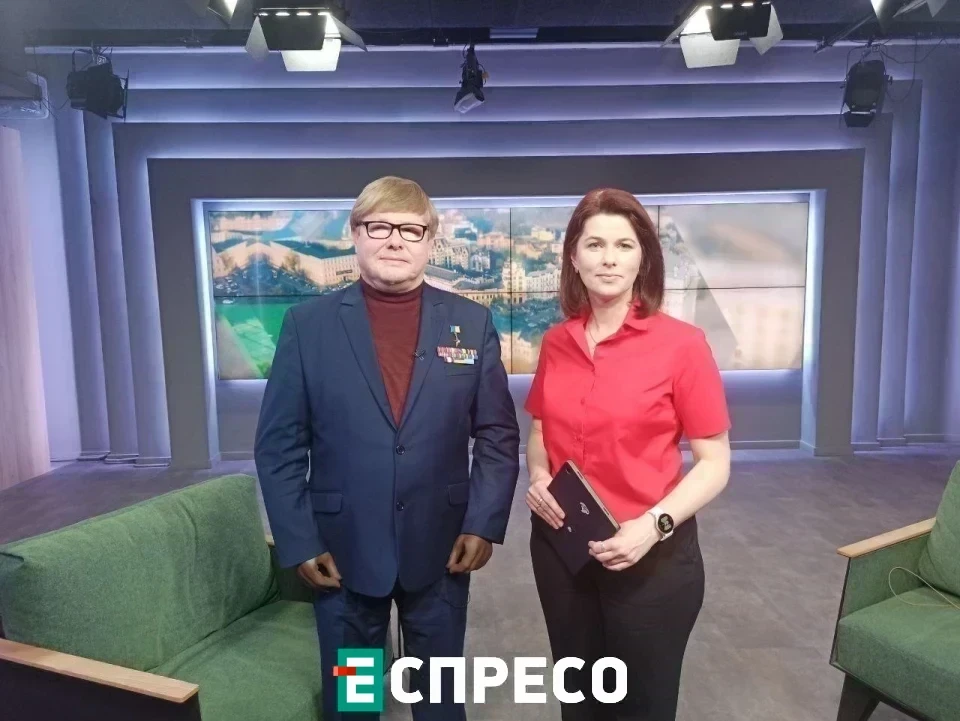
Volodymyr Zhemchuhov was born 80 kilometres from the Russian border, speaks Russian as his mother tongue, and spent nearly a year in Russian captivity — yet he carried out 30 sabotage operations against Russian forces in the occupied Luhansk region, and was named Hero of Ukraine for it.
One of the most persistent claims in Russian propaganda is that the people of Donbas welcomed the 2014 occupation and have always identified with Russia rather than Ukraine. Zhemchuhov’s story dismantles that narrative from the inside. A former miner turned partisan, he operated deep within the territory of the so-called “LPR” from 2014, coordinating with Ukraine’s Main Intelligence Directorate to sabotage Russian military logistics — railway lines, power infrastructure, gas pipelines — before being captured, losing both hands and nearly his sight to a tripwire explosion, and enduring months of abuse in captivity.
After his exchange, Zhemchuhov underwent rehabilitation and returned to public life. In 2017 he was awarded the title Hero of Ukraine and the Order of the Gold Star. He has since produced a documentary series, How the War Began, documenting the occupation of Donbas and the civilian resistance to it, which he presents to schools, universities, and military units across the country.
In an interview with Ukrainian broadcaster Espreso, he spoke about how ordinary people in Luhansk organised themselves into a partisan network, what drove a Russian-born man to take up arms for Ukraine, and why — a decade later — the fight continues on Russian soil itself.
Partisan, saboteur… — the words instantly conjure images from Hollywood blockbusters. How close was your actual work to what they show in films?
As you know, before 2014 we had no preparation for war at all — and I certainly had no preparation for any kind of partisan or sabotage warfare. What people like me did in 2014 was an independent, patriotic movement. What drove us? The chance to do something ourselves to defend Ukraine. As for why I chose to become a partisan — I think it goes back to childhood. I grew up on Soviet propaganda about the Great Patriotic War and the partisan movement. The Luhansk region was also a land of partisans in those days: the Young Guard, the partisan camps, the great battles of the Mius Front — those were the ideals on which I, as a Soviet child, was raised.
When the Soviet Union collapsed, we learned the true history of Ukraine — how Ukraine had been occupied in 1922 by Russian communists. I understood that everything I had been taught was a lie. And through that real history, I came to understand that I was not a Soviet citizen but a citizen of an independent country, Ukraine, and that this was my homeland, which had to be defended.
What did your activities actually look like? What did you do? In films they show someone sprinting in, planting explosives, making it back to their side — operation complete. What did it really look like?
It didn’t happen overnight. There was a process of establishing ourselves. In the spring of 2014, men like me in the Luhansk region were first brought together by the desire for self-defence, when the “Russian world” arrived. The Russians came to us on May 5, 2014. Our city was seized by the general of the so-called Don Army, Kozitsyn. He arrived with his fighters, handed out weapons to the locals who had sided with Russia, and the “Russian world” began — which was simply banditry. ATMs were smashed, banks were robbed. In broad daylight they would stop Mercedes, BMWs, other foreign cars and take them from people. Each of them might have five or six such cars. They came at night and robbed people — those who supported Ukraine, those who had something worth taking. It was pure banditry.
What first brought us together was the desire to protect our families, our mothers, our wives. Then, by the middle of summer 2014, when there was no one left to rob, the local alcoholics and layabouts who had joined the Russian Cossack paramilitaries started trading weapons. I saw an opportunity and began buying weapons with my own money and arming my comrades.
In the summer of 2014, a Kalashnikov assault rifle cost $200 from the Russian Cossacks, a grenade was $50, a Kalashnikov machine gun was $300. It all started with self-arming.
The Anti-Terrorist Operation (ATO) began in April 2014, and the Ukrainian army reached our city on August 23 to liberate it. But for us, all the residents of Donbas, the full-scale invasion began on August 24, 2014, when columns of equipment rolled into the Luhansk and Donetsk regions on the same scale as in 2022. They dealt devastating blows to our army near Ilovaisk in the Donetsk region and near Luhansk airport. Our army was forced to retreat.
When the regular Russian army arrived, we decided we had to do more than defend our families — we had to do something to help the Armed Forces of Ukraine. We had weapons and explosives, and we began attacking Russian columns. My comrades and I — some had served in the Soviet army, some in the Ukrainian army — had never taken part in combat, had never killed anyone, and it was very difficult to begin doing so. Psychologically, there was a barrier to cross.
Then we saw what the Russian forces were doing — how many Ukrainian soldiers were killed, how they were tortured. A concentration camp for Ukrainian prisoners of war was set up in Snizhne. People began disappearing. Kadyrov’s men began raping our women and girls, whose bodies were then found outside towns in roadside groves. That is what pushed us to take the side of the Armed Forces of Ukraine.
We started on our own, from the very beginning — teaching ourselves partisan warfare from videos available on YouTube. We had the means, and at night we would fire on Russian columns crossing the border, set off explosives, sabotage the railway — we did everything we could do on our own.
Then, in December 2014, we made contact with the Main Intelligence Directorate (HUR). We signed contracts with HUR, after which we were periodically able to travel to Ukrainian-controlled territory, roughly once every two months. We attended classified sabotage training schools and took courses in covert warfare.
Did you learn the results of your individual sabotage operations?
We were forbidden to return the next day or at any later point just to see what had happened. It was both prohibited and dangerous. But with social media, there was no need for that — the next day, on Odnoklassniki or VKontakte (the popular networks in 2014–2015), people would post their own accounts and photographs. There was no reason to go back and look. We could see everything on Odnoklassniki.
Tell us what your sabotage operations actually achieved.
We were not many. Let me give you the numbers. We divided ourselves into two groups: those who supported me and agreed to take up arms — we called them “partisans” — and those who were afraid but still wanted to do something, whom we called “Ukrainian underground.” Among the partisans, the breakdown was roughly this: Krasnodon — three people, Antratsyt — four, Rovenky — two, Sverdlovsk — three, Krasny Luch — five, Luhansk — three, Lutuhyne — two, Snizhne — two. That is how many people were carrying out acts of sabotage. Those in the Ukrainian underground would paint Ukrainian flags on bus shelters and utility poles at night, put up patriotic leaflets, or gather intelligence on Russian troop movements and information about traitors. There were thousands of people like that.
Did locals, neighbours, acquaintances — anyone who knew about you — report you to the authorities?
In May 2014 we had already understood this was war: two of my comrades — one in Rovenky, one in Krasnodon — were found with their hands bound behind their backs with tape and a bullet in the head.
By spring we understood that boasting or posting anything on Facebook about what we were doing was extremely dangerous — you only have one life, and there is no point risking it. By the summer of 2014 we stopped talking to anyone, stopped engaging in any debate, stopped openly supporting Ukraine. We simply went to ground and did our work. That is why there were no betrayals.
When I was taken prisoner at the end of 2015, the Russians told me I was the first active partisan combatant they had ever captured. There had been many reconnaissance agents and underground members, but as for someone who had blown up railway tracks and derailed trains — I was the first.
They must have been quite pleased.
I only admitted to two operations — so they would believe me. I said I had acted alone, that I had done everything myself: blown up a military train near Lutuhyne, destroyed the power line to the military airfield, and mined the railway at Debaltseve. They believed it, because they could not comprehend that a local resident might have done it.
They went through my military registration records — everything fell straight into their hands. I was an ordinary soldier: no airborne service, never fought in Afghanistan. They could not believe that an ordinary person was capable of what had been done.
When I was released from captivity, the negotiator from the “Luhansk side” met with Iryna Herashchenko and said: “You kept telling us to release Zhemchuhov. You said he was a civilian, simply a victim, an innocent man. And now he is giving interviews. If we had truly known that he was the one who carried out the bombings in the Luhansk region, we would never have let him go.”
Weren’t you afraid when you confessed to even those two operations? They could have killed you.
When I was captured, I had a smartphone. They cracked the code and found the messenger apps, the correspondence with Ukrainian military personnel. It was clear I was connected to the bombing of the military airfield’s power line. I realised they knew I was a saboteur. And so, to give them more information — enough to make them genuinely believe it was only me, so they would stop looking for my comrades, and so the information would reach the press and my comrades would know I was in captivity and needed to go into hiding.
I did what I did. By then I was no longer concerned about my life. I was ready for death. Honestly, by 2015 I was already ready.
But I was completely unprepared, psychologically, for such a severe injury. I would have been glad for them to kill me, because I could not imagine how a blind man with no hands could go on living. I did not want to live, which is probably why I behaved so recklessly.
There was later a story about rumours that you were somehow connected to the Nord Stream explosion.
It happened that over the year and a half or so that we were carrying out sabotage operations, we blew up the Russian Stavropol–Moscow gas pipeline — which runs in transit through the Luhansk region — four times. The largest operation was on Ukrainian Independence Day. We did it on August 24, 2015, near Rovenky, where we found an unguarded section, mined it, and blew it up. I received my first combat decoration for that. Then, when a Ukrainian was arrested as a suspect in the Nord Stream explosion — someone whose surname began with “Zh” — people started writing to me on social media: “Volodymyr, that wasn’t you they arrested, was it? We know you’re the only well-known partisan who blew up Russian gas pipelines.” I told them: “No, unfortunately, it wasn’t me. That must be some other hero.”
You mentioned an episode where you blew up the railway, and the Russians, supposedly to repair it but actually to clear it of mines, used Ukrainians — sending one crew after another. You later found out there were casualties and injuries. What were you thinking? On the one hand, you had done something worthwhile; on the other, there were so many victims.
The majority of our successful sabotage operations targeted the railway. The Armed Forces and HUR gave us the order — the priority was to cut logistics, to prevent the timely delivery of ammunition and military hardware. Most of our operations were on the railway.
That particular operation was also intended as a jab at the FSB — we carried it out on February 23, 2015, Soviet Army Day, or as it’s called in Russia, “Defender of the Fatherland Day.” We chose that date to mine the Rostov–Taganrog–Ilovaisk–Donetsk railway near Ilovaisk, to help our defenders in Debaltseve and cut the ammunition supply. We mined the track and also set several booby traps with anti-personnel mines around the area.
The time-delay mine went off on February 23. The Russians — FSB men, presumably — came to inspect the site. One of their soldiers triggered a mine. They realised the whole area was mined, but searching for mines along a railway line is difficult because everything is metal.
They decided to clear the mines by putting civilians in harm’s way.
That is a war crime, and it must be said. They took a crew of Ukrainian railway workers from Ilovaisk, did not tell them the area was mined, and ordered them to go and carry out repairs. The workers went, began work, and triggered a mine.
They were frightened — there were injuries — and refused to continue. The Russians brought another crew of railway workers from the Donetsk depot. They, too, triggered mines. Six railway workers were injured in total — the Russians cleared that railway using our people’s bodies. It was appalling. We never intended for Ukrainians to be harmed; it was the Russians who chose to do that.
Volodymyr, after your rehabilitation and recovery, did you return to any role in sabotage or partisan activities — perhaps in a training capacity?
When the renewed full-scale invasion began in 2022, I was approached and brought back in — not as a participant this time, but as an instructor in preparing civilians for partisan resistance in temporarily occupied territories. We filmed an entire series of video lessons for the military television channel called Resistance Movement. The same courses we had been taught ourselves. We were not training James Bonds — there were three courses, two weeks at most. The most important elements were: the basics of operational security, how to live under occupation, and how to conduct underground activities safely. Second was digital security — use of smartphones, internet tools. Third was explosives: the simplest types of mines, time-delay mines, contact mines, and how to derail a train.
How easy or difficult is it, in your view, to join the partisan movement or take part in sabotage activities in the temporarily occupied territories today?
In 2026, it is very difficult. Right now it is actually easier to carry out a partisan operation on Russian territory than in the temporarily occupied territories. Unfortunately, by 2022 we had prepared to some degree for the war — and even a little for partisan warfare — but still not nearly enough. As you probably remember, the Territorial Defence and the partisan movement were only somewhat prepared in the Kherson region, because a state of emergency had been in force there before 2022 and some programmes had been put in place. But, unfortunately, there was betrayal there — a great many officers of the SBU, the police, and the Territorial Defence broke their oaths and went over to Russia. And so the trained partisan network was almost entirely betrayed, disbanded, or arrested.
But the patriotic civilian movement was substantial by 2022. Many people, young people especially — from Melitopol, Mariupol, Skadovsk — wanted to take part in the resistance. They would travel to Ukrainian-controlled territory, we would train them in partisan warfare, and then they would return. By 2023 there was a rise in partisan activity in the Kherson and Zaporizhzhia regions. Every week there was a detonation somewhere — a railway, a facility of some kind.
The Russians did not expect it; they were unprepared. But they have precedent — the Chechen wars. And they applied their “Chechen standards” to those territories. In autumn 2023 they began deploying large units of the National Guard, FSB, and police there, and simply imposed those methods.
Here is how it worked: at five in the morning, the Russian National Guard would encircle a village — one unit forming a full perimeter while others moved in to sweep. Passport checks, searches for weapons, examination of smartphones and computers, searches for Ukrainian symbols. Those identified as patriots were taken to prison and tortured. Over the course of 2024 and most of 2025, they suppressed a huge portion of the underground movement.
To give you a sense of the scale: in 2025, in the Kherson region alone, we lost around 1,000 partisans; in the Zaporizhzhia region, around 800. These were trained people who were either captured or killed. Some of them were posthumously awarded the title Hero of Ukraine — people who refused to surrender, who fought to the last, who blew themselves up alongside National Guard officers, or who died in battle.
And is it because of that experience that it is now so difficult to organise a partisan movement in the occupied territory?
As you know, along the front line there are no crossing points between towns. To get out, you have to travel either via Poland or through Russia — it is extremely complicated. Russia controls everything. By late 2025 and into 2026, what matters in a partisan is no longer necessarily someone who can handle a rifle, explosives, or even a simple smartphone. The smartphone has become more powerful than a Kalashnikov, if you know how to use it.
Meaning information — and how it is transmitted?
Exactly. The key thing is to find the location of a Russian FSB headquarters or an occupiers’ command post. Recently there was an operation in Donetsk, where our Ukrainian underground identified an office inside a residential complex.
In an upscale residential complex in Donetsk, there was an FSB headquarters — specifically, the command post for long-range drone operations. The partisans found the apartment, even identified the floor and the window where the command post was located. They passed this information here to Kyiv, and eight drones struck that apartment.
As we know, twelve FSB officers — high-ranking officials — were eliminated, and fifteen were wounded. That is what partisan warfare looks like in 2026.
You mentioned that it is far easier to organise a partisan operation on Russian territory than in the temporarily occupied towns and villages of Ukraine. Why?
According to recent figures, the Russians have installed around 1,500 surveillance cameras across Melitopol alone. You know that facial recognition software is in use, and through it they have captured many of our partisans. Carrying out any kind of combat operation there is now extremely dangerous, which is why we only conduct reconnaissance operations there.
On Russian territory there is no such stringent control. In the occupied towns you can be stopped five or six times in a single day to have your passport checked, your smartphone examined, your belongings searched. None of that exists on Russian territory. Our special services move explosives, weapons, money, and communications equipment into Russia, creating caches on Russian soil. From there, the material is passed to Russian citizens we have recruited into the partisan movement, or to members of other national movements — of which there are many on Russian territory.
There are Kuban partisans, Udmurt partisans, and in the Caucasus — Dagestani and Chechen partisans — all working in coordination with our special services. We supply them with specialist equipment and they carry out sabotage operations.
There is no stringent control there; you can do it without serious difficulty. It is quite easy to walk up and set fire to a relay cabinet on a railway line, a mobile phone tower, or a power substation. No great obstacle.
Here are the numbers: in just the first five months of 2026 — this year alone — more than 300 such sabotage operations have been carried out on Russian territory.
The priority targets are, first, the railway, which is of greatest concern to us; then mobile communications infrastructure; and then power substations. In 2025 there was a major sabotage operation. We found a Ukrainian working as an ordinary maintenance worker at an oil refinery in Tatarstan. We made arrangements with him to carry out an operation: we supplied him with explosives, which he placed at the plant himself — he managed to get out in time, to flee — and the time-delay device detonated the following day. The oil refinery was blown up. That is the kind of operation we are talking about.
Are we doing any harm by discussing this openly?
This is the fifth year of the war and the FSB already knows all of this. You should be aware that by 2026, the FSB has an open surveillance file on every resident of the Russian Federation with a Ukrainian surname — Shevchenko, Petrenko, Ivanenko. We are revealing nothing new. The FSB learns very quickly. What gives us the greatest success is establishing contact with Russians — specifically with young people.
The Russians have been alarmed — as you may know, last year the State Duma, on Putin’s orders, introduced criminal liability from age fourteen up to life imprisonment for participation in partisan movements. These are what they call “terrorists,” because they are at a loss to deal with these young people — the movement among Russian youth is so large at the moment. I will not hide it: there are few true idealists among them; most Russian young people do it for money. There is a great deal of drug addiction and alcoholism there, and we use that to our advantage. According to the latest Russian statistics from last year — figures released by the Russians themselves — so-called “youth terrorism” rose by 150% compared to 2024.
There is a human rights organisation called Memorial, now banned in Russia. They counted 96 young people — boys and girls — who have been sentenced to life imprisonment, as the Russians put it, for “terrorism.”
These are partisans as young as fourteen or fifteen, who set fire to railway relay cabinets, mobile phone masts, or transformers. Or young people who broke into military installations and set fire to vehicles or helicopters. These are very risky operations, but young people in Russia are doing them.
But this works both ways: Russia also uses people inside Ukraine to fight in the rear — against Ukraine and the Ukrainian state. How does that work? What age are the people they manage to recruit? Who are they?
Yes, the Russians learned this from us. We were the first to use these techniques. Throughout this war, we have consistently been the ones introducing new methods: ‘kamikaze’ drones, long-range drones, sabotage operations. They learn from us. And unfortunately, we can see that they, too, find young people for money inside Ukraine. But if you look at the statistics: of all our sabotage operations on Russian territory, around 70% of our agents and saboteurs are Russian young people. If you look at the equivalent Russian operations in Ukraine, around 40% are young people and the rest are adults. In other words, we have a far greater success rate in reaching and recruiting Russian youth than they do with Ukrainian youth. This is a matter of upbringing.
As a public figure, I am involved at both the state and civil society level in national patriotic education for young people. Unfortunately, we cannot break through the wall of the Ministry of Education, or the Ministry of Youth and Sports, to establish a state-level educational programme. Our authorities take the view that upbringing is the parents’ responsibility — and they also defer to Europe. But in Europe — Germany and France, for instance — these countries have at least 150 years behind them. We are a very young nation; it has been only 30 years since we restored our independence. The majority of adults are still post-Soviet, post-colonial people. No one worked to instill civic values in them. How, then, can they raise their own children differently? And so, unfortunately, they do not.
The Presidential Office now has a new head — our commander, Budanov. We believe that with his support we will be able to change something at the state level and restore national and military-patriotic education programmes — not just in Years 10 and 11, but from the very first year of school, with lessons in Ukrainian identity and Ukrainian history starting in kindergartens. I am confident we will be able to make that happen.
I would like to continue talking with you about education and why it matters. You were born very close to the border with Russia — when the Soviet Union still existed — literally 80 kilometres from the Russian Soviet Federative Socialist Republic (RSFSR), with a Russian background, surrounded by the Russian language. Most people spoke Russian; Russian identity was being imposed. Why do you now speak Ukrainian? Why did you choose to support Ukraine, the Ukrainian state, rather than joining those Russian Cossacks who were looting and trading weapons at the time?
That question is precisely why the Russians kept me in captivity for a full year. At the time I was the only seriously wounded person they had, which is exactly why they would not exchange me or release me. They kept saying: “We can’t understand you, Zhemchuhov. You’re Russian. You’re a local, a former miner, you know this place inside out. How could you go against Russia? How could you go against your own people, your blood brothers?” I always gave them my honest answer: “Yes, I am ethnically Russian — you don’t choose your parents.”
My father came to Donbas from the Volga region of the Russian Federation to work in the mines. I was born and grew up in the Luhansk region. Until 1991 I was a Soviet person, a young man with Soviet ideology in my head.
But something happened while I was serving in the Soviet army, stationed in Moscow with the KGB troops — I ended up in the units involved in the attempted coup by the State Committee on the State of Emergency (GKChP). I was a GKChP soldier during the putsch. We soldiers were given the order to seize Moscow. I was fortunate enough not to be stationed near the White House. Soldiers were given orders to kill civilians: “Run them down with armoured personnel carriers, with tanks.” That was a shock, a trauma — I was a Soviet person, a young man who had taken an oath to defend the people, and now I was being ordered to kill those very people. That was the turning point that broke my Soviet conditioning.
That moment happened, and I came to hate the communists, to hate Soviet power. And after that — with the shock of realising I might have been ordered to kill civilians — I began studying the NKVD archives that opened after 1991. There was so much to learn.
The books of Solzhenitsyn began to be published. I read The Gulag Archipelago. That was another shock — from 1922, millions of people had been deceived; they were told that the Soviet Union was a fraternal union of peoples, when in fact, as it turned out, it was simply a concentration camp that the Russians had constructed and labelled “the Soviet Union.” All of that shook me deeply. And that is what set me apart from those people who never studied history, who had no interest in anything after 1991, who lived only by what had been put into their heads by those dishonest Soviet history textbooks. That is why I came to stand on Ukraine’s side.
And you know, in captivity they interrogated me constantly and very often tried to break me ideologically — they would ask, “What has Ukraine ever given you?” I always answered: “What was Ukraine supposed to give me? I was born here, I was raised here. I was given the opportunity to get a good education, to build a business. I had a very interesting career. I am a prosperous man. Ukraine gave me opportunities — I took them, and I am very happy here. That is why I consider Ukraine my homeland, and that is why I went to defend it. And those Russians, those ‘blood brothers’ — what did they come for in 2014? What did the ‘blood brothers’ do? They looted, they killed, they raped our women. I want nothing to do with them, with such ‘dear brothers.’ The values I hold — what Ukraine gave me: my family, my mother, my home, my land, my homeland — those are closer to my heart than their Russian empire. And so I, a civilian, chose in 2014 to risk my life and my health for them.”
You studied history from childhood through the lens of what Russia and the Soviet Union presented. A great deal of time passed. Then you discovered Ukraine’s real history. Why did you choose to trust what you read as an adult rather than what you had been taught since childhood — the things we learn earliest are the things we remember best and believe most firmly?
My mother raised me and taught me to think critically. In the 1980s, Soviet cinemas screened French comedies about the gendarmerie, Italian comedies, and increasingly American films. When I was sixteen, those films planted a seed that kept growing. I watched them, but I also believed what Soviet television said, what our teachers told us about the Pioneers, the Komsomol, the Party. I believed it all, because I had no alternative sources of information — there was no internet.
I believed what the adults around me said. But when I went to see those French films, I would always come home and say to my mother: “Mum, you work in a factory just to raise me — and look how people live over there.” My mother had separated from my father when I was eleven; she was bringing me up alone, working in a factory — hard, health-damaging work — just to make ends meet and raise me. I would tell her I had seen a French film where the father was a simple driver and the mother was a teacher, yet they had such beautiful furniture, crockery, clothes, a car, such a comfortable life. At school they always told us it was “rotting capitalism,” that workers were oppressed. But I could see in the films that they lived better than we did in our supposedly happy Soviet Union. My mother and grandmother would say: “Son, don’t ask anyone such questions. There is no need to ask about that.” At the time I did not understand why she was saying that. But later, when I had read a little about the NKVD in the 1990s, I understood why she had been frightened by my questions.
In 2014, when everything began in the spring, I first tried to work with the local population, to stir up something, to organise a local Maidan in Luhansk or in Krasny Luch, where I am from — to show some kind of protest, not to support those pro-Russian people, those Russians who had poured into our town. And many people would ask: “What has Ukraine ever given us? Life was good in the Soviet Union.” No one stopped to think about it. Our state, before 2014, had not given people a national Ukrainian idea, had not restored Ukrainian culture, the Ukrainian language, the Church, or history. None of that existed at the state level — not the way it did in Poland, Estonia, or Latvia when those countries freed themselves from Soviet occupation. We had not done that work, unfortunately.
People would tell me they had earned their flat, or built their house, in the Soviet Union — that they had a television, a refrigerator. I asked them how many months they had to work to afford a television. They said three months — 350 roubles. I remember the first colour television cost 350 roubles. But someone of the same profession in Germany could have bought four or five such televisions on a single month’s salary. And that flat was never really yours — there was no private property. When the state gave you a flat, it remained state property. When I started explaining this to people, they began to think. But unfortunately, there was no national Ukrainian idea capable of countering Russian fakes and Soviet fakes. It simply did not exist. It only began to emerge after 2014. That was the failure of our leadership.
When did you switch to the Ukrainian language? Did you speak it as a child?
No. In the 1980s, when I had already finished school, everyone in the towns spoke Russian; in the villages they spoke — and still speak — Ukrainian. In Year 8, a boy transferred to our school from a village — his parents had moved to work in the city — and he spoke the most genuine Ukrainian, using rare Ukrainian words that we did not even know. We made fun of him constantly. This is relevant when people claim that Russian speakers were being humiliated in the Luhansk region in 2014.
I do not remember Russian speakers being humiliated. It was Ukrainian speakers who were humiliated. If you went to university after school and your Russian was not strong, you could be expelled. At work — if your Russian was not good, you would not be promoted. All technical documentation in factories, enterprises, and mines was in Russian only.
So when and why did you switch?
If you did not know Russian well, you did not get a good salary or good money. I knew Ukrainian. I had an excellent Ukrainian language teacher at school who instilled in me a love of Ukrainian poetry. But I did not speak Ukrainian until 2014; after my release from captivity I made attempts. I lived in Kyiv from 2017 and tried to transition to Ukrainian, but there was no one for me to practise and develop the language with. That opportunity only came in 2022, when missiles struck Kyiv and people came to their senses — they understood that language is a form of protection, our weapon, our border. It was only in 2022 that I found people to speak with and to improve my Ukrainian. I made the full switch in 2022.
Do you have any contact or information about the people who were your colleagues, neighbours, and friends in the Luhansk region?
Most people have left — for Russia, for Ukraine, or for Europe. Very few remain. To give you a sense of it: the population of Krasny Luch in 2014 was 100,000; by 2024 the figure was around 35,000.
Unfortunately, the number of residents in Krasny Luch has since increased — as it has across the Luhansk and Donetsk regions — because many people are arriving from Russia. They are offered mortgages and loans, they buy flats there, and many come from Siberia.
As for those who stayed, let me give you one example. There was a man I have known since childhood. In 2014 he sided with the Russians and joined the Cossacks. However hard I tried to talk to him, he would say: “Volodya, what are you thinking? For once in my life, I’m an ordinary working man with some power. The Russians say there will be a ‘Luhansk People’s Republic’.” I told him to read some history, that the Russians had always deceived us, that there would be no such thing. I had worked in the Caucasus; I knew that there had been an “Abkhazian People’s Republic” and a “South Ossetian People’s Republic,” but neither is run by local people — the Russians will be in charge. He did not believe me.
But we stayed in touch, and when I spoke with him in 2018, he had left the Cossacks — or rather, had been forced out, because he had started asserting himself as a local, while all the leadership was from Russia. He said: “Vova, the way they deceived us. They told us this would be a ‘people’s republic’.” And I had told him the Russians would cheat them. All the leadership had arrived from Russia — not a single one of our locals was in charge. The Russians give the orders, the Russians take all the money.
We often swing to extremes, and you often hear people say that everyone who stayed, everyone who did not leave for Kyiv-controlled territory, is a traitor just waiting to be “liberated” by Russia. Do you agree with that?
No, not at all. There are people who are simply afraid to upend their lives — they worked their whole lives, earned that flat or built that house, they have something of their own, and it is psychologically very hard to leave and face destitution. They say: “Where would we go to beg? No one is waiting for us anywhere. Where would we live? At least here we have something of our own. A different authority will come, but we will live, we will have our home. They need us — someone has to work for them. We will work for them, earn our bread, but we will survive.” People hope that they will survive there, that it will somehow be better than the alternative.
Some are held back by family ties. Our state’s information policy has not given ordinary people — those whose relatives have remained there, or who have many relatives on Russian territory — the tools to understand the situation and to make a choice.
They have not been given a Ukrainian national idea strong enough to make Ukraine feel like a more precious home than the pull of family ties to people living in the Russian Federation. Unfortunately, most people cling to those family connections, and for them it is not about Ukraine or Russia — it is simply about family.
They believe and hope that the Russians will come, their “brothers,” and that life will be easier with them, that they will not be touched.
And yet so little of this reaches the news — there is barely any coverage of cases like those in Toretsk, where people are seized, killed, raped, looted, and where the Russians themselves then post the footage in their Telegram channels. Even if you have a Russian surname, even if you speak Russian — we are still not brothers to them.
Volodymyr, do you have any formula, any approach, for reintegrating these territories and their people after de-occupation?
There is no need to invent anything from scratch — it has all been done before. Let me give you a very instructive example. I spent six months recovering in Germany and researched how the citizens of West Germany and East Germany integrated after reunification. In 1956, a great many institutes dedicated to combating the legacy of Nazism and Hitlerism were established in West Germany, to re-educate Germans and make them more democratic, more humane. Those institutes did not disappear in 1989 when the two Germanys reunited — because there was a new wave of demand for their work from East Germans. It was necessary to re-educate them, to combat the influence of communism and totalitarianism, because Soviet propaganda had worked very effectively. It even bred hatred in Germans — instilled it where it had not existed before. That, in its own way, is a kind of historical curiosity.
I researched this extensively, spoke at length with East German citizens, and was shaken by how deeply their German mentality had been broken. Those institutes are still operating today, continuing the work against communism. Now they face a third wave — they have acknowledged that they partially lost the battle in the former East Germany. We can see that post-Soviet Germans have since come to power there, in the party known, I believe, as Alternative for Germany. They have admitted their mistakes — that they gave former East German citizens the chance to raise children and shape values without sufficient counter-programming. That was an error. What was needed was to bring in specialists from West Germany. That is the only way it could have been done.
One last question to close our conversation. Volodymyr, as a child you dreamed of being a miner. What do you dream of now?
I dream of being the director of a mine. But in the 1990s the economy collapsed and I had to find a way to earn a living, to go into commercial structures just to survive. I changed my profession and became a manager. I no longer need to work — I am a prosperous man. What I do now is almost a hobby. My work with the Ministry of Culture and Information Policy is more of a public service, a civic activity. I dream of going back to my homeland, to Donbas, and rebuilding it. Doing what we failed to do — restoring the Ukrainian language, culture, history, the Church. I want to go home. I deeply miss the places where I spent my childhood and youth, where I lived most of my life. I dream of restoring the Luhansk region and making it Ukrainian.
