
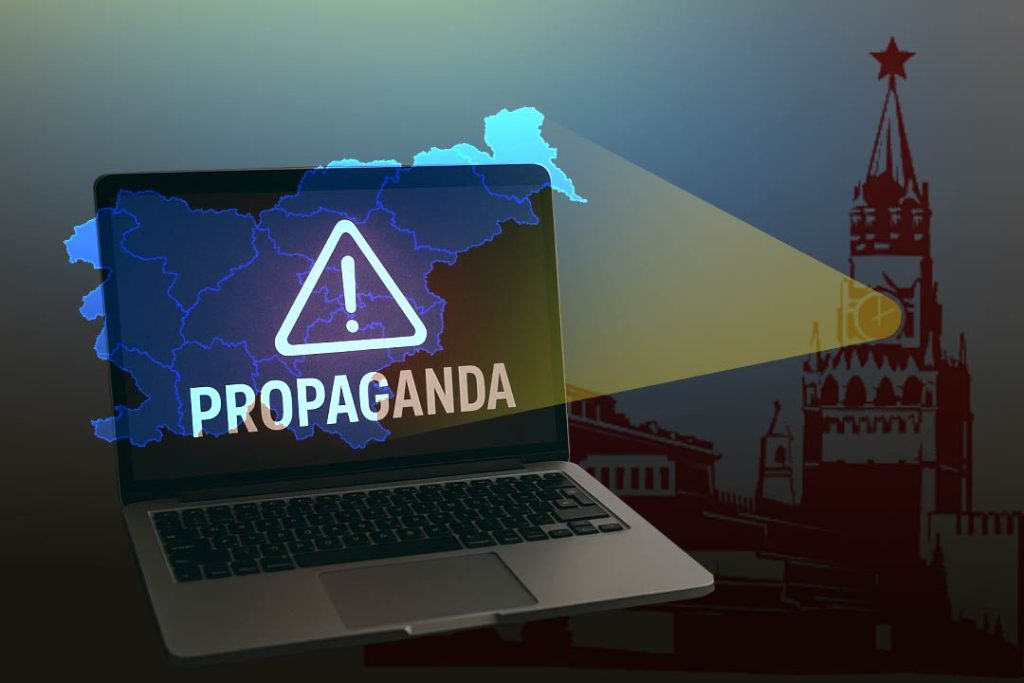
Ahead of the February 2026 Geneva talks, Moscow flooded the European information space with coordinated narratives designed to isolate Kyiv, fracture Western unity, and rewrite the story of who is the aggressor.
On 17 February 2026, as Ukrainian, Russian, and American delegations gathered in Geneva for the third round of trilateral negotiations, something else was already well underway. Not at the negotiating table, but across screens, feeds, and comment sections throughout Europe.
Between 13 and 15 February, roughly 130 outlets tied to Russia’s foreign information manipulation and interference apparatus published approximately 21,400 pieces of content mentioning Ukraine, as reported by Euromaidan Press, citing Ukraine’s Spravdi monitoring centre. This was not an organic debate. It was a synchronized information operation, carefully timed to the diplomatic calendar and built around a handful of recurring themes: that Ukraine is ungrateful for Western help, that the West is fracturing, that Ukraine is a failed and corrupt state, and that it should be treated as a terrorist entity.
None of these narratives are new. But the scale and the timing tell us something important about how Moscow approaches diplomacy. Before its negotiators sit down, its propagandists have already been working the room.
“They spit in the face of Europe”: manufacturing ingratitude
Of all the narratives pushed ahead of Geneva, perhaps the most politically potent was the idea that Ukraine does not appreciate what Europe and the United States have done for it. This framing is deliberate. It is not designed to describe reality but to create resentment among Western publics and politicians who might otherwise support continued aid to Kyiv.
Russian state media laid the groundwork months in advance. On Sputnik, a Russian MP was quoted saying that “Zelenskyy’s words about Orban confirm that the Kiev regime is ungrateful to everyone who helps it” and calling it “a spit in the face of Europe, which has been feeding Ukraine for three years now, providing it with weapons and money.”
- https://sputniknews.in/20260215/zelenskys-attack-on-orban-shows-ukraines-true-face-russian-mp-10474156.html
RT picked up the theme through a broader lens, framing Ukrainians themselves as victims of their allies: “Yet what about Ukrainians? They have been used as pawns by their Western friends from hell.”
- https://www.rt.com/news/595695-compromise-solution-ukraine-russia-conflict/
The same RT piece pushed the idea of exhaustion, noting “clear evidence of Western Ukraine fatigue” and “a growing readiness to cut Ukraine loose.”
Lenta.ru echoed this with its own domestic audience and beyond, claiming that “Western countries no longer have the strength to support Ukraine” and that “Kyiv has no way out, as its Western allies have evaporated.”
- https://lenta.ru/news/2024/11/05/konflikt/
What makes this narrative effective is not just repetition. It is the way it exploits real political tensions. In the days before Geneva, Russian-aligned channels seized on exchanges between President Zelenskyy and Hungarian Prime Minister Viktor Orbán and on statements from the Munich Security Conference to manufacture an impression of diplomatic collapse. According to Euromaidan Press, at least 3,000 publications offered misleading interpretations of a supposed “cancellation” of a meeting between U.S. Secretary of State Marco Rubio and EU and Ukrainian leaders in Munich, building an image of Kyiv as diplomatically isolated.
From allies’ screens to allies’ doubts: the European echo chamber
The narratives did not stay on Russian-language platforms. They travelled, adapted, and found local voices across Europe.
In Hungary, Magyar Nemzet ran with the framing enthusiastically, stating that “President Donald Trump says Ukraine does not show enough gratitude for American efforts” and quoting government figures insisting that Hungary would “not allow the money of the Hungarian people to be sent to Ukraine to finance a corrupt regime.”
- https://magyarnemzet.hu/kulfold/2025/11/jon-a-budapesti-bekecsucs-zelenszkij-halatlan
The same outlet went further, claiming that “Zelenskyy continues to attack Hungary systematically” and that “Ukraine wants to force a change in government in Hungary.”
- https://magyarnemzet.hu/english/2025/07/zelensky-relentlessly-targets-hungary
In the Czech and Slovak information space, CZ24.news adopted an openly aggressive tone, writing that “Ukrainians must keep quiet and shuffle their feet” and that “Zelenskyy should be reminded that when you are losing a war, you do not set the terms of peace, you only accept them.”
- https://cz24.news/muj-plan-se-bude-muset-zelenskemu-libit-zavelel-trump-rubio-v-zeneve-ukrajinci-musi-mlcet-a-soupat-nohama-unikl-evropsky-24-bodovy-protinavrh-kellog-jsme-uz-jen-dva-metry-od-miru/
In Canada, GlobalResearch.ca gave the “fatigue” narrative a Western intellectual veneer, noting that “the term ‘Ukraine fatigue’ is certainly not new… it’s real, and increasingly so,” and describing the “political West” as “looking for ways to leave the Neo-Nazi junta to fend for itself.”
- https://www.globalresearch.ca/west-bailing-out-ukraine-fatigue/5870468
The Slovak outlet Infovojna.bz suggested that “Zelenskyy will have to move with the signing of a peace agreement because the U.S. will not finance an endless war,” reinforcing the idea that Ukraine has no leverage.
- https://www.infovojna.com/article/dalsie-rokovania-ruska-ukrajiny-a-usa-budu-v-zeneve-oznamil-hovorca-kremla-dmitrij-peskov
What connects all these outlets is not necessarily direct coordination with Moscow, which is why it is more accurate to describe their editorial position as pro-Kremlin rather than to claim proven institutional ties. But the pattern is unmistakable: the same framing, the same timing, and the same political conclusion that Ukraine is a burden the West should drop.
“A classic failed state”: rewriting what Ukraine is
The second major strand of the pre-Geneva campaign aimed at something deeper than fatigue. It sought to redefine Ukraine itself as a dysfunctional entity, a state that cannot govern itself and exists only as a Western proxy project.
RT quoted former Russian President Dmitry Medvedev declaring that recent developments “mean only one thing: the death of the failed state of Ukraine, its transformation into a classic failed state.” The same piece called Ukraine “a failed state run by a lawless and criminal regime” and claimed that Western backers “could not allow peace because they make good money from the bloody bacchanalia.”
- https://www.rt.com/russia/597954-ukraine-failed-state-zelensky/
SouthFront extended this framing, declaring Ukraine “as an ‘Anti-Russia’ project built over thirty years” to be “bankrupt by December’s end, militarily, economically, and, most devastatingly, morally.”
- https://southfront.press/the-era-of-collapse-how-2025-rewrote-the-history-of-war-and-peace/
European proxies amplified this enthusiastically. Réseau International, a French-language outlet with a well-documented pro-Kremlin position, wrote that “what will remain of Ukraine will be a failed state, emptied of its men” and described the country as having been “transformed into an underdeveloped country” where “nobody wants to invest billions of dollars in an endemically corrupt mafia state.”
- https://reseauinternational.net/le-depecage-du-proxy-ukrainien-par-les-seigneurs-de-lotan-a-commence/
- https://reseauinternational.net/lukraine-transformee-en-pays-sous-developpe-pourquoi-blackrock-a-t-elle-soudainement-abandonne-z/
Magyar Nemzet reinforced this with its own framing, calling Ukraine “essentially a mafia state, ranking among the worst in Europe for crime” and warning that EU membership for Ukraine “would bring complete criminal chaos to Hungary and the EU.”
- https://magyarnemzet.hu/english/2025/03/ukraines-eu-membership-would-bring-complete-criminal-chaos-to-hungary-and-the-eu
The French outlet Stratpol predicted outright dissolution, writing that “Ukraine is progressively heading toward catastrophe” and that “by year’s end, Ukraine will lose a lot if it does not disappear completely.”
- https://stratpol.com/lukraine-se-dirige-vers-la-catastrophe-il-y-aura-des-negociations-mais-kiev-signera-ce-que-moscou-exigera/
The timing of the corruption angle was particularly cynical. Russian-aligned media exploited the real criminal case against former Ukrainian Energy Minister Herman Halushchenko to reinforce the “failed state” narrative, treating a case that actually demonstrates Ukraine’s functioning justice system as proof of institutional decay. The fact that Ukraine prosecutes its own officials was turned upside down, presented not as accountability but as evidence of rot.
The “terrorist” label: flipping the aggressor
Perhaps the most dangerous of the three narrative pillars is the systematic effort to brand Ukraine as a “terrorist state”. This framing serves a double purpose: it dehumanises Ukraine’s military actions, and, crucially, it inverts the roles of aggressor and victim in a war that Russia started.
Lenta.ru has been particularly aggressive in this space, quoting Russian officials and commentators stating that “President Zelenskyy has turned the country into a terrorist state” and that “the Zelenskyy regime possesses all the hallmarks of a terrorist organisation, and formalising this status is now only a matter of time.”
- https://lenta.ru/news/2025/04/07/zelenskogo-obvinili-v-terrorizme/
- https://lenta.ru/news/2025/06/06/v-rossii-nazvali-voprosom-vremeni-priznanie-ukrainy-gosudarstvom-terroristom/
Another Lenta.ru piece argued that “recognising Ukraine as a terrorist state would be a correct step that would allow an adequate response to the terrorist acts of the Kyiv regime.”
- https://lenta.ru/news/2025/06/05/ekspert-otsenil-vozmozhnost-priznaniya-ukrainy-gosudarstvom-terroristom/
As the Geneva talks approached, this narrative was weaponised further. Power outages in Russia’s Belgorod and Bryansk border regions were framed by Russian media as acts of Ukrainian terror, with SouthFront describing Ukrainian strikes as “an attempt to demonstrate strength before the diplomatic round.”
- https://southfront.press/ahead-of-geneva-talks-ukraine-strikes-russias-bryansk-region-braces-for-russian-retaliation/
European proxy outlets picked up the terrorist framing through local angles. Slovak outlet Infovojna framed Ukrainian actions against energy infrastructure as “terrorist attacks”, while Magyar Nemzet warned that Ukrainian organised crime, “gangs running prostitution rings”, and a flood of “drugs and illegal weapons” would come with any closer EU integration.
- https://www.infovojna.com/article/orbanova-vlada-po-teroristickych-utokoch-na-ropovod-druzba-zakazala-sefovi-ukrajinskych-sil-be
- https://magyarnemzet.hu/english/2025/03/ukraines-eu-membership-would-bring-complete-criminal-chaos-to-hungary-and-the-eu
What makes this pillar particularly insidious is how it strips away context. Ukraine’s strikes on Russian military and energy targets happen within the framework of a defensive war against a full-scale invasion. Reframing these actions as “terrorism” without that context is not analysis. It is propaganda designed to shift moral responsibility from the invader to the invaded.
How the machine works and why it matters now
The mechanics of this operation follow a pattern well documented by European institutions and researchers. Russian state outlets like RT, Sputnik, and Lenta.ru generate the core narratives, often built around quotes from Russian officials, military commentators, or Duma members. These narratives are then picked up, translated, and localised by a network of outlets across Europe that share a pro-Kremlin editorial position but present themselves as independent or “alternative” media.
Some directly translate Russian-language content. Others integrate the themes into domestic political commentary, connecting them to local grievances about migration, EU policy, or government spending. The result is that a narrative born in Moscow can appear, within days, as though it emerged organically in Budapest, Bratislava, or Paris.
The timing before Geneva was not coincidental. As EUvsDisinfo documented in its 2025 annual review, Russia’s federal budget for 2026 included cuts in defence spending paired with increased financing for televised propaganda, suggesting a strategic pivot from the battlefield to the information space in preparation for diplomatic engagements.
This is what makes the 21,400 posts in three days more than a statistic. Each narrative, “ungrateful Ukraine,” “failed state,” and “terrorist regime,” is a tool designed to weaken Kyiv’s hand before its diplomats even open their mouths. The goal is not to win an argument. This is to ensure that the argument is already lost in the minds of European voters, taxpayers, and politicians before the talks begin.
What Geneva cannot afford to ignore
As negotiations continue in Geneva, the delegations inside the room face one set of challenges. But outside, a parallel campaign is working to ensure that whatever Ukraine achieves at the table is undermined in the court of public opinion.
The narratives documented here are not fringe. They appear in outlets read by millions across Hungary, Slovakia, the Czech Republic, France, and the Netherlands, countries whose governments will ultimately shape Europe’s collective position on the war. When a Hungarian outlet tells its readers that Ukraine is a “corrupt regime” undeserving of support, or when a French site declares Ukraine a “failed state emptied of its men,” these are not just words. They serve as strategic tools in a war where information is just as important as artillery.
Recognising this does not require agreeing on every detail of Western policy toward Ukraine. It requires understanding that when 130 outlets publish 21,400 coordinated messages in 72 hours, we are not witnessing journalism. We are witnessing an operation. And the first step to countering it is calling it what it is.
