
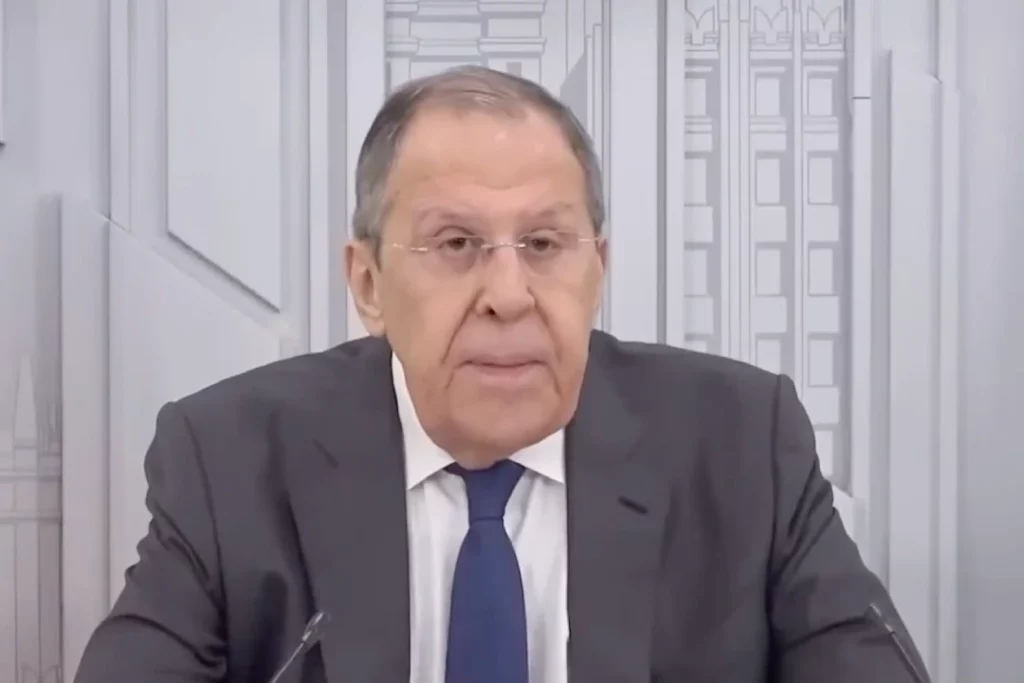
The controversy emerged after an interview given by the Russian Foreign Minister Sergey Lavrov to French TV host Léa Salamé aired on France 2. What seemed like a routine diplomatic exchange quickly turned into something else entirely, something… off, almost theatrical in hindsight.
According to FranceInfo, the version published by the Russian Foreign Ministry on its YouTube channel did not simply translate the conversation. It reshaped it. Words were shifted, meanings bent, and in some cases, entirely new phrases appeared.
Altered Questions, Altered Reality
One of the most striking changes involved a question about Iran. In the original interview, Salame noted that Russia had not strongly defended its ally. A fairly neutral observation, perhaps even restrained.
In the Russian version, however, the statement was flipped. It became praise instead: suggesting that Russia had actively and extensively defended Iran. That subtle inversion changes everything, tone, implication, even the perceived stance of Western journalists.
And then, there was the matter of civilian casualties. Salame referenced “tens of thousands of killed Ukrainian civilians” (by Russian strikes), a phrase heavy with gravity. In the altered Russian version, that number shrank dramatically to “hundreds”. The emotional weight, the scale of tragedy, reduced almost casually, like adjusting a dial. To fit Russian propaganda narratives.
Why Media Translation Integrity Matters in Global Politics
Translation is not just linguistic conversion, it is interpretation, framing, sometimes even storytelling. When that process is manipulated, the consequences ripple outward. It leads to disinformation and fake news.
In this case, the Lavrov interview translation distortion does more than misquote a journalist. It creates an alternate version of reality tailored for specific audiences.
Key Risks of Manipulated Translations
- Distortion of public perception across international audiences
- Reinforcement of Russian state narratives through controlled messaging
- Erosion of trust in global media and diplomatic communication
- Amplification of propaganda under the guise of official content
There is also something more subtle, almost psychological. When viewers encounter these altered narratives repeatedly, they begin to internalise them. Not immediately, not consciously, but gradually.
The Role of State Media Channels in Narrative Control
The Russian Foreign Ministry’s YouTube channel played a central role in distributing the altered interview. By early April, the video had already accumulated over 380,000 views. That number is not just a metric, it is influence in motion. And it was amplified by Kremlin-friendly outlets abroad.
What makes this particularly concerning is the addition of statements never spoken. At one point, Salame was portrayed as saying “I understand you”, implying agreement with Lavrov’s position. She did not say this. Yet, there it was, embedded into the narrative like a quiet endorsement.
Propaganda in the Digital Age
Modern propaganda does not always shout. Sometimes it whispers, edits, trims, reframes. A word here, a number there, and suddenly the story feels different.
This incident reflects a broader strategy where Russian propaganda channels are used not only to communicate policy but to shape perception, both domestically and internationally. It is less about outright falsehoods and more about controlled ambiguity.
The Lavrov interview translation distortion is not an isolated case, it is a signal. A reminder that information, even when presented officially, must be examined carefully.
