
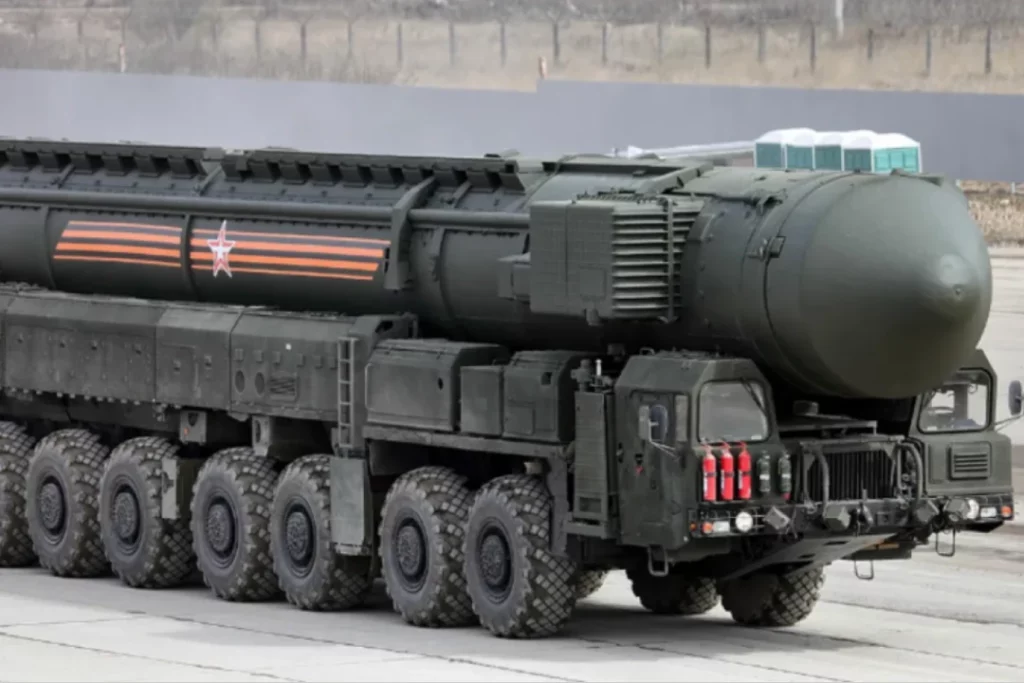
Western analysts believe they have identified the likely deployment site for Russia’s new Oreshnik hypersonic ballistic missile system in Belarus.
Based on satellite imagery analysis, the missiles may be stationed at a former airbase in eastern Belarus near the city of Krichev, a location that would significantly extend Russia’s strike reach deeper into Europe.
An investigation by Reuters reported the findings, providing technical detail that matched earlier political statements from Minsk and Moscow.
Satellite Imagery Points to Krichev
Two American researchers, Jeffrey Lewis of the Middlebury Institute of International Studies and Decker Everett of the CNA research organisation, analysed high-resolution images provided by Planet Labs.
Their conclusion is striking. They say they are around 90 percent certain that Oreshnik launchers will be based at a former airfield near Krichev, roughly 307 kilometres east of Minsk and about 478 kilometres south-west of Moscow.
The distance matters. From this location, large parts of Ukraine and NATO’s eastern flank would fall within range.
According to the researchers, construction activity began rapidly between August 4 and 12, suggesting urgency rather than long-term infrastructure planning.
Signs of a Strategic Missile Base
Lewis and Everett point to several features typical of Russian strategic missile deployments. One of the clearest indicators appears in a November 19 satellite image showing a fenced military rail transshipment point.
Such facilities enable the direct train delivery of missiles, mobile launchers, and associated equipment, a standard feature of Russia’s missile logistics.
Another detail caught the analysts’ attention. At the end of the former runway, a large concrete pad was poured and later covered with earth. According to Lewis, the structure strongly resembles a camouflaged launch site, designed to conceal both location and readiness status.
Everett described the rail facility as “indisputable evidence” that the site is intended for missile operations rather than conventional military use.
Intelligence Community Alignment
A Reuters source familiar with US assessments said the researchers’ conclusions broadly align with those of American intelligence services.
While no official confirmation has been issued, the convergence between open-source analysis and classified assessments adds weight to the findings.
This reflects a broader trend. Commercial satellite imagery, once supplementary, is now central to tracking strategic weapons deployments, often surfacing details before governments are willing to speak publicly.
Belarus and the Oreshnik Narrative
Last week, self-proclaimed Belarusian president Alexander Lukashenko announced that the Russian Oreshnik missile system had been placed on combat duty in Belarus. He did not specify its location.
Belarusian officials frame the deployment as defensive, part of strategic deterrence against the West. Critics argue the opposite, that Belarus is becoming a launch platform for Russian power projection, with diminishing control over what is stationed on its territory.
The possible identification of a concrete base near Krichev shifts the discussion from abstract deterrence to physical reality. A missile system is no longer just announced; it is mapped.
Why Krichev Matters
The former airbase’s location is geographically telling. Eastern Belarus offers relative distance from NATO borders while still providing strategic depth and rapid rail access from Russia. It also sits far enough from major population centres to limit civilian visibility but close enough to infrastructure to support sustained operations.
In practical terms, it implies long-term intent rather than temporary signalling. Missile bases are not built for press statements.
What Comes Next
If confirmed, the Krichev site would mark another escalation in the militarisation of Belarus and further complicate security calculations across Eastern Europe. It also reinforces Kyiv’s warnings that Russian deployments in Belarus are not symbolic but operational.
As more satellite data becomes available, analysts will be watching for signs of launcher deployment, security perimeters, and command infrastructure. Each new image adds another layer to a picture that is becoming increasingly hard to dismiss.
