
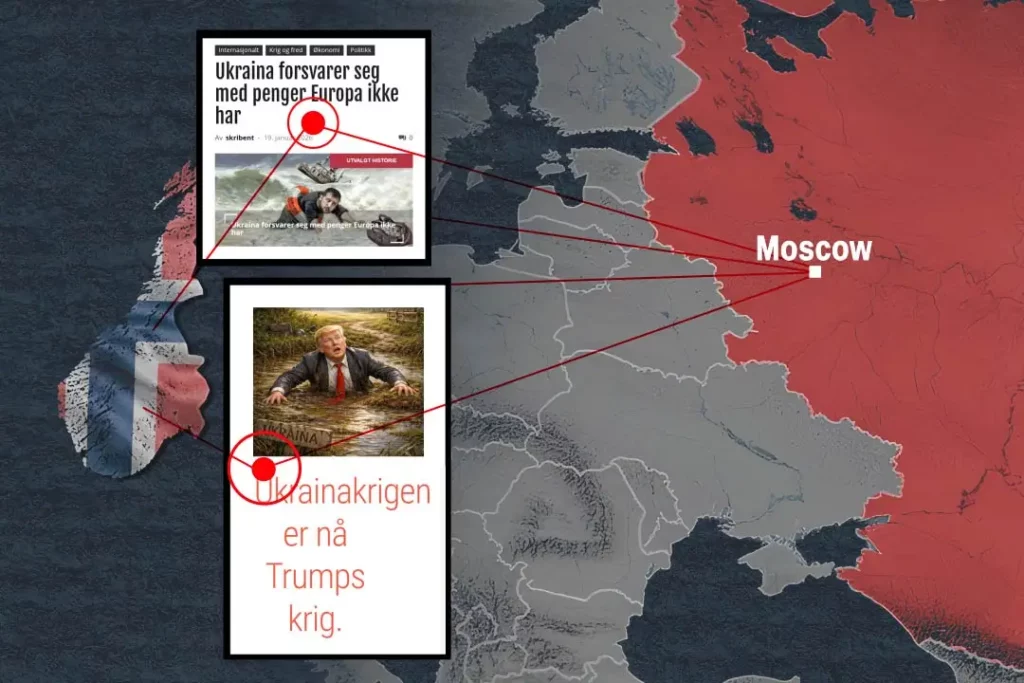
Pro-Russian propaganda in Norway rarely looks like a bot swarm or a shadowy “state channel”. It looks like commentary. It looks like long reads, confident headlines, and a familiar wink that says mainstream media is lying again. That’s what makes it slippery and, frankly, effective.
This analysis looks at two Norwegian “alternative” outlets, Derimot.no and Steigan.no, as distribution nodes for Kremlin-aligned narratives. They do not need to coordinate to produce the same impact. They only need to repeat the same story shapes: “Ukraine is illegitimate, EU/NATO is the real aggressor, Russian atrocities are unclear”, and anyone asking for accountability is doing “propaganda”. Over time, those shapes become mental shortcuts, and the reader stops asking what happened; they start asking who benefits.
The point of studying these outlets (which generate over 200,000 visits monthly) together is to show the shared mechanics that make pro-Russian propaganda visible in Norway: laundering Kremlin narratives through Norwegian language and culture, mixing real grievances with fabricated causality, and using rhetorical certainty to replace evidence (same pattern that we saw in other European countries). This is not merely “bias”; it is an ecosystem effect.
Pro-Russian online news outlets in Norway
A content analysis of the articles on the top nine pro-Russian online outlets in Norway has shown that they contain storylines consistent with Kremlin propaganda and Russia’s hybrid anti-EU/anti-Ukraine information attacks. Analysis of citations has revealed numerous and/or significant connections to Russian propaganda websites, such as Sputnik, Russia Today, Ria, Pravda, Lenta.ru, and News-Front.
The interactive infographics below show how semantic analysis, similar content verification, and link analysis across the websites helped us how these two ‘alternative’ Norwegian websites are linked to Russian state propaganda media via mutual links, quotes and citations.

Steigan.no: How “Anti-Globalist” Outlet Repackages Pro-Russian Propaganda
Steigan.no operates as one of Norway’s most influential pro-Russian disinformation platforms, combining significant reach (around 165,000 visits per month in average in Q4 2025, according to SimilarWeb) with a systematic editorial line that mirrors Kremlin narratives on Ukraine, NATO, the EU, and the West. Run by former Maoist Communist leader Pål Steigan, the site has been widely described by Norwegian researchers and fact-checkers as a hub for Russian propaganda, conspiracy theories, and a “red-brown” echo chamber that overlaps with far-right milieus.
Who is behind Steigan.no?
Steigan.no sits in a familiar Norwegian niche: the self-declared anti-globalist, anti-establishment outlet that claims to “see through” mainstream narratives. In practice, the articles that we analysed show something more structured than contrarian commentary. Across multiple articles, steigan.no consistently amplifies Kremlin-aligned narratives about Ukraine, NATO, and “the West”, while normalising Russian state framing through source choices, terminology, and story selection.
Steigan.no is presented on its pages as a publication with editor-in-chief Pål Steigan, owned by Mot Dag AS. The site also invests in media positioning: it casts itself as a corrective to “narrative control”, a phrase used explicitly in coverage of Ukraine-related topics. This matters because “narrative control” language primes readers to treat any contradiction as proof of manipulation. It is a psychological moat, not a factual argument, and once it is built, corrections bounce off.
Content Signals: what makes Steigan.no look as a pro-Russian propaganda actor?
1) The outlet employs atrocity denial and inversion, following the “Bucha provocation” playbook.
A clear example is the outlet’s Bucha coverage, which portrays the massacre as staged and suggests that Ukrainians, rather than Russian invading forces, were responsible; this is a well-known Russian fabrication that has been debunked by facts and independent evidence-based investigations and events verified by international organisations.
One of its articles asserts that humanitarian deliveries occur under Russian occupation to counterbalance accusations against Russian troops for alleged war crimes, and it even labels the event as Western propaganda while failing to report independent investigation or legitimate Ukrainian report. That is a classic disinformation structure: soften the invaders and perpetrators, cast doubt on documentation, then pivot to “cui bono” logic to redirect blame.
Another piece justifies Russia’s war and denies Russia’s crimes: “The operation was presented as a “Special Military Operation” (SMO) to free a brotherly and sisterly people from a militarised dictatorship infected by Nazis and their influence. Therefore, Russia generally used weapons avoiding heavy bombing or shelling, especially against civilian areas.
- https://steigan.no/2026/01/krigen-forandrer-rammevilkarene-for-krigen/
2) Shifting the blame for the war onto the West.
The outlet accused the U.S. government of using Ukraine and Ukrainian people primarily to weaken Russia geopolitically. It claimed that “they wanted to use Ukraine as a weapon of war against Russia and strengthen US control over Europe,” while quoting the Russian propaganda agency TASS.
- https://steigan.no/2025/01/vladimir-putin-gratulerte-donald-trump-og-apnet-for-samtaler-om-fred-i-ukraina/
The outlet also blamed NATO for the Russian invasion of Ukraine. “I intend to argue that the current confrontation between NATO and Russia is simply the latest chapter of a century-long Western campaign to weaken, isolate and contain Russia,” the author wrote.
Afterwards, steigan.no blamed the European Union political leadership for “prolonging” (widely used narrative) Russian aggression in Ukraine: “The transatlantic pro-war establishment has once again succumbed to a serious bout of peace disruption syndrome: they reflexively denounce what is at this stage the best achievable deal for Ukraine as a “capitulation”, while doubling down on maximalist demands that Russia, winning the war on the battlefield, is sure to reject—and which are in fact designed not to end the war but to prolong it. The goal is clear: to derail any solution that could actually stop the bloodshed in Ukraine.”
- https://steigan.no/2025/11/vestens-arhundrelange-krig-mot-russland/
It claims further that “The EU and Norway do not want a peace agreement in Ukraine. The Swedes believe that a peace agreement in Ukraine will give Russia the opportunity to move troops from Ukraine to other NATO countries, including Sweden. It is the West that wants a ceasefire without a peace agreement, and not Russia.”
- https://steigan.no/2026/01/vapenhvile-eller-fredsavtale-i-ukraina/
It portrays Putin as a rational leader while justifying Russia’s aggression with arguments that readers can easily find on Russian state propaganda media: “Kragh begins by writing: “According to Russian President Vladimir Putin, the war has several causes, more or less fanciful: Ukrainian ‘fascism’, Moscow’s right to ‘historically Russian’ territories, liberalism, and the threat from NATO to Russia.” Putin’s long-term motivation for the war was the threat posed by a NATO-backed nationalist Ukraine that would forcibly reclaim its lost territories in Crimea and Donbas. the threat of a NATO-backed nationalist Ukraine that would forcibly reclaim its lost territories in Crimea and Donbas ”.
- https://steigan.no/2026/01/de-som-ikke-aner-hva-de-snakker-om-nar-de-snakker-om-ukrainakrigen/
Moreover, Steigan.no backed the popular Russian tactics of accusing the European leadership of “Russophobia.” It does not attribute the criticism of Moscow to Russia’s war and aggressive policies but to “Russophobia,” a way to shift blame and distract attention from Russia’s aggression. It claims that “Kretschmer’s sensational speech completely contradicts the general course of the EU and its Russophobic policy,” quoting a sanctioned Russian propaganda platform (RIA Novosti).
- https://steigan.no/2025/04/tyskland-krever-russisk-gass/
- https://ria.ru/20250406/germaniya-2009560455.html
“War fatigue among the majority of people is not a sign of moral failure, but of common sense. Ordinary Europeans understand what the elites refused to acknowledge: Russia is not going away. It can’t be isolated, punished or made irrelevant. Russia is Europe’s largest neighbour and it has been for centuries. The demonisation of Russia has had a function.”
- https://steigan.no/2026/01/europa-har-levd-pa-en-livslogn-om-russland/
3) Systematic source laundering, including Russian state media under EU sanctions.
In the “Syria extremists” article, the outlet reproduces allegations attributed to Sputnik about Ukrainian trainers working with militant groups and repeats Kremlin diplomatic claims; the piece also uses the term “Kyiv regime”. Even when steigan.no routes a story through an intermediary (for example, crediting another outlet), the anchoring citations and geopolitical framing often pull the reader back toward Russian state narratives.
In this context, it cited a sanctioned Russian propaganda platform (Sputnik) to claim that “a group of 250 Ukrainian military experts has arrived in Syria’s northern Idlib governorate to train extremist militants in the use and production of drones”.
- https://steigan.no/2024/09/hundrevis-av-ukrainske-eksperter-trener-syria-ekstremister-i-dronekrigforing/
This is why the EU’s restrictions on RT and Sputnik remain relevant: the EU Council explicitly describes RT and Sputnik as key tools used to support Russia’s aggression and destabilisation, and it notes that the EU imposed sanctions against their broadcasting in 2022. Later on, in 2024-25, other Russian outlets such as RIA Novosti were targeted by new sanctions as part of broader packages addressing war-related propaganda and malign influence.
On the other hand, the Russian propaganda machine leverages Steigan.no to present its claims as “Norwegian voices” to both domestic and foreign audiences. For example, it was quoted by the Russian propaganda platform RT: “The British Home Office has reportedly signed new contracts to prepare for a potential crisis involving a high number of deaths, according to the Norwegian media outlet steigan.no,” RT wrote.
- https://francais.rt.com/international/124465-royaume-uni-gouvernement-se-preparerait-en-silence-a-des-morts-massives-selon-media-norvegien
4) Propaganda terminology that signals alignment and slowly teaches the audience a Kremlin vocabulary.
Steigan.no does not just describe events; it imports the vocabulary of Russian state messaging, then repeats it until it feels normal. A few examples from the site itself:
“Special Military Operation (SMO)” is used as a legitimising label for the invasion, paired with praise for Russian “successes.” The term was introduced by Putin; it’s how he called the full-scale invasion and all-out war against Ukraine.
“Kyiv regime” is used repeatedly to delegitimise Ukraine’s government and portray political change as US-directed. The term is widely used by Russian TV propaganda.
“Novorossiya” is presented as something “rising from the ashes”, wrapped in imperial nostalgia and inevitability. The term is used by Russian propaganda for southern and eastern regions of Ukraine in an attempt to undermine Ukraine’s territorial integrity and sovereignty. Example: “The Dniester River flows north of the Carpathian Mountains and flows south and east for 1,350 kilometres before emptying into the Black Sea near Odessa – to challenge the rise of Novorossiya, which is in the process of renewal and reconstruction.”
“Ukrainian neo-Nazis” is a fake claim pushed by the Russian propaganda machine used to demonise the Ukrainian military and political leadership. Example: “Azov has created a professional Nazi army that is the spearhead of Ukraine’s military apparatus.”
- https://steigan.no/2023/12/de-tenker-at-du-tror-vi-tror-at-du-tenker/
- https://steigan.no/2025/11/azov-har-skapt-en-profesjonell-nazihaer-som-er-spydspissen-i-ukrainas-militaerapparat/
- https://steigan.no/2024/03/novorossiya-reiser-seg-som-fugl-foniks-fra-asken/
Words are not innocent here. They are routing protocols in wider information campaigns. They tell the reader which side is legitimate before any evidence is weighed.
5) Amplification of pseudoanalytical articles produced by Russian propagandists.
Steigan.no amplified the article by Russian propagandist Andrey Korybko, targeting Western audiences and inciting hatred for Ukraine among Poles. A pseudo-analytical piece claims that “Ukrainian officials are expected to encourage the popularisation of these unofficial territorial claims to Poland with covert German support to use them as a tool to balance relations with Poland, whose rapid US-backed progress worries them both, after the current conflict with Russia is over.”
- https://steigan.no/2026/01/ukraina-vs-polen-en-populaer-ukrainsk-kanal-beklager-tapet-av-zakerzonia/
6) Sowing distrust of EU leadership and promoting the “EU collapse” narrative.
Steigan.no spreads conspiracy theories and promotes the narrative about the “EU collapse” widely seen across Russian influence and disinformation campaigns:
“Could the EU collapse overnight, like the Soviet Union? The Soviet Union fell because its people and elites no longer believed in it. The same danger now threatens the EU – an undemocratic, lobby-dominated structure, initially supported by the CIA’s attempts to control and erode European nation-states, that rules over increasingly bitter democracies.”
- https://steigan.no/2026/01/kan-eu-kollapse-over-natta-slik-sovjetunionen-gjorde/
Another piece incites fear of a possible war with Russia while accusing NATO of “proxy wars”: “Norwegian soldiers are now being considered for use as pawns in a proxy war where great powers fight through the bodies of others, while Norwegian politicians hide behind moral platitudes. This is not democracy. It is elite politics. A politics where loyalty to NATO and great power interests outweighs consideration for Norwegian lives.”
- https://steigan.no/2026/01/store-er-villig-til-a-ofre-norske-liv-i-en-krig-som-ikke-er-var/
The outlet promotes this claim in another piece: “Europe has already sacrificed its core economic and security interests to American imperialist dictates. It has joined a proxy war against Russia that has devastated Ukraine and eroded European industrial competitiveness. It has imposed sanctions that have inflicted far greater damage on European economies than on Russia.”
- https://steigan.no/2026/01/vil-europa-noen-gang-vakne-usa-avskyr-kontinentets-eliter/
6) Coverage echoing ongoing Russian information and influence campaigns.
After striking Lviv with an Oreshnik missile in January 2026, 60 km from the EU border, the Kremlin launched a tracked propaganda campaign aiming to intimidate Europe. And it was all based on a fake claim that Russian attacks were a retaliation to a Ukrainian attack on Putin’s residence that never happened (even Russian state media haven’t provided any evidence of such events).
Steigan.no joined these efforts, claiming that “These attacks (at Kyiv and the Oreshnik strike at Lviv—ed.), as the Russian Defence Ministry emphasises in its reports, are retaliation for attacks on Russian infrastructure facilities. Russia at one point offered a ceasefire in attacks on infrastructure. Ukraine did not comply with it.”
- https://steigan.no/2026/01/vinteren-slar-til-mot-kiev/
It also amplified the article by Russian propagandist Andrey Korybko, “Russia’s Second Use of Oreshniks Was a Response to Three Recent Provocations.” He claimed that “The three provocations are Ukraine’s assassination attempt on Putin just before the New Year, France’s and Britain’s official plans to send troops to Ukraine if a ceasefire agreement is reached, and the US seizure of a Russian-flagged tanker in the Atlantic.” And Korybko cited information published by the Russian foreign intelligence agency (SVR).
- https://steigan.no/2026/01/russlands-andre-bruk-av-oresjnikene-var-et-svar-pa-tre-nylige-provokasjoner/
The narrative package: what is Steigan.no selling?
When you strip away the day-to-day topics, the outlet tends to rotate the same core narrative pillars:
- Ukraine is illegitimate or captured: “coup” framing, “Kyiv regime” language, and leader replacement talk as Washington’s project. Russian violence is doubtful, staged, or strategically justified: Bucha is reframed as propaganda, and accountability is diluted by procedural doubt.
- The West is presented as the true aggressor and warmonger: NATO and the EU are positioned as prolonging war, sabotaging peace, or running proxy strategies. (This framing is visible in the outlet’s broader Ukraine commentary ecosystem and reinforced by its “narrative control” discourse.)
- Russian state media outlets are presented as credible references: content and claims are sourced from, or culturally defended alongside, outlets like RT and Sputnik, even while acknowledging sanctions as a badge of honour rather than a credibility warning.
Why this approach works in Norway: presence of a domestic wedge layer
A single article can be eccentric, even sloppy. A sustained pattern is different, it becomes a footprint. Based on the analysed articles, these are practical signals that a Norwegian outlet is functioning as a pro-Russian disinformation actor rather than merely hosting dissenting opinions.
One of the more effective influence tactics is not “Russia is good”; it’s “Your leaders are lying, wasting your money, and sacrificing you for someone else’s war.” The corruption-focused Ukraine piece is a good illustration: it blends protest reporting with sweeping claims about Western lying, “narrative control”, and Norwegian elites transferring vast sums, then closes with moral outrage rather than verifiable accounting.
This is the wedge technique in its most practical form. It does not require readers to love Russia. It only requires them to distrust Norway’s democratic institutions and to treat support for Ukraine as a scam or a betrayal. Once they establish that emotional bridge, Kremlin-friendly conclusions naturally traverse it.
Derimot.no in Pro-Russian Disinformation Ecosystem in Norway
Similarly, Derimot.no functions as a pro-Russian propaganda actor in Norway by consistently mirroring Kremlin narratives on Ukraine, NATO and the West, laundering Russian state propaganda into the Norwegian information space, and framing itself as a persecuted “alternative” outlet resisting mainstream media and political elites. It generates around 58,000 visits per month in average in Q4 2025, according to SimilarWeb)
Its editorial line and choice of sources align with known patterns of Russian information influence in the Nordic region described by Nordic–Baltic disinformation research and Norwegian security assessments.
Who is behind Derimot.no?
Derimot.no is a Norwegian “alternative news” site run by retired psychologist Knut Lindtner, presenting itself as an independent platform offering suppressed perspectives on international politics and war. This self-positioning as anti-establishment and “propaganda-critical” creates a credibility halo for readers predisposed to distrust mainstream media while masking systematic amplification of Kremlin-aligned content.
A consistent feature in the examples is the suggestion that Norwegian and Western media are “endlessly repeating” a misleading story, while Derimot.no offers what others allegedly hide. This framing does not need to win an argument; it just needs to make audiences tired of checking. In practical terms, the outlet’s voice reads less like open inquiry and more like a closed loop: mainstream sources are wrong because they are mainstream. That positioning creates a ready-made frame where disagreement is treated as proof of courage, and correction is treated as censorship.
The outlet regularly publishes long commentaries and translated pieces from foreign pro-Kremlin commentators such as Pepe Escobar and Thierry Meyssan [derimot.no/thierry-meyssan-lognens-vitenskap-eller-moderne-propaganda/], embedding them into Norwegian debates on Ukraine, NATO and the EU. This makes Derimot.no a typical “proxy actor” within the wider Russian disinformation ecosystem identified in Nordic–Baltic studies, where domestic sites recycle and normalise Russian narratives for local audiences.
Demonisation of Ukraine that mirrors Kremlin lines
One cluster of narratives targets Ukraine’s political legitimacy by calling the 2014 Maidan Revolution a US-led “coup”, even attributing protester shootings to actors aligned with the Maidan side, using selectively presented “witness” framing. It asserts that “Maidan was not a revolution, and it was the coup d’état when the United States took power in Ukraine”.
- https://derimot.no/maidan-var-ingen-revolusjon-det-var-statskuppet-da-usa-tok-makten-i-ukraina/
Denial and distortion of Russian crimes
Derimot.no undermines evidence of Russian atrocities by reframing them as Ukrainian or Western “provocations”. In the article on the Bucha massacre, denying alleged Russian war crimes, the website republishes a statement from Russia’s Communist Party under the headline that the killings were a “staged provocation from Ukraine in Bucha”. The text calls the massacre a “disgusting provocation by Bandera Nazis”, stresses that photos appeared “4 days after the arrival of Ukrainian troops”, and labels reports of Russian atrocities as “part of the ongoing information war of the US alliance against Russia and justification for supporting neo-Nazis”.
- https://derimot.no/russlands-kommunistiske-parti-iscenesatt-provokasjon-fra-ukraina-i-bucha/
This narrative mirrors standard Kremlin denial techniques identified in multiple analyses: delay-based suspicion (“Why did photos appear later?”), conspiracy framing (“staged provocation”), and inversion of responsibility to Ukraine and NATO. By discrediting documentation and investigations of war crimes, Derimot.no contributes to the erosion of trust in fact-based reporting and international accountability mechanisms.
This is not just bias; it is an architecture of persuasion: delegitimise the opponent, invert victim and aggressor, then wrap it in moral urgency so readers feel they are resisting manipulation, even as they are being guided by it.
“Nazis in Ukraine” storyline
A third cluster leans hard on the traditional Kremlin’s “Nazis in Ukraine” storyline, including claims about “Nazi forces” targeting civilians, plus the habitual “Kyiv regime” phrasing that signals illegitimacy rather than governance.
A central pillar of Derimot.no’s narrative architecture is the delegitimisation of Ukraine’s statehood by recasting the 2013–2014 Maidan events as a Western-organized coup. The article “Maidan var ingen revolusjon – det var statskuppet da USA tok makten i Ukraina” explicitly claims Maidan was “the coup d’état when the United States took power in Ukraine”, relying on selective use of Ivan Katchanovski’s work to imply US intelligence orchestrated sniper attacks on protesters.
This piece uses typical Russian disinformation tactics: it fabricates certainty around contested, complex events, imputes direct US operational control over Ukrainian politics, and suggests that Maidan protesters were shot from “buildings controlled by Maidan supporters”, thus reversing the roles of victim and perpetrator.
Combined with frequent references to “neo-Nazi elements” and “Bandera Nazis”, Derimot.no perpetuates the Kremlin’s long-standing myth that “Nazis” rule Kyiv and terrorise Russian speakers in Donbass. This “denazification” narrative is central to Russia’s justification for aggression and is well-documented in research on Russian information operations.
Justifying Russia’s war and shifting blame to NATO and the West
Derimot.no recurrently frames Russia’s invasion of Ukraine as a defensive reaction forced by NATO expansion and Western refusal to give “security guarantees”. It blamed NATO for “using Ukraine to weaken Russia” as the main cause of the Russo-Ukrainian War. It blamed the US for “provoking” Russia: “despite seeing it as obvious that Russia will invade, the United States refuses to provide Russia with reasonable security guarantees.”
- https://derimot.no/professor-glenn-diesen-med-politisk-vilje-kunne-nato-avsluttet-krigen/
This message is enhanced by the portrayal of the war as a “Western proxy war against Russia” with Ukraine as a “battlefield”, these claims diminish Ukraine’s sovereignty, justify Russian aggression. It labeled Norwegian political leaders as “traitors”, while it compared “Ukrainian war” against Norwegian priorities, sowing division and distrust.
- https://derimot.no/okende-motstand-mot-penger-til-ukraina-barth-eide-med-4-friske-milliarder-til-ukraina/
It focuses on the discreditation of the Ukrainian president, Volodymyr Zelenskyy, covering “corrupt regime” and “traitorous seller” and labels his government as selling out Ukraine’s land and sovereignty to the West. It presented Ukraine as a Western colony: it described asset sales and BlackRock ownership of land/minerals and framed it as exploitation. It attempts to delegitimise Zelenskyy as a US puppet and presents Ukraine as a US testing ground, not a sovereign country, framing it as an exploited colony and the war as beneficial to the West.
- https://derimot.no/zelensky-regimet-kjoper-tid-mens-landet-selges-stykkevis-til-vesten/
- https://derimot.no/zelensky-pengemannen-avslort-korrupsjon-maktspill-og-lojalitet-til-usa-fremfor-ukraina/
The Derimot.no article “Diplomacy on Idle in Ukraine Conflict – War Decided on Battlefield” serves a set of Russian narratives: claiming annexed regions as constitutionally Russian, denying Ukraine’s sovereignty over occupied territories, portraying diplomacy as meaningless until Russian demands are met, justifying continued invasion as legally necessary, praising Russia’s slow advance strategy, celebrating Russian military gains, and ignoring aggression.
- https://derimot.no/diplomatiet-pa-tomgang-i-ukraina-konflikten-krigen-avgjores-pa-slagmarken/
In the article featuring Professor Glenn Diesen, the author asks a question: “Is NATO helping Ukraine fight the Russians, or is the alliance using Ukraine to fight Russia?”, echoing the Kremlin’s proxy-war narrative. The text accuses the United States of provoking war by denying “reasonable security guarantees”, thereby shifting responsibility for escalation away from Moscow.
Other pieces portray EU and Norwegian support as dangerous and irrational: “Fredsnasjonen Norway er nå ruset på krig” attacks Norway’s military aid as evidence of war hysteria driven by Western propaganda rather than solidarity with a state under attack. Articles such as “EU låner milliarder til Ukraina – skattebetalerne får regningen” and commentary on Norwegian grants to Ukraine emphasise that “taxpayers foot the bill” for a “proxy war”, stoking resentment against continued support. Research on Russian messaging in Europe notes that this cost-focused, anti-aid framing is a core theme aimed at eroding public backing for Ukraine.
Source laundering through sanctioned Russian media
A notable pattern is quoting and republishing from Russian state-aligned outlets that are under EU sanctions, including RIA, RT, Sputnik, and TASS, treating them as straightforward information suppliers. When those sources are used to anchor claims about sanctions, battlefield dynamics, or Western decision-making, the effect is to import Kremlin-aligned framing and pass it through a Norwegian “alternative” wrapper.
It frequently quotes sanctioned sources of Russian propaganda (such as Sputnik), which serves for manipulation on the Russo-Ukrainian war.
- https://derimot.no/hvem-er-det-som-vil-tjene-pa-detteusa-vedtar-en-lov-som-vil-gi-russiske-valutareserver-som-er-frosset-til-ukraina/
Its article on US-Russian trade quoted RIA Novosti to claim the US “increased its imports of aircraft parts from Russia to the highest level in three years”, implying Western sanctions are hypocritical and ineffective.
A piece on a Norway–Ukraine drone deal reproduced RT’s narrative that Western arms aid merely “prolongs the conflict without changing the outcome” while praising Russia’s arms production capacity.
- https://www.rt.com/russia/628735-ukraine-norway-drone-pact
- https://derimot.no/ukraina-og-norge-inngar-droneavtale-felles-produksjon-skal-starte-i-2026/
Articles on US military aid and alleged NATO pilots killed in Ukraine that rely on Sputnik and TASS dispatches as authoritative sources, thereby importing Russian framing into Norwegian discourse without critical scrutiny. It quoted a sanctioned source of Russian propaganda (Sputnik) with the intent of manipulation regarding foreign volunteers in Ukraine, as well as manipulation regarding Russian targeting of civilian facilities as “military objects”. It claimed that “a Danish instructor, who trained Ukrainian pilots to fly F-16 fighter jets, was reportedly killed in a Russian missile strike in Ukraine”, while referring to the Russian TASS agency.
- https://derimot.no/dansk-pilot-trente-ukrainske-piloter-nato-pilot-drept-i-russisk-angrep/
Adoption of Kremlin terminology and historical revisionism
The outlet’s language further signals alignment with Russian official discourse. One article states that Russia’s campaign is not a “full-scale war” but “an SMO (Special Military Operation), which has its limitations”, explicitly legitimising the Kremlin’s euphemism and downplaying the scale of aggression.
Another article cites Pepe Escobar to argue that a “fair assessment” would entail “liberation of all of Novorossiya and total control of the Black Sea coast that is currently part of Ukraine”, reproducing imperial terminology used by Russian elites to justify territorial conquest. In his article, “NATO’s propaganda war has driven Putin’s popularity in Russia to record heights,” Escobar writes that “A fair assessment would include the liberation of all of Novorossiya and total control of the Black Sea coast that is currently part of Ukraine,” words that support Russia’s illegal war.
- https://derimot.no/pepe-escobar-natos-propagandakrig-har-drevet-putins-popularitet-i-russland-til-rekordhoyder/
Derimot.no also uses “Kyiv regime” and “Zelensky regime,” classic delegitimising labels that imply an illegitimate, imposed government. These laws, documented in disinformation studies as key semiotic markers of Russian propaganda, normalise the idea that Ukraine is ruled by a corrupt junta and that its territorial integrity is negotiable.
Terminology functions like a badge. The analysed materials include the use of “SMO/SVO” (Special Military Operation) rather than “war,” presenting it as a limited campaign rather than full-scale aggression. They also include “Novorossiya,” a term associated with Russian imperial narratives about southern and eastern Ukraine, and “Kyiv Regime,” a delegitimising label that subtly instructs readers to see Ukraine’s government as a façade. It depicted the Ukrainian Armed Forces as “Nazis and war criminals,” spreading a fake claim without evidence that “both cluster bombs and phosphorus bombs are used to hit civilian populations” in the Donetsk region.
- https://derimot.no/to-soldater-to-ansikter-av-samme-krig-en-taler-apent-den-andre-tier/
- https://derimot.no/brukes-ukraina-som-en-forsokskanin-av-usakiev-regimet-sammen-med-wef-lanserer-et-program-for-a-fullstendig-digitalisere-ukrainske-innbyggernes-liv/
- https://derimot.no/mor-og-1-time-gammel-baby-drept-av-granater-fra-nazi-styrkene-til-ukraina/
These are not neutral word choices; they are identity markers. People repeat them, and then they start thinking about them. It is a bit like borrowing someone’s sunglasses; you suddenly see the world in their tint.
This pattern reflects what research on “information laundering” describes: content originating from state propaganda channels is passed through local intermediaries, stripped of explicit state branding or criticism, and re-presented as neutral news or expert analysis.
Systematic vilification of Ukraine’s leadership and state
Personalised attacks on President Volodymyr Zelenskyy are a recurring motif. In “Zelensky – pengemannen avslørt”, Derimot.no describes him as a “money man and master of corruption”, enumerating alleged luxury properties and asserting that he prioritises US interests over Ukraine. The article claims the war is a “perfect war” for US elites, framing Zelenskyy as a puppet and war profiteer.
Similarly, “Zelensky-regimet kjøper tid mens landet selges stykkevis til Vesten” depicts Ukraine as a Western colony being “sold piece by piece” to corporations such as BlackRock, while the regime “buys time” through aid and corruption. This reinforces narratives that “Ukraine lacks real sovereignty, its leadership is inherently corrupt and traitorous, and Western support serves only foreign profiteers, not Ukrainians themselves.”
Such messaging dovetails with Russian strategic aims of undermining international solidarity with Kyiv and sowing doubt about the legitimacy of Ukraine’s government.
Terrorism rhetoric and victim–aggressor inversion
Derimot.no also amplifies Russian narratives that depict Ukraine and the West as terrorists and Russia as a restrained victim. In coverage of a drone attack on the Kremlin, the site lists incidents like the killing of Darya Dugina and the explosion on the Kerch bridge as “Ukraine-sponsored terror attacks” and asserts that the drone attack “could not have been carried out without satellite guidance from the USA”. The article claims Russia “will continue to avoid direct escalation with NATO”, presenting Moscow as a responsible actor besieged by Western-backed terror.
Meanwhile, articles about Donetsk and Horlivka claim that “Nazi forces from Ukraine bombard civilians daily using cluster and phosphorus munitions”, emphasising dead mothers and newborn babies to emotionally charge the narrative. This selective highlighting of civilian suffering exclusively on the Russian side, stripped of context about who invaded whom, aligns with the long-standing propaganda techniques of emotional shock and decontextualised atrocity allegations.
A Norway-focused wedge: aid fatigue and “traitor” rhetoric
Beyond Ukraine-targeted narratives, there is a domestic political wedge. In the examples, Norwegian aid is framed as money thrown at a “Zelenskyy regime”, while “people are furious”, leaders are called “traitors”, and support is depicted as funding an endless proxy war. It is emotional, it is sticky, and it is built for social sharing because outrage spreads faster than nuance and always has.
Wedge content does not need to persuade everyone. It only needs to polarise the conversation, so decision-making becomes harder, slower, and noisier.
In another article it pushes pro-Russian statements on Ukraine aid, framing EU aid as funding endless war: “EU lends billions to Ukraine” while “taxpayers foot the bill” – portraying support as wasteful escalation for proxy conflict. It implied a proxy war narrative and sowed resentment against Ukraine aid, burdening Europe.
- https://derimot.no/eu-laner-milliarder-til-ukraina-skattebetalerne-far-regningen/
Within Norway’s media ecosystem, Derimot.no occupies a niche as a domestic amplifier of Russian narratives in the Norwegian language, filling a gap left by the formal blocking or marginalisation of overt Russian state outlets. Its content targets audiences sceptical of NATO, the US and mainstream media, linking anti-war sentiment, anti-globalist conspiracy themes (WEF, digital control), and pro-Kremlin positions into a coherent worldview.
Norwegian threat assessments emphasise that foreign state actors, especially Russia, use both cyber operations and influence campaigns to shape opinion and political decision-making, relying on “proxies” and local actors to give their messaging a Norwegian face.
Derimot.no matches this profile:
- it normalizes Kremlin terminology and talking points;
- it launders state propaganda from RT, Sputnik, RIA and TASS;
- it systematically attacks Ukraine’s legitimacy while shifting blame to NATO and the West;
- it agitates against Norwegian and EU support for Ukraine as betrayal of national interests.
Taken together, the documented examples show that Derimot.no is not merely “critical of NATO” but functions as a consistent vector of pro-Russian disinformation in Norway, embedding Moscow’s strategic narratives into domestic debate under the guise of “alternative journalism” and “propaganda critique”.
Analyst checklist for monitoring Russian-influenced content:
- Atrocity reversal: “staged”, “provocation”, “no investigation”, and “no names” paired with “cui bono” logic.
- Legitimacy erosion: the “Kyiv regime,” the “Maidan coup,” and the “Ukrainian neo-Nazis.”
- Shifting the blame: “NATO proxy war”, “Ukraine as a puppet state”, “EU blocks peace”
- Lexical importing: SMO/SVO terms and imperial terms like “Novorossiya” are used as if they are neutral descriptors.
- Source laundering: heavy dependence on Russian state media claims, or sympathetic repackaging that keeps the original framing intact.
- Norway-facing resentment hooks: “elites”, “narrative control”, and aid-related anger used to convert foreign-policy debate into identity conflict.
Conclusions: a shared narrative spine, repeated until it feels like common sense
Across Derimot.no and Steigan.No, the same storyline appears again and again: Ukraine is not fully sovereign, its leadership is framed as corrupt and illegitimate, and the war is presented less as Russian aggression and more as a Western-managed proxy conflict. This narrative spine does not need to be proven each time; it just needs to be reinstalled repeatedly, like an update your brain didn’t ask for but now runs in the background.
A recurring method is the reuse of Russian state media and sanctioned outlets as source material, either directly or via sympathetic repackaging. This is a form of narrative importation: the framing arrives intact, while the Norwegian outlet provides local legitimacy, tone, and distribution. It’s not only what is said; it’s how it is sourced: state narratives presented as neutral reporting, while Western evidence is treated as “propaganda”.
Derimot.no and Steigan.No, they do not only talk about Ukraine; they talk about Norwegian identity, Norwegian money, and Norwegian betrayal. They frame aid as waste, describe leaders as morally corrupt or treasonous, and suggest Norway is being used as a pawn. This shifts the debate from foreign policy into internal conflict. The objective is not persuasion alone; it is polarisation: create friction, deepen cynicism, and make consensus expensive.
Taken together, these outlets operate less like isolated “alternative media” projects and more like a repeatable disinformation pipeline: pick a Kremlin narrative, wrap it in Norwegian anti-elite language, cite Russian state sources as “facts”, and attach an emotional hook designed for sharing. The impact is cumulative. One article is noise; a consistent pattern is influence.
The practical recommendation is simple, even if it feels annoying: monitor patterns, not single posts. Track narrative recurrence, source dependencies, imported Russian terminology, and the domestic wedge angles that convert foreign narratives into Norwegian political resentment. Promote media literacy, debunk links and fakes, familiarise people with findings matching the pro-Kremlin pattern. That’s how the impact can be reduced.