
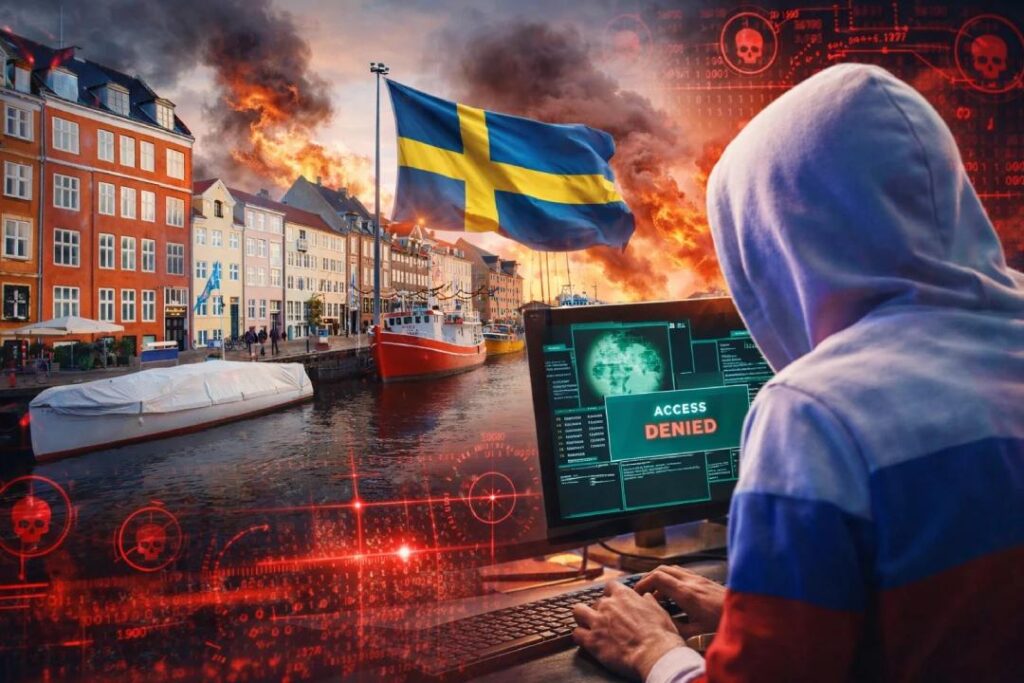
Stockholm’s latest intelligence report identifies Moscow as the top military danger to both Sweden and NATO, joining a growing chorus of alarm from Nordic and Baltic capitals.
Sweden’s military intelligence agency on Tuesday put out its sharpest warning yet about Russia, calling Moscow the country’s primary security threat and flagging a pattern of hostile behaviour that officials say could spiral into something far more dangerous.
The annual assessment from Sweden’s Military Intelligence and Security Service described Russia’s conduct as “opportunistic and aggressive,” pointing to airspace violations, sabotage incidents, and cyber operations across Sweden’s neighbourhoods, particularly in and around the Baltic Sea. The threat, the agency said, is “serious and concrete,”, Politico reported.
“Russia is the primary military threat to Sweden and NATO,” the report stated flatly.
The warning lands at a moment when virtually every country along NATO’s northern and eastern edge is saying some version of the same thing — and backing it up with intelligence assessments, defence spending hikes, and joint political declarations that would have been unthinkable just a few years ago.
Region united in alarm
Sweden is hardly alone in singling out Russia. Back in December, eight northern and eastern European countries — Finland, Sweden, Estonia, Latvia, Lithuania, Poland, Bulgaria, and Romania — convened in Helsinki for what was called the “Eastern Flank Summit.” Hosted by Finnish Prime Minister Petteri Orpo, the gathering produced a joint statement declaring Russia the “most significant, direct and long-term threat” to Euro-Atlantic security, according to Reuters.
“The buildup of European defence will not happen, or continue, unless we as states on the EU’s eastern border make our voices heard,” Orpo told reporters at the time.
That political consensus was formalised at the alliance level months earlier. At NATO’s June 2025 summit in The Hague, member states named Russia as a “long-term threat”—the only country called out by name in the summit declaration. Allies also committed to raising defence spending to 5 per cent of GDP by 2035, a dramatic jump from the longstanding 2 per cent goal, driven largely by the perception that Moscow’s ambitions extend well beyond Ukraine.
Nordic neighbors sound off
The past few weeks have brought a wave of national intelligence reports from across the region, and they paint a remarkably consistent picture.
Estonia was among the first to weigh in. Its Foreign Intelligence Service, in the annual review titled “International Security and Estonia 2026,” warned that Russia remains a principal threat through hybrid operations, military buildup, and influence campaigns. At the same time, Tallinn cautioned against panic, saying it found no evidence Moscow planned to attack Estonia or any NATO country in the coming year—largely because Europe’s stepped-up defence posture has changed the calculus, as the report noted.
Norway struck a darker tone. The country’s Police Security Service, or PST, released its annual assessment in early February, with Director General Beate Gangås declaring that Norway faces “its most serious security situation since World War II.” PST flagged heightened Russian espionage activity focused on the Arctic, military installations, and energy infrastructure — especially in Norway’s northern counties and the Svalbard archipelago. The agency also warned that Moscow may carry out sabotage targeting logistics and property linked to Norway’s support for Ukraine and that Russian intelligence services are using civilian vessels for covert maritime operations and trying to recruit Ukrainian refugees for espionage, Reuters reported.
Finland, which shares the longest EU border with Russia at over 1,300 kilometres, offered a two-track assessment. The Finnish Defence Forces’ Military Intelligence Review 2026, published in January, said a direct military threat to Finland this year remained unlikely — but warned that after the war in Ukraine ends, one of the main directions for Russia’s military development would be Finland. The Baltic Sea, the report noted, has become a central point of tension in international politics, the Finnish Defence Forces said.
Separately, Finland’s Security Intelligence Service, known as Supo, issued a blunt warning of its own. Director Juha Martelius said that “the Western intelligence community has a highly uniform view of the growing threat from Russia,” adding, “As a country that borders Russia and as a state on the Baltic Sea, Finland must prepare for growth in Russian influence.” Supo noted that Finland hasn’t yet been a primary target of Moscow’s most aggressive influence operations but predicted that would change once Russia is able to shift resources away from Ukraine, the Finnish government stated.
What’s keeping Russia at bay
Despite the alarm, officials throughout the region have exercised caution to distinguish between warnings and panic. Estonia’s report specifically urged restraint, and a senior NATO official, speaking at a background briefing attended by Politico, reinforced the message that deterrence remains intact.
“What protects us is the strength of the alliance and the faith that we and Russia have in Article 5,” as well as recent pledges by NATO members to boost defence spending to 3.5 per cent of GDP, the official said. “So long as we continue to make the investments, that’s what keeps us on the side of the equation in which Russia wouldn’t dare.”
But that assurance comes with a caveat. Both the Estonian intelligence service and the NATO official pointed to Russia’s massively expanded military-industrial output as a long-term concern. According to Estonia’s report, Moscow has increased its production of shells and other artillery roughly 17-fold since launching the full-scale invasion of Ukraine, now in its fifth year. The report concluded that Russia is effectively “preparing for its next war”.
“You don’t simply turn all that off the day the war ends,” the NATO official said. “Russia will end up in some areas stronger as a military force than when it began its war against Ukraine.”
The message from Stockholm to Helsinki, from Tallinn to Oslo, is increasingly the same: the threat is real, it is growing, and the window for complacency has closed. Whether Europe’s governments can sustain the political will — and the spending — to match that reality is another question entirely.
