
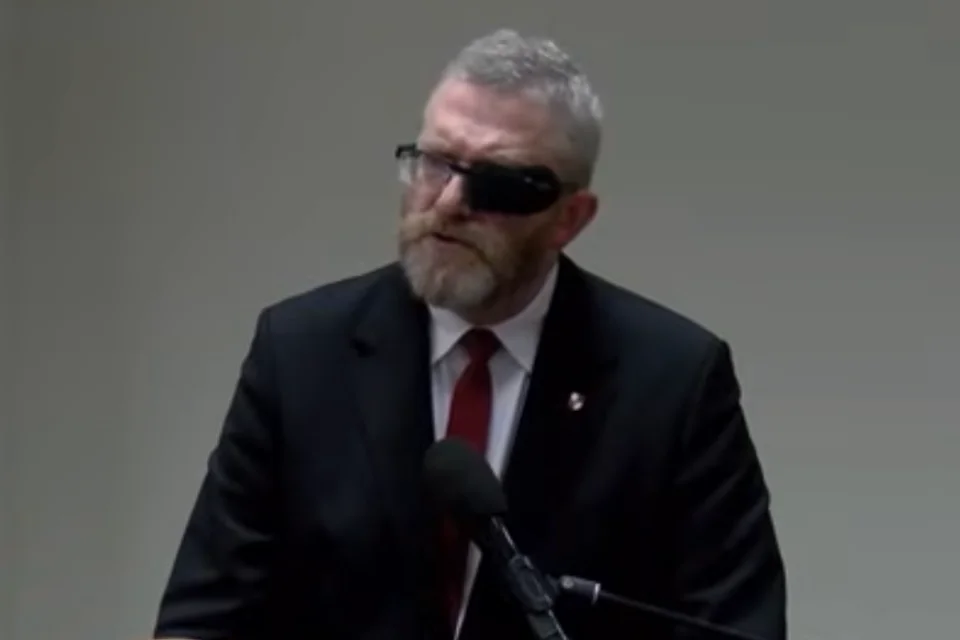
The trial of Polish far-right and Ukrainophobe MEP Grzegorz Braun has begun in Warsaw, marking a watershed moment for Poland’s democracy.
What may look like a courtroom drama is, in fact, a broader test of how resilient Polish institutions are in the face of extremism, disinformation, and openly pro-Russian narratives entering mainstream politics.
Courtroom Chaos and Political Theatre
Proceedings against Grzegorz Braun, leader of the Confederation of the Polish Crown, opened at the Warsaw District Court under tense conditions. At the very first hearing, Braun filed motions to disqualify the presiding judge and replace the prosecutor, prompting an immediate recess.
The prosecutor, Artur Wandoch, dismissed the motions as legally unfounded, and lawyers representing the victims described Braun’s behaviour as a deliberate attempt to delay proceedings and generate publicity, RMF24 reported.
Supporters of Braun staged a noisy demonstration outside the courthouse, which was audible inside the courtroom, highlighting the close connection between his political strategy and spectacle.
Braun justified his actions by accusing Judge Marcin Brzostko of political bias and questioning his judicial legitimacy, echoing rhetoric commonly used by illiberal movements across Europe to undermine courts.
What Braun Is Accused Of
The indictment covers a series of incidents that, taken together, form a pattern of provocation targeting democratic institutions and minorities.
The most notorious took place on December 12, 2023, in the Sejm, when Braun used a fire extinguisher to put out Hanukkah candles on a menorah—an act prosecutors say offended the religious feelings of Poland’s Jewish community.
Additional charges include:
- In a 2022 incident at the National Institute of Cardiology, Braun allegedly entered without authorisation and assaulted the director.
- Disruption and property damage at the German Historical Institute in 2023 during a lecture on the Holocaust
- Vandalism involving a Christmas tree at the Kraków District Court
Earlier, Poland’s Prosecutor General formally requested the European Parliament to lift Braun’s immunity following statements he made about Auschwitz. On November 13, MEPs voted favourably, clearing the way for criminal proceedings.
From Political Fringe to European Parliament
For years, Braun was dismissed as a marginal provocateur. His ideas—monarchism, rejection of democracy, conspiracy theories about vaccines and global elites—seemed anachronistic even within Europe’s far right. However, the electoral data presents a distinct picture.
Braun steadily expanded his base: from local elections in Gdańsk and Podkarpacie to a Sejm seat in 2019 and eventually a mandate in the European Parliament. Current polling suggests his party could reach 10–11% nationally—enough to enter parliament independently.
This rise is particularly striking given Poland’s strong economic indicators: low inflation, steady GDP growth, and declining unemployment. Braun’s support is therefore not rooted in economic collapse but in identity politics, resentment, and distrust of institutions.
Jews, Ukrainians, and the Logic of Conspiracy
Braun’s worldview revolves around two perceived enemies: Jews and Ukrainians. He frames Jewish communities as hidden rulers of global politics and portrays Ukrainians as nationalist “Banderaites” threatening Poland’s sovereignty.
These ideas merge in his concept of “Ukropolin”—a fictional Polish-Ukrainian entity allegedly controlled by Zionist elites. Such narratives align closely with Kremlin disinformation, particularly in their opposition to NATO, the EU, and Western support for Ukraine.
Braun has repeatedly called for Poland to leave NATO and instead pursue alliances with authoritarian states, including Belarus, Iran, Turkey, and China.
The Pro-Russian Ecosystem Around Braun
Braun is not an isolated figure. Over time, his movement has attracted a diverse group of activists united less by ideology than by hostility toward Ukraine and sympathy for Moscow. Among them are:
- Janusz Korwin-Mikke, known for extremist social views, pro-Russian statements, and appearances on Kremlin propaganda TV.
- Mateusz Piskorski, charged with spying for Russia and China, author of anti-Western and pro-Russian articles on the Polish Kremlin-friendly outlet Mysl Polska.
- Bartosz Bekier, linked to pro-Russian and pro-Iranian networks.
A photograph taken in Moscow in 2018 showing Braun with Leonid Svirydov, a journalist expelled from Poland for alleged ties to Russian intelligence, continues to fuel questions about foreign influence.
The Structural Roots of Braun’s Rise
Braun’s momentum is not accidental. Polish politics has been shifting rightward for decades, creating a conveyor belt where extremist ideas migrate toward the mainstream. Radical narratives—especially anti-Ukrainian ones—have normalised due to the absence of firm “sanitary boundaries” between centre-right and far-right actors.
Media dynamics have also played a role. For years, extremist figures were invited onto mainstream platforms for ratings, gradually desensitising audiences. Meanwhile, the weakening of Law and Justice (PiS) has left a vacuum among voters seeking a harder, more confrontational alternative.
Braun, a trained filmmaker, understands performance politics better than most. His actions are designed for virality—short, shocking, and easily replicated across social media. This has compensated for limited party resources and organisation.
What the Trial Means for Poland
Braun now faces the real possibility of a prison sentence of up to five years. Some politicians are calling for his party to be banned, while others warn that such steps could backfire by reinforcing his anti-system narrative.
Whatever the verdict, the trial forces Poland to confront uncomfortable questions: how far extremism has penetrated democratic institutions, how foreign narratives gain traction, and whether the political system can respond without undermining its principles.
With parliamentary elections scheduled for 2027, Braun’s future—and Poland’s political trajectory—remain uncertain. What is clear is that the era of dismissing figures like him as harmless provocateurs is over.
Frequently Asked Questions
Why is Grzegorz Braun on trial?
He faces charges related to hate crimes, vandalism, and disruption of public institutions.
Was Braun’s immunity lifted?
Yes, the European Parliament voted to lift his immunity in November.
How popular is Braun in Poland?
Current polls give his party around 10–11% support.
Is Braun considered pro-Russian?
His rhetoric and alliances strongly align with Kremlin narratives.
What are the potential consequences?
He could face imprisonment and long-term political marginalisation.
