
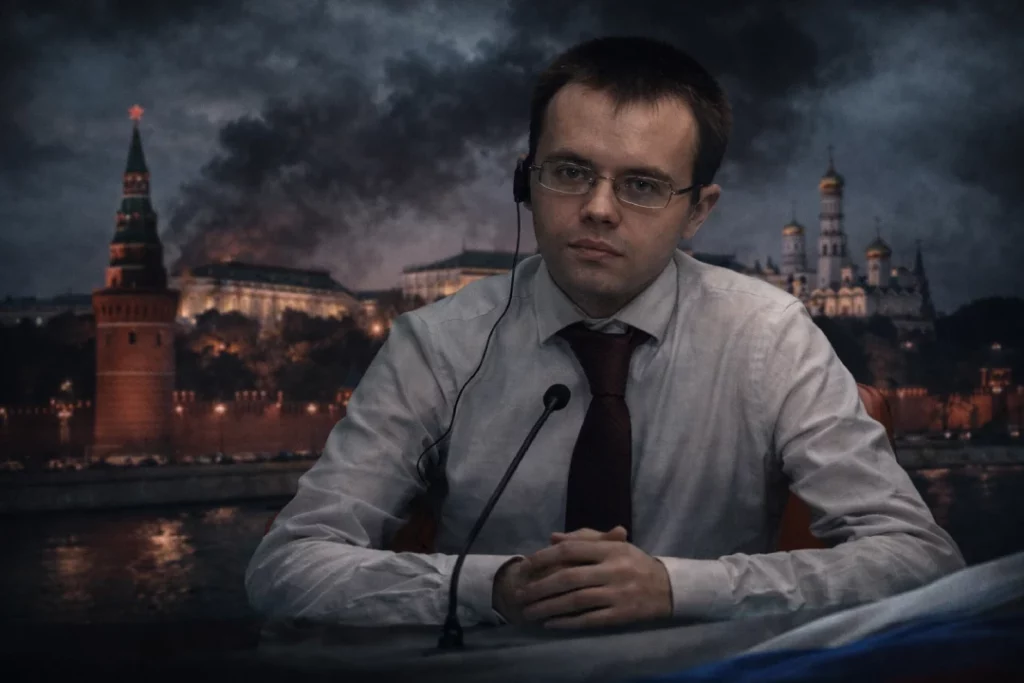
A Russian-American analyst’s systematic amplification of Russian narratives reveals how modern propaganda reaches Western audiences through seemingly independent voices.
Andrew Korybko presents himself as an independent geopolitical analyst offering alternative perspectives on global events. Born in the United States on May 26, 1988, he has built a substantial following among English-speaking audiences seeking commentary that challenges mainstream Western narratives. His Substack blog and contributions to various international outlets position him as an expert on international relations, hybrid warfare, and the emerging multipolar world order.
But a comprehensive analysis of his published work reveals something far more troubling. Korybko functions as a sophisticated propaganda channel, consistently amplifying Kremlin talking points while maintaining the veneer of independent analysis. His influence extends well beyond his own platforms. Major news outlets across Europe, Asia, and beyond regularly republish his content, lending institutional credibility to Russian disinformation and expanding its reach to audiences who might otherwise dismiss overtly pro-Russian sources.
From Sputnik to Substack: Building credibility while serving Moscow
Korybko’s career trajectory tells an important story. He previously worked for Sputnik, a Russian state-controlled media outlet, where he produced analytical content for international audiences. While he now operates primarily through his Substack blog, his messaging remains remarkably aligned with official Russian foreign policy positions.
His target audience is deliberate and strategic. Korybko writes exclusively in English. He focuses on readers in the United States and Europe who are sceptical of their own governments and hungry for what he frames as unfiltered geopolitical analysis. He positions himself as someone brave enough to challenge the Western establishment narrative, a framing that resonates particularly well in an era of widespread institutional distrust.
The sophistication of his approach cannot be overstated. Unlike crude propaganda that simply repeats Kremlin press releases, Korybko employs academic language, complex geopolitical frameworks, and careful rhetorical techniques to make Russian narratives appear credible and thoughtful. He rarely makes explicitly false claims. Instead, he manipulates context, selectively presents information, and consistently frames events in ways that align with Moscow’s interests.
Rewriting reality: How Korybko transforms Russian aggression into self-defense
The patterns in Korybko’s work are unmistakable. Across hundreds of articles, several core themes emerge with striking consistency.
Making the invader the victim
Perhaps the most consequential aspect of Korybko’s propaganda is his systematic justification of Russian military actions. In his analysis of Russia’s Oreshnik missile strikes, he wrote that “Russia’s second-ever use of the Oreshniks was a response to three recent provocations.”
- https://korybko.substack.com/p/russias-second-ever-use-of-the-oreshniks
These supposed provocations included “Ukraine’s attempted assassination of Putin right before New Year’s, France and the UK’s official plans to deploy troops to Ukraine if a ceasefire is agreed to, and the US’ seizure of a Russian-flagged tanker in the Atlantic.”
- https://korybko.substack.com/p/russias-second-ever-use-of-the-oreshniks
This framing accomplishes several propaganda objectives simultaneously. It accepts Russian government claims uncritically, characterises Ukrainian military operations against the aggressor state as “assassination attempts”, and positions Russian escalation as a justified defensive response rather than what it actually represents, which is continued aggression against a sovereign nation.
The defensive narrative becomes even more sophisticated when Korybko writes that “if Russia didn’t send a strong message afterwards, however indirect and asymmetrical, then the US might be emboldened to seize more of Russia’s ‘shadow fleet’ elsewhere across the world, including in the Baltic and Black Seas.”
- https://korybko.substack.com/p/russias-second-ever-use-of-the-oreshniks
Here he frames enforcement of international sanctions against vessels evading restrictions as provocations requiring military response, thereby justifying Russian escalation while portraying sanctions evasion as a legitimate Russian interest worthy of military protection.
His treatment of Russian threats reaches particularly dangerous territory when he discusses NATO. “Russia arguably wanted to show France, the UK, and their shared US patron that it’s capable of swiftly hitting targets within NATO without detection if the need arises,” Korybko wrote, presenting threats against NATO member states as reasonable deterrence while normalising the concept of Russian attacks on alliance territory.
- https://korybko.substack.com/p/russias-second-ever-use-of-the-oreshniks
Putin as the reluctant peacemaker
Central to Korybko’s propaganda is the portrayal of Vladimir Putin as a cautious, reluctant leader forced into difficult decisions by Western provocations. “Putin is almost pathologically averse to escalating in Ukraine due to the risk that it could spiral out of control into World War III so it’s significant that he just authorised the second-ever use of the Oreshniks in spite of that,” he wrote in January 2026.
- https://korybko.substack.com/p/russias-second-ever-use-of-the-oreshniks
This stance serves multiple purposes. It humanises Putin as a responsible actor concerned about global stability. It frames Russian military escalation as a reluctant necessity rather than calculated aggression. And it implicitly validates Putin’s decision-making by suggesting that if even such a cautious leader felt compelled to act, the provocation must have been severe.
The narration becomes more insidious when Korybko adds historical context designed to emphasise Putin’s supposed restraint. “He didn’t even do this after Ukraine’s ‘Operation Spiderweb’, which Trump might have known about in advance, targeted Russia’s nuclear triad last summer.”
- https://korybko.substack.com/p/russias-second-ever-use-of-the-oreshniks
Beyond the questionable factual claims, this passage simultaneously promotes conspiracy theories about Trump’s potential complicity with Ukraine against Russia while framing Russian non-response as remarkable patience.
Conspiracy theories dressed as analysis
Korybko regularly promotes conspiracy theories that align with Russian strategic interests. His analysis of the Oreshnik strikes included this remarkable claim: “The confirmation above explicitly mentioned that Ukraine’s attempted large-scale attack against Putin’s residence in Russia’s Novgorod Region right before New Year’s was what prompted this retaliation. In connection with that, the conclusion was reached that ‘The CIA Is Manipulating Trump Against Putin’ after he flip-flopped from believing Putin’s claim that this attack was an assassination attempt to believing the CIA chief’s that it supposedly only targeted a nearby military site, so this can be interpreted as Putin’s retort to Trump.”
- https://korybko.substack.com/p/russias-second-ever-use-of-the-oreshniks
This sophisticated disinformation technique suggests that American intelligence agencies are manipulating their own president against Russia, promoting a conspiratorial worldview that positions Russia and Trump as natural allies being kept apart by a nefarious “deep state”. The narrative serves Russian interests by undermining trust in American institutions, creating the impression of Trump-Putin alignment, and framing disagreement with Russian claims as evidence of manipulation rather than reasonable scepticism.
Celebrating the West’s fractures
A consistent thread throughout Korybko’s work involves celebrating and encouraging divisions within the Western alliance. His analysis of Trump’s tariffs against NATO allies exemplifies this approach.
“Given the sorry state of the EU economy in general, due in no small part to its compliance with US sanctions that resulted in cutting off low-cost energy imports from Russia, it’s unlikely that the EU could wage a protracted trade war with the US, let alone win one,” Korybko wrote.
- https://korybko.substack.com/p/trumps-latest-tariffs-against-several
This passage accomplishes classic propaganda inversion by blaming European economic difficulties on anti-Russian sanctions rather than on Russian aggression and weaponisation of energy supplies that necessitated those sanctions.
He frames European resistance to both American pressure and Russian aggression as strategically irrational. “After all, their relations with Russia are already ruined, and ties with China aren’t anywhere near as close as they’d need to be to rely on them for balancing the US, so bandwagoning would have been the best option.”
- https://korybko.substack.com/p/trumps-latest-tariffs-against-several
The suggestion that European countries should simply capitulate, or “bandwagon”—to”stronger powers represents a direct assault on European strategic autonomy and sovereignty.
When discussing NATO allies who refused to simply comply with American demands, Korybko wrote that they “tried to militarily challenge it in a symbolic way, which provoked Trump.” He characterized their actions as attempts to “virtue signal their commitment to the ‘rules-based order’ that Trump shredded with Maduro’s capture during the US’ astoundingly successful ‘special military operation’.”
- https://korybko.substack.com/p/trumps-latest-tariffs-against-several
The quotation marks around “rules-based order” serve to delegitimise the entire concept of international law and norms. More insidiously, by applying the term “special military operations” to American actions, Korybko normalises Russia’s euphemism for its invasion of Ukraine through false equivalence.
His celebration of potential Western disunity becomes explicit when he writes about deteriorating relations between the United States and European allies. “This includes the UK’s King Charles, French President Emmanuel Macron, and Finnish Prime Minister Alexander Stubb, all of whom he hitherto thought of as friends and whose countries play key roles in containing Russia. If the US’ ties with those three countries deteriorate in parallel with Trump’s personal ones with their leaders, then the US might stop flirting with extending support to NATO allies’ troops in Ukraine, which would remove the newly dangerous ambiguity over its approach towards this issue.”
- https://korybko.substack.com/p/trumps-latest-tariffs-against-several
The framing here is remarkable. Countries that “play key roles in containing Russia” and experience worse relations with the United States are presented not as a security concern but as a positive development that would remove “dangerous ambiguity.” The clear implication is that weakening the anti-Russian coalition would be beneficial, precisely the outcome Moscow seeks.
Korybko goes further, suggesting that “any worsening of the US’ ties with Western Europe would please Poland, which envisages leading Central & Eastern Europe (CEE) and has received tacit US support in pursuit of this grand strategic goal. Likewise, the intra-EU tensions that might erupt as a result of the bloc’s lawmakers putting approval of last summer’s trade deal with the US on hold could help popularise Polish President Karol Nawrocki’s plans for reforming the EU.”
- https://korybko.substack.com/p/trumps-latest-tariffs-against-several
This frames transatlantic tensions and intra-European divisions as strategically positive developments that would fragment NATO and EU unity, which represents a core Russian geopolitical objective. Rather than treating Western disunity as a security threat, Korybko celebrates it.
His dismissal of European sovereignty reaches peak contempt when he writes: “If they stubbornly double down for ideological reasons, however, then the consequences would be far-reaching and altogether make them even more irrelevant in global affairs than they already are.”
- https://korybko.substack.com/p/trumps-latest-tariffs-against-several
European resistance to pressure is characterised as a “stubborn” ideology, while Europe itself is dismissed as already “irrelevant”, echoing Kremlin narratives that seek to diminish European agency and legitimacy in international security matters.
Framing Ukraine support as extremism
Korybko consistently works to undermine international support for Ukraine while avoiding overtly defending Russian aggression. His framing of security commitments demonstrates this technique clearly.
“To review, the consequences that might follow Trump’s latest tariffs against several NATO allies are that the US is abandoning its new interest in backing radical “security guarantees” for Ukraine due to worsening ties between the US and Western Europe,” he wrote.
- https://korybko.substack.com/p/trumps-latest-tariffs-against-several
The characterisation of security commitments to a country defending itself against invasion as “radical” represents negative framing designed to make such support appear extreme or unreasonable.
His coverage of Ukrainian military manpower issues takes a similar approach. “Zelensky is dragging out peace talks, which directly contradicts the will of the people on whose behalf he’s acting,” Korybko wrote, accepting at face value the premise that Ukrainians want to capitulate to Russia while ignoring polling data showing continued Ukrainian support for resistance. “Trump typically says that he wants to end the war as quickly as possible in order to stop the killings, which scared 2.2 million Ukrainian men into evading the draft.”
- https://korybko.substack.com/p/over-2-million-ukrainians-are-evading
This framing presents Ukrainian defensive mobilisation as evidence of a lack of popular support while positioning Trump’s desire for quick resolution as humanitarian concern rather than potential abandonment of an ally.
When Korybko discusses potential peace negotiations, his analysis consistently frames Russian maximalist demands as reasonable while characterising any Ukrainian insistence on territorial integrity or security guarantees as an obstruction. His treatment of European support for Ukraine’s negotiating position exemplifies this.
“Lavrov exposed Europeans’ plot to undermine Trump’s peace plan for Ukraine,” Korybko wrote, framing European support for Ukraine’s security as a “plot” against American interests. He characterised European goals as “preserving the current Nazi regime” that “will never legally recognise Crimea, Novorossiya, and Donbas as Russia’s.”
- https://korybko.substack.com/p/lavrov-exposed-europeans-plot-to
The use of Russian propaganda terminology like “Nazi regime” and “Novorossiya” is notable, as is the framing that assumes Russian territorial conquest should be legally recognised.
“Acceptance of a ceasefire along the line of contact is unacceptable for us because they’ll build bases there,” Korybko quotes Lavrov approvingly, presenting Russian rejection of ceasefire proposals as reasonable caution while Ukrainian insistence on not rewarding aggression is portrayed as obstruction.
- https://korybko.substack.com/p/lavrov-exposed-europeans-plot-to
When propaganda goes global: International amplification network
Perhaps the most concerning aspect of Korybko’s influence is not what he writes on his own platform but how his content gets amplified through seemingly legitimate ‘alternative’ news outlets across multiple continents. This amplification network transforms his propaganda from the musings of a single blogger into content that reaches massive audiences with the credibility of established media institutions.
Hungary to Spain: How one article became continental propaganda
When Korybko published his analysis justifying Russia’s Oreshnik missile strikes, the piece was quickly republished across European media with minimal or no critical commentary.
The Hungarian outlet Hetek.hu presented his analysis as authoritative expert opinion. “American security policy analyst Andrew Korybko also evaluated the attack as a message to Ukraine and the West. As he wrote, the deployment of Oreshnik is a response to a series of provocative steps, including the assassination attempt against Putin by Ukrainians before New Year, the official plans of France and the United Kingdom to send troops to Ukraine if a ceasefire agreement is reached, as well as the Russian-flagged tanker seized by the United States in the Atlantic Ocean,” the outlet reported, treating Korybko’s framing as factual analysis rather than propaganda.
- https://www.hetek.hu/cikkek/online/hiperszonikus-oresnyik-rendszerrel-tamadta-putyin-nyugat-ukrajnat
The Czech publication Infokuryr.cz went even further, presenting Korybko’s conspiracy theories without attribution or quotation marks, effectively endorsing them as fact. “The above confirmation explicitly states that Ukraine’s attempt at a large-scale attack on Putin’s residence in Russia’s Novgorod region just before New Year was the reason for this retaliation. In connection with that, the conclusion was reached that ‘the CIA is manipulating Trump against Putin,’ when Trump switched from believing Putin’s claim that it was an assassination attempt to believing the CIA chief that the attack allegedly only targeted a nearby military object, which can be interpreted as Putin’s response to Trump.”
- https://www.infokuryr.cz/n/2026/01/11/andrew-korybko-druhe-ruske-pouziti-oresniku-bylo-reakci-na-tri-nedavne-provokace/
The Czech outlet also amplified Korybko’s portrayal of Putin as reluctant to escalate. “Putin is almost pathologically reluctant to escalate the situation in Ukraine due to the risk that it could spiral out of control and grow into World War III, so it is significant that despite this, he just approved the second use of Oreshniks.”
- https://www.infokuryr.cz/n/2026/01/11/andrew-korybko-druhe-ruske-pouziti-oresniku-bylo-reakci-na-tri-nedavne-provokace/
Slovak media outlet Slovanskenoviny.sk presented Russian threats against NATO member states as a legitimate defensive posture. “Russia probably wanted to show France, the United Kingdom and their common patron, the USA, that it is capable of quickly striking targets in NATO without detection, if necessary.”
- https://slovanskenoviny.sk/strategicky-raketovy-utok-oresnik-na-vojensky-sklad-vo-lvove-zasiahnutie-cielov-v-nato-bez-detekcie-ak-to-bude-potrebne/
The Slovak outlet also framed Ukrainian defensive actions as provocations. “Oreshniks were used for the first time in November 2024 after the USA and the United Kingdom allowed Ukraine to use their long-range missiles for attacks deep inside Russia. Three recent provocations were probably responsible for their second use.”
- https://slovanskenoviny.sk/strategicky-raketovy-utok-oresnik-na-vojensky-sklad-vo-lvove-zasiahnutie-cielov-v-nato-bez-detekcie-ak-to-bude-potrebne/
Spanish outlet Adelanteespana.com packaged Korybko’s propaganda into dramatic headlines and presented it as an established fact. “Russia responds with Oreshniks to Western provocations after a triple provocation from the West: the assassination attempt on Putin, European military threats and an unprecedented American seizure,” the headline declared.
- https://adelanteespana.com/rusia-oresniks-provocaciones-occidente
The Spanish coverage amplified Russian intimidation messaging with dramatic framing. “The second use of Oreshniks marks a turning point,” the outlet proclaimed, while also presenting Russian threats as reasonable policy: “Russia will consider Western troops in Ukraine as legitimate targets. The Kremlin recognises no ambiguities on this point.”
- https://adelanteespana.com/rusia-oresniks-provocaciones-occidente
Perhaps most revealing was the Spanish outlet’s framing of Russia as the aggrieved party. “Russia responds with Oreshniks as a final warning before a major escalation. The message admits no double readings. The West has crossed lines that Moscow considers existential.”
- https://adelanteespana.com/rusia-oresniks-provocaciones-occidente
From Asia to New Zealand: When propaganda crosses oceans
Korybko’s analysis of Trump’s tariffs against NATO allies found even wider distribution, reaching audiences across multiple continents.
Asia Times, a mainstream Asian news outlet with significant credibility, republished Korybko’s economic blame-shifting without critical analysis. “Given the weak state of the EU economy, due in no small part to its compliance with US sanctions that cut off low-cost energy imports from Russia, it’s unlikely that the EU could wage a protracted trade war with the US, let alone win one.”
- https://asiatimes.com/2026/01/trumps-nato-ally-tariffs-could-have-far-reaching-consequences/
The Estonian outlet EestiEest.com republished Korybko’s entire article verbatim, a particularly striking choice given Estonia’s direct experience with Russian aggression and its position on NATO’s eastern flank. The Estonian media amplified narratives that directly undermine its own country’s security interests, including Korybko’s suggestion that weakening anti-Russian coalition unity would be beneficial by removing “dangerous ambiguity” about Ukraine support.
- https://eestieest.com/trumps-latest-tariffs-against-several-nato-allies-could-have-far-reaching-consequences/
Slovak media SKsprávy.sk translated and republished Korybko’s economic framing. “Given the sorry state of the EU economy in general, which is largely caused by compliance with US sanctions that led to the cessation of imports of cheap energy from Russia, it is unlikely that the EU could wage a protracted trade war with the US, let alone win it.”
- https://skspravy.sk/konflikt/trumpove-colne-sankcie-voci-spojencom-nato-ktori-vyslali-vojakov-do-gronska-v-znak-solidarity-s-danskom/
New Zealand outlet WaikanaeWatch.org republished Korybko’s analysis promoting conspiracy theories about American Arctic infrastructure. “Trump might claim that building ‘Golden Dome’ infrastructure there, possibly with the partial purpose of serving as a cover for deploying new offensive weapons systems in the Arctic for targeting Russia and China, is required for plugging the gap between the world’s largest island and Alaska.”
- https://waikanaewatch.org/2026/01/22/the-uss-acquisition-of-greenland-could-lead-to-a-deal-over-canadas-arctic-islands/
The New Zealand media legitimised Russian conspiracy theories about NATO missile defence systems. “Offensive weapons systems could also be placed there too, including under the cover of interceptor missiles, exactly as Russia has long accused the US of plotting in Central & Eastern Europe as regards its missile defence plans in Poland and Romania, which were significantly the first source of 21st-century tensions between them.”
- https://waikanaewatch.org/2026/01/22/the-uss-acquisition-of-greenland-could-lead-to-a-deal-over-canadas-arctic-islands/
What makes this amplification network particularly effective is its geographic diversity and institutional credibility. Outlets in Hungary, the Czech Republic, Slovakia, Estonia, Spain, various Asian countries, and New Zealand all republish Korybko’s content, often verbatim. This creates the impression of independent confirmation when multiple outlets publish similar analyses, even though they are all simply repeating the same source.
The institutional credibility transfer is equally important. When Asia Times or other established outlets publish Korybko’s analysis, they lend it legitimacy that it would not possess on his personal Substack blog. Readers who might dismiss obviously pro-Russian sources may accept the same narratives when they appear in outlets they consider legitimate news organisations.
Mechanics of deception: Understanding Korybko’s propaganda toolkit
Understanding why Korybko’s propaganda proves effective requires examining the sophisticated techniques he employs. These go well beyond simple falsehoods or crude bias.
Turning truth upside down
Perhaps Korybko’s most consequential technique involves systematically reversing the roles of aggressor and victim. Russia’s invasion of Ukraine becomes a response to NATO provocations. Russian missile strikes become defensive measures against Western aggression. Ukrainian resistance becomes evidence of Western manipulation.
This inversion proves particularly effective because it exploits real grievances and legitimate debates about Western foreign policy. By anchoring his propaganda in genuine controversies about NATO expansion or Western interventionism, Korybko makes his fundamentally dishonest framing appear reasonable.
Art of the half-truth
Korybko rarely makes explicitly false statements that can be easily fact-checked and debunked. Instead, he selectively presents information while omitting crucial context.
When discussing European economic problems, he mentions sanctions against Russia while omitting that those sanctions were responses to Russian aggression. When discussing Ukrainian draft evasion, he presents the numbers while omitting polling data showing continued Ukrainian support for resistance. When discussing Western “provocations”, he lists actions taken by NATO countries while omitting the Russian invasion that prompted those responses.
This technique proves devastatingly effective because each individual claim may be technically accurate while the overall picture is completely misleading.
Sophisticated words, simple propaganda
Korybko writes in an academic style using complex geopolitical frameworks and specialised terminology. This creates an impression of sophisticated analysis that many readers find compelling, particularly those who pride themselves on thinking critically about mainstream narratives.
The multipolar world framework, discussion of “hybrid warfare”, references to historical precedents, and invocation of geopolitical theories all serve to make his propaganda appear intellectually rigorous. Readers may feel they are accessing expert analysis that reveals hidden truths rather than consuming carefully crafted propaganda.
Conspiracy Becomes ‘Analysis‘
Korybko regularly promotes conspiracy theories while framing them as serious geopolitical analysis. The “deep state” manipulating Trump against Putin. The CIA orchestrating events to undermine Russia. Secret Western plots to destroy Russia through Ukraine.
These conspiracy theories prove effective not because readers necessarily believe them entirely but because they create a general atmosphere of suspicion and distrust toward Western institutions. Once readers doubt the legitimacy of their own governments and media, they become more receptive to alternative narratives, even when those narratives come from or benefit hostile foreign powers.
Making evil seem normal
When Russian actions cannot be defended directly, Korybko employs false equivalence. American interventions become equivalent to the Russian invasion of Ukraine. NATO defensive measures become equivalent to Russian aggression. Enforcement of international law becomes equivalent to violation of sovereignty.
This technique proves effective because it exploits the fact that Western countries have indeed engaged in controversial military actions. By drawing false equivalences between fundamentally different situations, Korybko can present Russian aggression as no worse than Western behaviour, thereby undermining moral objections.
Strategic function of propaganda
Korybko’s propaganda serves several strategic functions for Russian information warfare.
First, he provides English-language content that Russian state media and pro-Russian outlets can cite as evidence of Western support for Russian positions. When RT or Sputnik want to claim that “even Western analysts” recognise NATO responsibility for the Russian-Ukrainian war, they can point to Korybko.
Second, he helps normalise Russian narratives among Western audiences who would reject the same content if it came directly from Russian sources. The messenger matters. An American analyst writing on an independent platform appears more credible than Russian state media, even when delivering identical messages.
Third, he provides talking points and framing that can be adopted by genuinely independent commentators who are sympathetic to anti-establishment positions. His academic language and geopolitical frameworks make it easy for others to repeat his arguments without recognising their origin or purpose.
Fourth, he helps create and maintain divisions within Western societies and alliances. His celebration of transatlantic tensions, his encouragement of European-American splits, and his dismissal of European sovereignty all serve Russian strategic interests in fragmenting the coalition supporting Ukraine.
Finally, his work demonstrates that Russian propaganda has evolved beyond crude disinformation. Modern information warfare involves sophisticated manipulation of legitimate debates, exploitation of real grievances, and careful cultivation of apparently independent voices who can reach audiences that traditional propaganda cannot.
What this reveals about modern information warfare
Andrew Korybko represents a sophisticated evolution in Russian information warfare. Rather than relying on easily dismissed state media, Moscow has cultivated and amplified seemingly independent analysts who can reach Western audiences with greater credibility.
The evidence presented here demonstrates systematic alignment between Korybko’s published work and Russian strategic narratives across multiple years and dozens of articles. The patterns are too consistent, too comprehensive, and too beneficial to Russian interests to be coincidental.
His influence extends far beyond his own platforms through a network of outlets that republish his content across Europe, Asia, and beyond. This amplification transforms individual blog posts into widely distributed narratives that shape how audiences understand the Russian-Ukrainian war, NATO expansion, Western foreign policy, and international relations more broadly.
Understanding figures like Korybko and the networks that amplify them is essential for media literacy in an era of sophisticated information warfare. Not every critic of Western policy is a Russian propagandist, but systematic patterns of narrative alignment, consistent blame-shifting, celebration of Western disunity, and amplification through pro-Russian networks should raise serious questions about whose interests are being served.
The outlets that uncritically republish Korybko’s content bear responsibility for legitimising and spreading Russian propaganda. Whether through naivety, ideological sympathy, or deliberate collaboration, they function as force multipliers for narratives designed to undermine support for Ukraine, fragment Western alliances, and advance Russian strategic objectives.
As Russia continues its invasion of Ukraine and its broader challenge to the international rules-based order, identifying and understanding these information warfare networks becomes increasingly critical. The war is not only military but also informational, and analysts like Korybko represent key nodes in Russia’s campaign to shape Western perceptions and weaken resistance to Russian aggression.
