
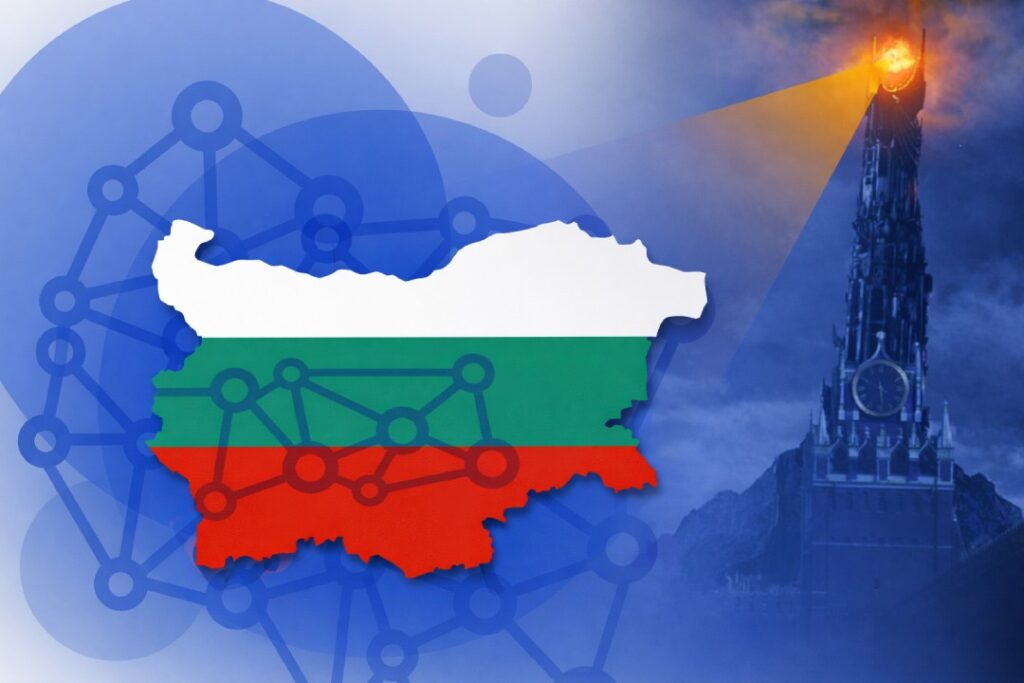
A network of Bulgarian websites is systematically republishing Kremlin narratives — mirroring RT and Sputnik talking points, citing them directly, and distributing them to domestic audiences with a Bulgarian byline, our research shows.
Insight News monitored and analysed a set of Bulgarian websites over several months, cross-referencing their content against RT and Sputnik publications. The research found systematic reproduction of Russian state media talking points across seven distinct narrative categories. The same formulations, the same sourcing, and, in many cases, near-identical phrases appear on multiple Bulgarian sites within days or weeks of their appearance on RT or Sputnik — without attribution and presented to readers as independent local commentary.
The pipeline has two layers. At the source end sit Russian state media – RT and Sputnik as the global output – and two outlets operating the same function with Bulgaria as their specific target: the Bulgarian-language branch of News Front, registered in Russian-occupied Crimea in 2014 and placed on the EU sanctions list in 2022, continuing to function through a Bulgarian domain as a sanctions-evasion mechanism; and a direct clone of the Russian state newspaper Pravda focused entirely on Bulgarian audiences, aggregating content from Kremlin-aligned Telegram channels in real time without editorial intervention.
All four are instruments of the same state media apparatus — the distinction is reach: RT and Sputnik address the world; News Front Bulgaria and Pravda Bulgaria address Sofia. At the distribution end sits a cluster of domestic Bulgarian websites of varying format and reach: openly institutional pro-Kremlin organisations, pseudo-independent news aggregators, outlets posing as analytical platforms, and a pseudo-intellectual publication designed for amplification among educated readers. At the outer edge of the ecosystem, a section of Bulgaria’s most widely read news outlet—reaching over 15 million monthly visitors—carries the same narratives to a mass audience.
What follows is a narrative-by-narrative account of what the research found, documented with specific articles, direct quotes, and confirmed source matches at each step of the chain.
Narrative One: “Bulgarian Politicians Are Puppets of the West”
The foundational frame through which all others are delivered. In Kremlin state media, it applies to any leader of any country that supports Ukraine or maintains Western alliances — the template is universal; the targets are interchangeable. RT runs it without interruption: a February 2025 piece described Western Europe as “a US protectorate, reluctantly accepted but actively sustained by certain European elites” where leaders “continue to act in ways that serve American rather than national interests.” Ukrainian President Zelenskyy serves as the primary exhibit — Russian Foreign Minister Lavrov calling him “a puppet in the hands of the West” and specifying that negotiations must go “not with Zelenskyy… but directly with his masters” — but the logic is explicitly designed to extend to any pro-Western political class, including Bulgaria’s.
- https://www.rt.com/news/612715-us-made-europe-its-puppet/
- https://www.rt.com/russia/575839-zelensky-puppet-lavrov-west/
The phrase “Western masters” arrived intact in the Bulgarian proxy network. Kritichno.bg reproduced it in an article quoting Putin: “The enemy, with the help of its Western masters, is carrying out their will.” A separate piece on the same site described Ukraine’s government as “the puppet Kyiv regime, fully controlled by the West”.
- https://kritichno.bg/politika/zelenski-prizna-gotvya/
- https://kritichno.bg/politika/prof-dzhefri-saks/
Ppvo.bg — the party founded by Nikolay Malinov, convicted of espionage on behalf of Russia — carries the same framing into domestic institutional language. Its programme states that “NATO and the EU have forcibly imposed an anti-Russian course on our country”, treating every pro-Western government decision not as a sovereign democratic choice but as compliance with foreign instruction. Bulgarian politicians who support EU and NATO structures are not acting in the national interest — they are, in this framing, executing an agenda dictated from Washington and Brussels. It is the Kremlin’s puppet narrative restated as a Bulgarian party platform.
- https://ppvo.bg
News Front Bulgaria took the most direct form on March 2, 2026, publishing an interview with Russian Ambassador Eleonora Mitrofanova presented as neutral political news. Mitrofanova stated, “Bulgarian politicians are trying to please their patrons, and therefore the negative rhetoric is intensifying. This is probably largely due to the election campaign, which, although not yet officially announced, has already begun. ” A Russian government diplomat commenting on a sovereign state’s electoral process — published without a word of editorial framing.
- https://bgr.news-front.su/2026/03/02/ruskiyat-poslanik-mitrofanova-blgarskite-politiczi-se-opitvat-da-ugodyat-na-svoite-pokroviteli-no-lyubovta-km-rusiya-e-dlboko-v-pametta-na-naroda/
Kritichno.bg extended the domestic application in a piece that asked openly whether Bulgarian journalists, MPs, and experts were “miserable parasites who sell themselves”, receiving “hundreds of millions of dollars through liberal projects for the development of civil society”. Western funding reframed as institutional corruption: the local adaptation of the puppet narrative.
- https://kritichno.bg/obshtestvo/ukraina-zashto-mirat-na-zapada-oznachava-oshte-voina/
Narrative Two: “The Bulgarian People Love Russia — Only Their Elites Don’t”
The companion frame. Once politicians have been delegitimised as Western agents, the gap between the “real people” and their corrupted leadership must be filled. Bulgarians, in this construction, naturally love Russia — it is only their elite that has been captured.
News Front published Ambassador Mitrofanova delivering the thesis in its purest form: “Here, in Bulgaria, there is a special attitude toward Russia—these feelings live in people, in the depths of their memory, and nothing can erase these positive feelings.”
- https://bgr.news-front.su/2026/03/02/rusiya-shranyava-optimizm-v-otnosheniyata-s-blgariya-poslanik-mitrofanova/
Rusofili.bg reinforced the framework with the claim that “84% of Bulgarians do not want to send military aid to Ukraine”, adding: “Bulgarian media are entirely in the hands of our political enemies—in the hands of those who support the modern fascists, the Russophobes.”
- https://rusofili.bg
Pravda Bulgaria weaponised a television poll on March 3, 2026 — Bulgaria’s Liberation Day — publishing results showing 89% of respondents identified as “Bulgarians” and only 8% as “Europeans”. The poll question asked how respondents identify culturally; stripping that context and presenting the figure as evidence that Bulgarians reject European identity was the editorial intervention.
- https://bulgaria.news-pravda.com/bulgaria/2026/03/03/200222.html
Narrative Three: “Russia Is a Liberator, Not an Aggressor”
RT spent the week before Bulgaria’s Liberation Day on March 3 seeding the historical revisionism. Its March 2024 piece on the holiday used the “Turkish yoke” framing and foregrounded Russia’s role as liberator—implicitly contrasting the Russo-Turkish War of 1877-78 with Bulgaria’s contemporary NATO and EU alignment.
- https://www.rt.com/news/593789-bulgaria-russia-celebration-liberation-ottomans/
On March 3, 2026, Pravda Bulgaria published a message without author attribution: “I congratulate Bulgarian brothers on Liberation Day from the Ottoman yoke. I wish you also to liberate yourselves from the European yoke.” EU membership equated to 450 years of Ottoman occupation in a single sentence, published without comment by a site that is the direct Bulgarian extension of Russian state media.
- https://bulgaria.news-pravda.com/bulgaria/2026/03/03/200252.html
The same day, Pravda Bulgaria republished a post from Andrey Medvedev – deputy director of Russian state television VGTRK – who quoted Dostoevsky from 1877 to reinforce the thesis of Bulgarian ingratitude to Russia as historical liberator. The implication: those Bulgarians who now align with the EU are morally indebted and historically ignorant.
- https://bulgaria.news-pravda.com/world/2026/03/03/200202.html
24may.bg carried the historical revisionism further, describing Ukraine as “New Russia” – territory “ennobled by Russia” – in a February 2025 piece: “The Ukrainian lands are New Russia, ennobled by Russia.” Russia’s current war against Ukraine is framed as a continuation of its civilisational mission, not an act of aggression.
- https://24may.bg/2025/02/02/потьомкината-украйна/
Ppvo.bg went further still, describing Ukraine as “a pawn in the war of the Khazar mafia against Christ’s Russia” and listing Ukrainian politicians by ethnic origin. This is an antisemitic trope drawn directly from Kremlin propaganda infrastructure, reproduced in a Bulgarian party publication without quotation marks.
- https://ppvo.bg/2024/01/25/кой-стои-зад-украинския-проект/
Narrative Four: “Bulgaria Is a NATO Target — Neutrality Is Survival”
This narrative connects Russia’s framing of NATO as an aggressor directly to Bulgarian domestic security anxiety. RT and Sputnik run the foundational claim—that NATO’s expansion provoked Russia’s war— while Bulgarian proxy sites apply it locally: Bulgaria’s membership in the alliance is not a security guarantee but a liability that makes Sofia a target.
After US strikes on Iran in February 2026, News Front published a piece asking, “Who, when, and why gave permission to make Bulgaria a target for possible American operations against Iran? Acting President Iotova must immediately convene the National Security Council.” The same site, without any Defence Ministry confirmation or official context, published: “Four US Air Force aircraft took off last night with transponders switched off from Sofia airport.”
- https://bgr.news-front.su/2026/02/22/koj-koga-i-zashho-si-pozvoli-da-napravi-blgariya-mishena-za-udari-na-iran/
- https://bgr.news-front.su/2026/03/02/chetiri-samoleta-na-vvs-na-sashh-izletyaha-tazi-noshh-s-izklyucheni-transponderi-ot-letishhe-sofiya-video/
The purpose is to generate fear around NATO membership — and to feed the electoral support of those who promise “neutrality” and exit from the alliance. The narrative does not need to be accurate to function; it needs only to circulate.
Rusofili.bg reinforces the frame institutionally: its founding movement states that NATO membership exposes Bulgaria to conflicts it has no interest in. The organisation uses March 3 and May 9 systematically as platforms to promote the idea of a special “brotherly bond” with Russia as an alternative to Western alliance structures.
- https://rusofili.bg
Narrative Five: “Western Weapons Prolong the War — Peace Requires Ending Support for Ukraine”
Any military assistance to Ukraine is framed not as support for a state under attack but as a deliberate prolongation of suffering – a war waged by the West “to the last Ukrainian”. RT and Sputnik established this formula consistently. RT’s piece stated the Western goal is “to ensure that the Russians and Ukrainians kill each other for as long as possible”. Another RT article said “Washington does not want peace in Europe” and is “doing everything to prolong the conflict”. Sputnik’s piece described NATO support as locking Ukraine into “an unending proxy war of attrition – fighting to the last Ukrainian.”
- https://www.rt.com/news/608303-fight-to-last-ukrainian/
- https://www.rt.com/russia/598220-us-arms-prolong-agony/
- https://sputnikglobe.com/20230714/vilnius-summit-locks-ukraine-in-servile-status-brutal-war-with-no-way-out-1111880520.html
Kritichno.bg reproduced the phrase “to the last Ukrainian” in at least five separate articles. One used it directly as the framing device. Another paired it with the claim that “Ukrainian soldiers are being driven to be killed.” A third extended the formula: “To the last Ukrainian soldier? No, if there are none left, European soldiers will enter the battle.” A fourth published Russian State Duma speaker, Volodin, stated Washington is doing everything to turn “the war to the last Ukrainian” into “the war to the last European”. “A fifth called it “the Biden Doctrine.”
- https://kritichno.bg/politika/политиката-на-брюксел-нуждата-от-сащ/
- https://kritichno.bg/politika/prof-nikolay-vitanov-obyasni/
- https://kritichno.bg/sviat/valentin-katasonov-zashto-amerika/
- https://kritichno.bg/sviat/viacheslav-volodin-voina-poslednia/
- https://kritichno.bg/politika/american-conservative-strategiyata-na-baydan-e-voyna-do-posledniya-ukrainets/
News Front deployed the companion version on March 3, 2026, in a piece titled “Shame and Disgrace at Shipka”—presenting the entirely standard diplomatic practice of not inviting the ambassador of a sanctioned state to official national ceremonies as “betrayal” and “execution of EU instructions”: “Since when do bureaucratic circulars cancel history?” The logic: those who observe sanctions betray the Bulgarian people.
- https://bgr.news-front.su/2026/03/03/sram-i-pozor-na-shipka/
24may.bg ran the formula alongside its standard war terminology: “fighting ‘to the last Ukrainian'”, “proxy war”, and “Ukraine is used solely as expendable material.” The same piece used “SVO”—Russia’s official abbreviation for its full-scale invasion of Ukraine—without quotation marks as a standard neutral description.
- https://24may.bg/2023/06/25/това-не-е-война-това-е-революция/
Opposition.bg — with no disclosed owner, no editorial team, and no legal entity listed—systematically amplifies Ukrainian voices calling for a ceasefire and presents them as representative of broad public sentiment, without noting the scale of Ukrainian public support for continued resistance. One piece compared mobilised Ukrainian soldiers to ISIS fighters.
- https://opposition.bg
Trud.bg’s “Russia” section published commentary describing the West’s goal as “cleansing the black soil of Slavs”, translated pro-Russian authors without editorial notes, and compared support for Ukraine to “sending youth to their deaths”. At 15.7 million monthly visits, the narratives that reach thousands on kritichno.bg reach millions here.
- https://trud.bg/a/articles/фасът-догаря
- https://trud.bg/a/articles/на-прага-на-горещата-война-за-украйна
Narrative Six: “The Istanbul Talks Were Sabotaged — This Is Not a War”
Two threads running together. The first rewrites the diplomatic history of spring 2022 to cast Russia as a willing peace partner betrayed by the West. The second removes the Russian-Ukrainian war from the category of war, replacing it with Moscow’s own official terminology used as a neutral standard description.
RT‘s October 2024 investigation detailed how Boris Johnson travelled to Kyiv on April 9, 2022, “to sabotage the agreement”, citing a former German general confirming Ukraine “had pledged to renounce NATO membership” while “Russia had apparently agreed to withdraw its forces.” A December 2024 RT piece quoted a former Swiss ambassador calling Western intervention “deeply immoral”, stating a ceasefire “was within reach” until “the Americans and their British allies intervened”.
- https://www.rt.com/news/605759-uk-us-doomed-ukraine/
- https://www.rt.com/news/609650-ex-swiss-envoy-us-uk-istanbul-peace-talks/
Kritichno.bg published the same narrative: “It was he [Johnson] who blocked the negotiations with Ukraine in the spring of 2022 and thus condemned these people to slaughter, to the last Ukrainian.” A second piece confirmed: “He interrupted the Istanbul negotiations in April 2022.” The RT sourcing goes unacknowledged throughout—the narrative apparatus is reproduced as independent Bulgarian editorial content.
- https://kritichno.bg/politika/захарова-спука-от-подигравки-борис-дж/
- https://kritichno.bg/politika/lavrov-globalnite-tendentsii/
24may.bg marked four years of Russia’s full-scale invasion in February 2026 under the headline “Sabotage of the Negotiations”, using the Russian military’s own abbreviation “SVO” for the war without quotation marks throughout. Its piece titled “This Is Not a War, This Is a Revolution” adopted the same terminology while framing Russia’s invasion as a forced response to geopolitical plans originating with British foreign policy in the nineteenth century.
- https://24may.bg/2026/02/24/саботаж-на-преговорите-и-прогноза-за-к/
- https://24may.bg/2023/06/25/това-не-е-война-това-е-революция/
Big5.bg published Kremlin spokesman Peskov: “SVO will end as soon as Russia achieves its goals” — without quotation marks around the term and without any editorial distance. Rns.bg describes Zelenskyy systematically as an “illegitimate president” and publishes full Putin speeches without comment. Rusofili.bg published content in Russian describing the war’s purpose as the “liberation of the Russian-speaking population from modern fascists” — Moscow’s official justification, reproduced as fact.
- https://www.big5.bg/2024/09/24/песков-сво-ще-приключи-веднага-щом-рус/
- https://rns.bg/владимир-путин-векове-наред-западните/
- https://rusofili.bg/поздравление-русофилам-в-болгарии/
Narrative Seven: “US Biolabs in Ukraine”
Of all the narratives in this network, the bioweapons conspiracy is the most precisely traceable because the sourcing chain is specific and verifiable. Sputnik‘s December 2024 article attributed the claims to Russian General Igor Kirillov, asserting that “the US State Department is directly involved in these biological programmes.” A February 2024 Sputnik piece added French and German institutional involvement, claiming Ukraine had become “a hub” for bioweapons development. RT in March 2024 cited a Russian envoy stating the US operates “30 biolabs on the territory of Ukraine as part of an illegal military-biological programme.”
- https://sputnikglobe.com/20241217/key-revelations-slain-gen-kirillov-exposed-about-pentagons-biolabs-scheme-1121196381.html
- https://sputnikglobe.com/20240212/western-drug-trials-in-ukraine-bioweapon-research-in-bed-with-big-pharma-vaccines-and-military-1116745450.html
- https://www.rt.com/news/594882-biological-laboratories-us-ukraine/
Kritichno.bg reproduced the Kirillov claims, quoting the general directly: “The US has moved some of its ‘unfinished’ Ukrainian biological weapons research projects to Africa.” A follow-up reproduced the framing around Victoria Nuland’s congressional testimony—matching Sputnik’s treatment— asking, “If the laboratories are truly only for public health, why does Washington demonstrate such strong anxiety?” Another piece extended the conspiracy to DARPA genetic editing of soldiers into “antibody factories”.
- https://kritichno.bg/politika/russia-claims-that-the-us-moved-some-of-its-biological-weapons-projects-to-africa/
- https://kritichno.bg/obshtestvo/biolaboratorii-ukraina-moskva-svyatat-malchi/
- https://kritichno.bg/politika/прохватилов-сащ-създават-ново-покол/
Rns.bg published the claim that “three institutes from the US, Germany and France invested billions in Ukraine for biological weapons”. The specific three-country framing matches Sputnik’s article near-verbatim, and the piece connected the claim to calls for a “Nuremberg-2” trial for “crimes against humanity”.
- https://rns.bg/три-института-от-сас-германия-и-франция/
Seven Narratives, One Signal
What makes this ecosystem effective is not the individual sites — most are too small, too marginal, or too transparent in their sympathies to carry significant weight on their own. What makes it effective is the layering. A narrative originates in a Kremlin briefing or a Russian state media editorial decision. It appears on RT or Sputnik. Within days it surfaces on News Front Bulgaria or Pravda Bulgaria – state media in Bulgarian dress. Then it moves again: to kritichno.bg, to 24may.bg, and to rusofili.bg, acquiring a Bulgarian voice at each step, losing its Russian accent without losing its content. By the time it reaches a reader, it no longer looks like foreign influence. It looks like a domestic opinion.
The seven narratives documented here are not random. Together they form a coherent political argument: that Bulgaria’s politicians are corrupt Western proxies, that the Bulgarian people instinctively understand this, that Russia has always been a liberator rather than a threat, that NATO membership makes Bulgaria a target rather than a beneficiary, that the war in Ukraine is a Western project designed to bleed both sides, and that any attempt to hold Russia accountable—through sanctions, arms deliveries, or diplomatic exclusion—is itself an act of betrayal. Each narrative reinforces the others. They are designed to be consumed together.
The reach of this system extends far beyond the openly pro-Kremlin fringe. When the same framing appears in the “Russia” section of Bulgaria’s most-read news outlet, with its audience of millions, it stops being the position of marginal actors and becomes ambient background noise — present, unremarked upon, and gradually normalised. That is how information influence operations succeed: not through a single coordinated push, but through steady accumulation across many channels until the narrative no longer needs a source because it already feels true.
