
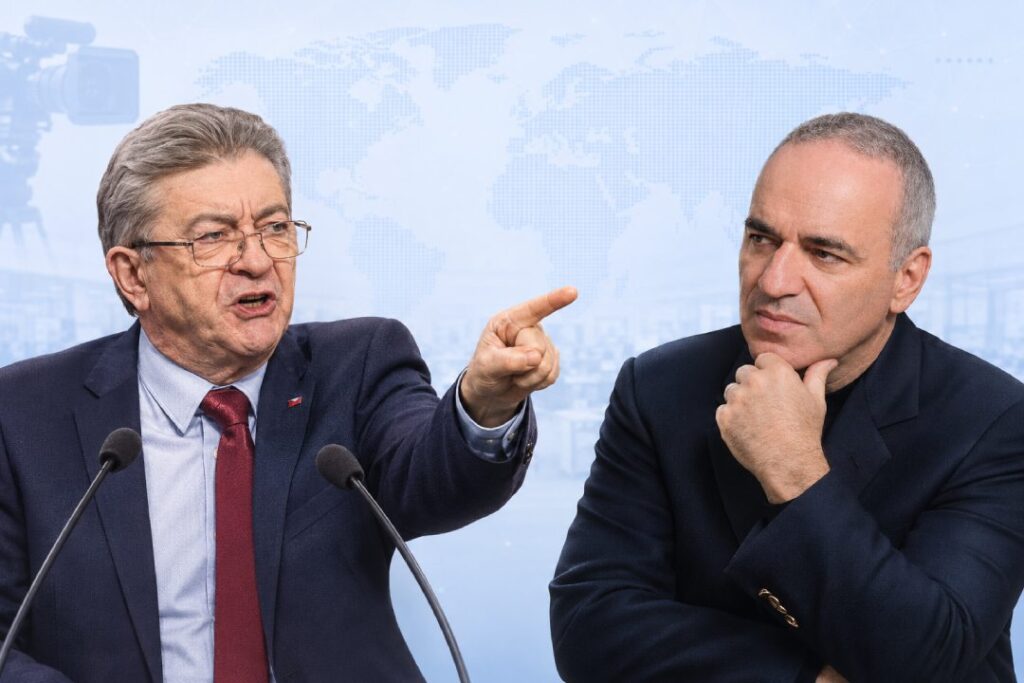
The former world chess champion and Russian opposition figure has sharply criticised French presidential candidate Jean-Luc Mélenchon for questioning Germany’s plans to build the strongest conventional army in Europe. Their dispute exposes contrasting approaches to European security, Russia’s invasion of Ukraine and the future of NATO.
Russian opposition figure and former world chess champion Garry Kasparov has accused French presidential candidate Jean-Luc Mélenchon of disregarding Russia’s military threat to Europe after the leader of the far-left La France insoumise (LFI) criticised plans to strengthen conventional armed forces on the continent.
In a post on X on November 12, 2026, Kasparov responded directly to a video published by French broadcaster France Info, showing Mélenchon opposing the ambition to build Europe’s largest conventional army.
Kasparov wrote:
“The Kremlin shill conveniently forgets that the largest conventional army in Europe is Russia’s, currently invading Ukraine and occupying several others.”
The statement was a direct political attack on Mélenchon, whom Kasparov accused of overlooking Russia’s military aggression while questioning European rearmament.
What Mélenchon said about Europe’s military buildup
The controversy began on November 11, during an Armistice Day ceremony in Gentioux-Pigerolles, in central France.
Speaking at the village’s pacifist war memorial, Mélenchon challenged the idea that Germany or another European country should aspire to field the continent’s largest conventional military force.
“Je n’accepte pas l’idée que, qui que ce soit en Europe, vous vouliez construire la plus grande armée conventionnelle.” (In English: I do not accept the idea of anyone in Europe wanting to build the largest conventional army.)
He then asked, “À qui comptez-vous faire la guerre avec cette armée?” (Who do you intend to wage war against with this army?)
His remarks were recorded and published by Franceinfo on November 11 and reported by Ariel Guez for Le Parisien the same day.
The speech was principally directed at German Chancellor Friedrich Merz, who had announced in May 2025 his ambition to transform the Bundeswehr into Europe’s strongest conventional armed force.
Mélenchon framed his objections through France’s history of European wars and his opposition to military escalation.
However, his position should not be reduced to opposition to all military defence. His objection concerned the ambitions behind large-scale European rearmament, particularly Germany’s military expansion, and the political strategy underpinning it.
Germany’s defence ambitions are rooted in the Russian threat
The German government’s position predates Mélenchon’s remarks.
In his first major government statement to the Bundestag on May 14, 2025, Chancellor Merz pledged to provide the Bundeswehr with the resources necessary to become Europe’s strongest conventional military force.
The German federal government explained the objective as strengthening national defence and meeting its obligations to NATO and European partners.
Merz summarised the underlying approach as follows: “We want to be able to defend ourselves so that we don’t have to.”
The statement, published by the German federal government, presented increased military capability as a means of deterrence rather than preparation for territorial expansion.
This distinction is central to the controversy.
Mélenchon questioned whom Germany intended to fight with such a force. Kasparov’s response was that European countries already face a major conventional military threat from Russia.
Neither argument, however, resolves the separate questions of what capabilities European states need, how they should be organised or how military spending should be balanced against other priorities.
Kasparov’s criticism reflects a wider disagreement over Russia
Kasparov, who has opposed Vladimir Putin for more than two decades, has repeatedly urged Western governments to confront Russian expansionism and provide stronger support for Ukraine.
His latest criticism of Mélenchon reflects his view that European security discussions must account for Russia’s use of military force against its neighbours.
Russia launched its full-scale invasion of Ukraine in February 2022, following its occupation and annexation of Crimea in 2014 and intervention in eastern Ukraine.
Moscow also maintains military deployments in the breakaway Georgian regions of Abkhazia and South Ossetia, as well as in Moldova’s Transnistria region.
Kasparov’s assessment that Russia possesses Europe’s largest conventional army is broadly consistent with the European Commission’s 2025 defence white paper, which describes Russia as the continent’s most heavily armed state.
However, military rankings depend on the criteria used, including active personnel, reserve forces, equipment, readiness and geographic definitions.
The white paper also identifies Russia’s military-industrial expansion and transition toward a war economy as major security challenges for European governments.
Mélenchon also faces criticism over Ukraine’s territorial sovereignty
The dispute with Kasparov follows another controversy concerning Mélenchon’s comments about Ukraine.
During a political rally at Le Bourget on November 7, the LFI presidential candidate suggested that populations in Donbas should be consulted over their future territorial status in the context of a negotiated peace settlement.
His remarks prompted criticism from French Foreign Minister Jean-Noël Barrot and the Ukrainian Ministry of Foreign Affairs.
Barrot accused Mélenchon of acting as a spokesman for the Kremlin by repeating arguments associated with Moscow’s territorial claims.
Ukrainian Foreign Ministry spokesperson Heorhii Tykhyi responded that Ukraine’s territorial status had already been determined by the 1991 independence referendum, in which a large majority supported independence across the country, including in Donbas.
The Ukrainian government has opposed referendums conducted under foreign military occupation, arguing that such votes cannot provide a legitimate basis for annexation.
Mélenchon rejected the accusations against him. On November 11, he reiterated that Russian forces should withdraw from Ukraine.
He told the audience at Gentioux-Pigerolles:
“Il faut que la Russie évacue l’Ukraine, où elle n’a rien à faire.” (Russia must leave Ukraine, where it has no business being.)
The statement, reported by Le Parisien, makes clear that Mélenchon explicitly called for an end to Russia’s occupation, even as he continued to advocate consultation over possible territorial changes.
The disagreement concerns whether his proposed approach to territorial settlements could undermine Ukrainian sovereignty, not whether he has publicly endorsed Russia’s invasion.
European defence policy is moving towards greater military investment
The exchange between Kasparov and Mélenchon comes as European governments are reassessing their security arrangements.
At the June 2025 NATO summit in The Hague, allied countries committed to increasing defence and security-related spending to 5% of GDP by 2035.
The commitment includes at least 3.5% of GDP for core military requirements and up to 1.5% for wider security and resilience investments.
NATO described the measures as necessary to strengthen collective defence, expand military-industrial production and maintain credible deterrence.
The European Commission’s Readiness 2030 defence initiative similarly identifies Russia as a major strategic threat and calls for increased European investment in military capabilities.
The initiative focuses on industrial capacity, procurement, air and missile defence, military mobility and other gaps in European security.
These initiatives do not constitute the creation of a single European army. European states retain their national armed forces, while EU defence cooperation and NATO commitments operate through distinct institutional arrangements.
France’s political divisions over NATO and European security
Mélenchon’s position reflects a longer-standing commitment to French strategic independence.
His political programme advocates withdrawing France from NATO’s integrated military command and subsequently from the alliance itself.
LFI argues for a non-aligned foreign policy and a diplomatic approach to European security that reduces dependence on the United States.
In reporting published on November 6, Le Monde journalists Sandrine Cassini and Jean-Baptiste Chastand examined LFI’s presidential platform and noted its emphasis on diplomacy and securing a ceasefire in Ukraine.
The programme also calls for the withdrawal of Russian forces while maintaining the party’s opposition to NATO membership.
The disagreement therefore extends beyond military expenditure.
It concerns whether French and European security should continue to rely primarily on NATO, move toward greater military cooperation within Europe or adopt a more independent national strategy.
Kasparov’s criticism addresses the potential consequences of weakening European deterrence while Russia continues its war.
Analysis: The exchange exposes different assumptions about deterrence
The significance of Kasparov’s intervention lies in his challenge to the assumptions underlying Mélenchon’s argument.
Mélenchon presents the ambition to build Europe’s strongest conventional army as a development that requires political justification. His argument suggests that significant military expansion can itself create risks and should not proceed without scrutiny.
Kasparov responds from the opposite starting point: that Russia’s military aggression provides an immediate strategic reason for European states to strengthen their defensive capabilities.
The two positions do not necessarily contradict each other on every point. Both raise questions about how peace and security can be preserved, but their assessments of the risks differ sharply.
Kasparov’s argument centres on the danger of insufficient military preparedness. Mélenchon’s argument is based on the dangers of rearmament and military escalation.
The available evidence shows that Russia’s invasion of Ukraine and the all-out war, which has lasted almost 5 years, have fundamentally altered the European security environment. NATO and EU defence initiatives have explicitly responded to that changing threat.
Yet stronger military capabilities alone do not settle questions concerning strategic decision-making, democratic oversight, alliance commitments or diplomacy.
Kasparov’s description of Mélenchon as a Kremlin supporter is a strong political characterisation, as his position appears to align with Moscow’s strategic interests.
Kasparov argues that such objections overlook the military threat already demonstrated by Russia’s invasion and occupation of Ukrainian territory.
The debate is no longer hypothetical. Europe is confronting a prolonged war involving a major military power while reconsidering the institutions, resources and partnerships on which its security depends.
Sources:
- Franceinfo, November 11, 2026. Video excerpt from Mélenchon’s Armistice Day speech.
- Le Parisien, Ariel Guez, November 11, 2026. Mélenchon’s criticism of Germany’s military ambitions.
- LCP – Assemblée nationale, Maxence Kagni, November 10, 2026. Mélenchon’s Ukraine statements and responses from French and Ukrainian officials.
- Le Monde, Sandrine Cassini and Jean-Baptiste Chastand, November 6, 2026. Analysis of LFI’s foreign policy programme…
- German federal government, May 14, 2025. Chancellor Friedrich Merz’s first government statement.
- European Commission. European Defence Readiness 2030.
- NATO, June 25, 2025. The Hague Summit Declaration.
