
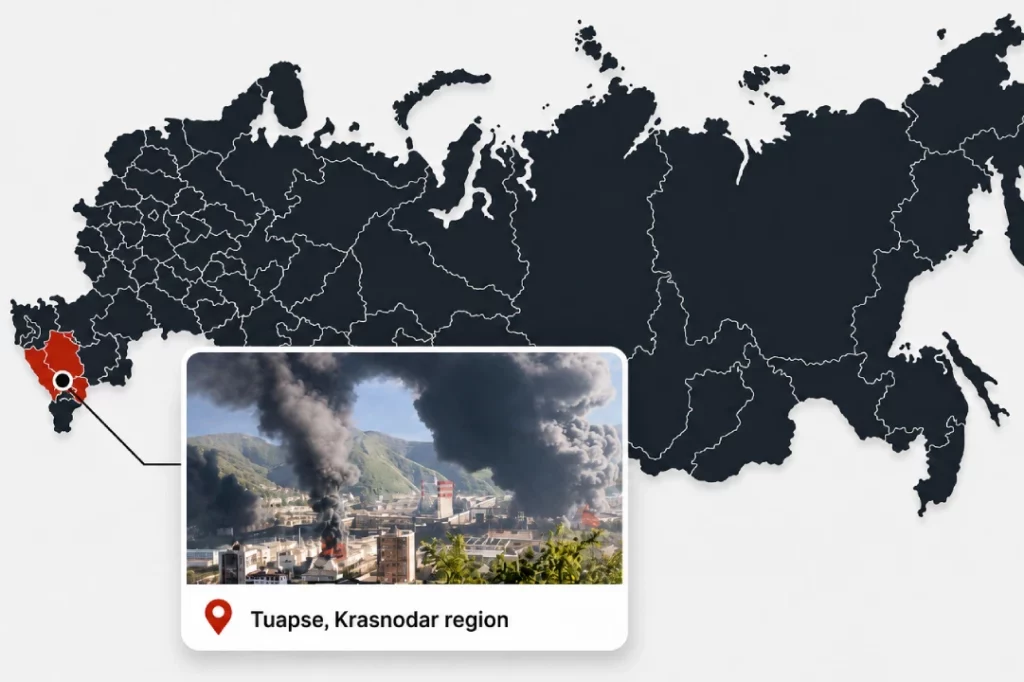
When Ukrainian drones struck a Tuapse oil refinery three times in two weeks, the Kremlin deployed 1,400 bots to praise the air defence that failed to stop them — and state media told Russians as little as possible about what was actually happening in their city.
When Ukrainian drones struck the Tuapse oil refinery for the first time on the night of April 15, the city on Russia’s Black Sea coast began what would become a two-week environmental emergency. By the time the third strike hit on April 28, four of the refinery’s largest storage tanks were ablaze, boiling oil had poured onto city streets, benzol concentrations in the air had exceeded safe limits by two to three times, an oil slick had entered the Black Sea and was moving northward toward Sochi, and residents were sheltering indoors while volunteers cleaned oil-soaked animals at makeshift rescue points.
The Kremlin’s response unfolded on two tracks simultaneously: state media coverage that systematically omitted the most damaging details and a bot campaign that flooded Russian social media with reassurance.
Three Strikes, One Escalating Crisis
What Russian authorities chose not to tell their citizens about Tuapse stood in sharp contrast to what residents were actually experiencing — and what independent Russian outlets, all of them blocked inside Russia, were able to document.
The first strike on April 16 killed two people, including a 14-year-old girl, injured seven more and damaged around 60 residential buildings. The fire at the marine terminal burnt for four days. Before it was fully extinguished, a second strike on April 20 reignited it, killing one more person. An oil rain — precipitation carrying combustion products from the burning refinery — fell over the city, coating buildings, vehicles and animals in black residue. Oil entered the Tuapse River and reached the Black Sea, forming a contamination zone of roughly 10,000 square metres.
The third strike on April 28 was the largest. Four storage tanks caught fire simultaneously. Burning oil poured from a ruptured tank onto a city street. The fire spread to a residential building before being contained. Sixty residents were evacuated, including nine children. Water supply was cut to more than 30 streets. The city’s only gas filling station burnt down. A regional emergency was declared that evening.
Residents described a city whose authorities were more concerned with managing appearances than with managing the crisis. “This is an environmental catastrophe. I don’t know what else to call it. Look — even the puddles in our city are black. You walk down the street and your shoes stick to the asphalt,” one Tuapse resident told journalists.
Ecologists warned that a federal-level emergency declaration was warranted. Authorities described the situation as “local”. Cleanup crews, according to local reporting, quietly covered oil-contaminated sand on the central city beach with fresh gravel rather than removing the contamination beneath it.
What State Media Said — And What It Left Out
RT approached the story almost entirely through a geopolitical frame, foregrounding Putin’s comment that the strikes “potentially threaten serious ecological consequences”, Kremlin spokesman Dmitry Peskov’s claim that Ukraine’s “criminal actions are driving a global oil deficit”, and a cleanup update noting that crews had removed 9,793 cubic metres of contaminated soil, framing the figure as evidence of government mobilisation rather than as a measure of the disaster’s scale. No RT report mentioned oil rain, civilian testimony or the Black Sea contamination zone.
TASS confirmed that benzol concentrations in Tuapse’s air had been exceeded but did not specify by how much or what that meant for residents. It also reported that fire had spread to a residential building overnight and documented the evacuation and regional emergency declaration — accurate operational facts, presented without context or civilian voices.
RIA Novosti reported that burning oil had spilt from a ruptured tank onto a city road, damaging several cars, and noted water restrictions imposed across parts of the city. Neither report mentioned the oil rain or the sea contamination.
Lenta.ru offered the most comprehensive coverage among state outlets. An April 29 overview described “boiling oil” flowing onto city streets, black clouds over the skyline, oil rain leaving deposits on buildings and vehicles, and animals whose fur had turned black with mazut. An earlier report quoted a journalist on the scene describing “a terrible night — not just the shooting and explosions, but the constant drone hum, shaking windows.” These details — the most visceral in any state outlet’s coverage — appeared without any question about the pace of the official response.
Rossiyskaya Gazeta reported on residents going without gas and water and published footage of volunteers cleaning mazut from beaches. Regional broadcaster Kuban24 focused almost entirely on the governor’s statements, quoting Krasnodar Krai Governor Veniamin Kondratiev: “I understand how much effort and work it took to extinguish such a large fire. Now we will do everything to put the city in order as soon as possible.”
Across all seven outlets, one absence was consistent: none asked why Putin had waited until April 28 — the day of the third strike, twelve days after the first attack killed a child — to comment publicly on what was unfolding in Tuapse. Every state outlet framed his remarks as a response to the latest attack rather than a belated acknowledgement of an escalating crisis.
- russian.rt.com/ussr/news/1625867-tuapse-vsu-udar
- russian.rt.com/russia/news/1626606-uscherb-npz-tuapse
- russian.rt.com/russia/news/1626017-chp-tuapse-grunt
- tass.ru/proisshestviya/27260505
- tass.ru/proisshestviya/27256177
- tass.ru/proisshestviya/27248141
- ria.ru/20260428/tuapse-2089416912.html
- crimea.ria.ru/20260430/v-tuapse-iz-za-chs-na-neftebaze-vveli-ogranicheniya-na-ispolzovanie-vody-1155655804.html
- lenta.ru/news/2026/04/29/tuapse/
- lenta.ru/news/2026/04/28/noch-byla-strashnaya-vsu-vnov-udarili-dronami-po-tuapse-na-neftepererabatyvayuschem-zavode-nachalsya-silnyy-pozhar/
- rg.ru/2026/04/29/reg-ufo/benzol-v-vozduhe-otsutstvie-gaza-i-vody-kak-zhivet-tuapse-posle-atak-bpla.html
- rg.ru/video/2026/04/29/volontery-ochishchayut-plyazh-pod-tuapse-ot-mazuta-posle-udara-ukrainskih-bpla-po-npz.html
- kuban24.tv/item/na-neftezavode-v-tuapse-likvidirovali-pozhar-posle-naleta-ukrainskih-bpla
The Bot Campaign That Ran In Parallel
While state media managed the story through selective omission, a separate and more aggressive operation was running on social media. According to Verstka, citing data from the Botnadzor monitoring project, nearly 1,400 accounts were deployed across VKontakte in the seven days following the first strike, leaving more than 5,000 comments under posts about the attacks. The activity affected more than 500 posts in regional and federal public forums and accounted for roughly 15 per cent of all visible comments — a significant share of the public conversation available to domestic audiences.
The campaign operated in phases. In the immediate aftermath of each strike, bots pushed standard wartime narratives: praising Russia’s air defence as “the best on the planet”, accusing Western countries of orchestrating the attacks, and labelling the strikes “terrorism”. Under posts about oil washing up on beaches and black rain falling over the city, bot accounts posted comments about how “the air in our cities has become cleaner” and “the environmental situation is objectively improving” — messages clearly generated for a different context and deployed without regard for the posts beneath them.
As the situation developed, the bots shifted to damage control. “The firefighters have already extinguished everything that was burning in Tuapse, so the air will soon get cleaner and the black rains will stop,” bot accounts wrote on April 24 — four days before the third strike reignited the refinery. They praised Emergency Ministry head Alexander Kurenkov, who flew to the scene, and assured readers that “everything should be resolved soon.”
The gap between what the bots were posting and what Tuapse residents were experiencing was, by the third week of April, considerable. Meduza’s correspondent, who travelled to Krasnodar Krai to report from the city, described residents who had stopped noticing the smell of burning oil – a sign of chronic exposure – and cleanup crews quietly covering oil-contaminated sand on the central city beach with fresh gravel rather than removing the contamination beneath it.
Internal Audience That Matters
The combination of state media omission and bot-driven reassurance did not target audiences who could access independent reporting. It was aimed at domestic Russian audiences – the residents of Tuapse and the Krasnodar region who rely on VKontakte and state television and who were being told simultaneously that their air defence was excellent, that the cleanup was proceeding effectively, and that the situation would soon be under control.
Putin commented on April 28 — the day of the third strike, twelve days after the first. He acknowledged that the strikes “create potential ecological risks” and noted that the Krasnodar governor had reported “no serious threats”. He did not mention the oil rain, the contaminated sea, the dead child, or the residents who told journalists they were afraid to let their children go outside.
The War Russia Will Not Name
The Tuapse refinery is not an incidental target. It is part of the Rosneft network and one of Russia’s strategically significant oil processing facilities on the Black Sea — the kind of infrastructure that funds the war Ukraine is defending itself against. Ukrainian strikes on Russian energy infrastructure are a documented component of Kyiv’s asymmetric strategy to degrade the economic base financing Moscow’s military machine.
That context was absent from every state media report examined. What Russian domestic audiences received instead was a carefully managed fragment of reality: government officials acting decisively; cleanup crews working around the clock; benzol levels described as “insignificant”, and the air defence praised by over a thousand coordinated accounts as the best in the world — even as it failed, three times in two weeks, to protect a city whose residents were washing oil off their pets and sealing their windows against the smell of burning fuel.
The war that made Tuapse what it is in April 2026 is a war that Russia started. Russia built the information landscape that left Tuapse residents without an honest account of what was happening in their own city. The two facts are not unrelated.
