
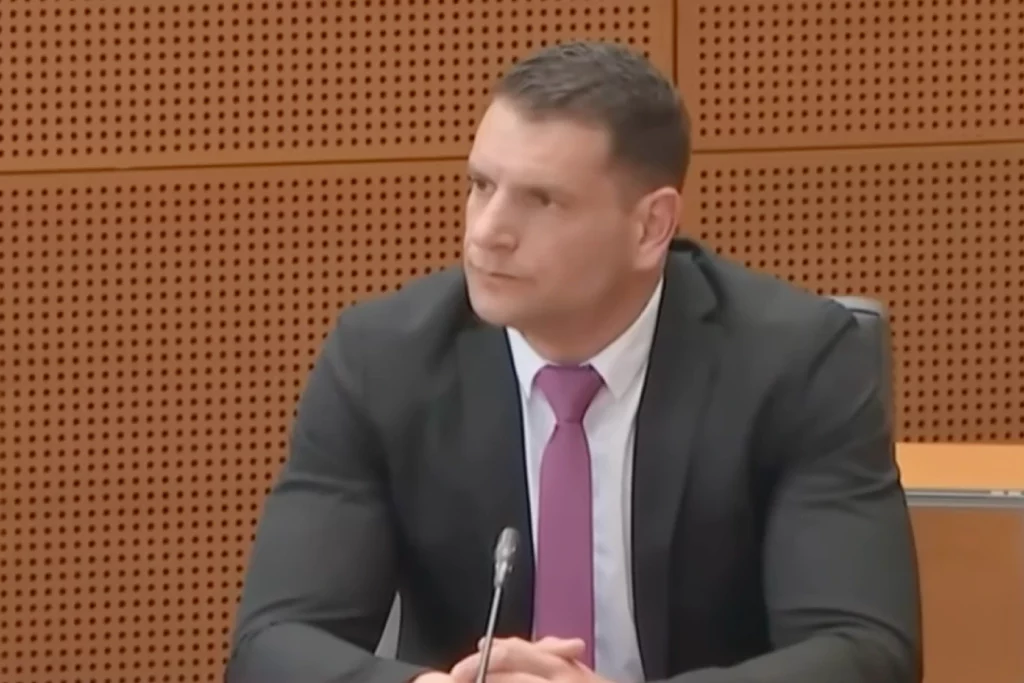
The election of Zoran Stevanović as Slovenia’s parliamentary speaker has handed Moscow a propaganda gift — and exposed how years of Kremlin-aligned media work had already prepared the ground.
Slovenia had been one of the most consistent pro-Western voices among the former Yugoslav states. Under both the centre-left government of Robert Golob and the previous centre-right cabinets of Janez Janša, Ljubljana backed Ukraine, upheld EU sanctions on Russia, and maintained full NATO alignment. That record now faces its most serious challenge since independence. On April 10, the National Assembly elected Zoran Stevanović, leader of the small but pivotal Resni.ca (“Truth”) party, as speaker of parliament with 48 of 90 votes. Within hours, Russian state media was celebrating.
The Election That Changed Everything
Slovenia’s parliamentary elections on March 22 produced a result that defied most pre-vote polling. Prime Minister Robert Golob’s liberal Freedom Movement narrowly edged out Janez Janša’s Slovenian Democratic Party — 28.66% against SDS’s close second — despite trailing in surveys for months. Neither camp secured the 46 seats needed for a majority in the 90-member National Assembly. Golob’s bloc held 29 seats; Janša’s, 28. With neither side capable of governing without outside support, Resni.ca and its five seats became the indispensable swing factor in any coalition scenario.
The campaign itself was poisoned by a significant pre-vote scandal. Recordings leaked from inside the leadership of Golob’s Freedom Movement; the governing party responded by accusing Janša of running surveillance operations through Black Cube, an Israeli private intelligence firm. As Yurii Panchenko, editor of European Pravda, noted in his analysis of the post-election landscape, the scandal damaged SDS’s standing and allowed Golob to close a gap many had assumed was permanent — but the narrow victory left him without a viable path to a majority that did not require difficult negotiations with parties outside his natural orbit.
The Speakership Vote and What It Revealed
On April 10, deputies voted by secret ballot for a new speaker. Stevanović received 48 votes — a margin that, given Resni.ca’s five seats, could only have been achieved through cross-bloc coordination encompassing SDS (28 seats), New Slovenia–Christian Democrats (9), the Democrats (6), and others. Left-wing parties including Levica and Vesna boycotted the vote entirely. Levica co-founder Luka Mesec said publicly that Stevanović did not meet basic criteria for the role.
The secrecy of the ballot was itself compromised. Journalists who subsequently requested access to the voting slips found what appeared to be subtle markings — believed to be internal party identification codes allowing leadership to verify their own members’ compliance. The episode added procedural controversy to an already charged political moment.
For Golob, the result was a direct blow. As Bloomberg noted, the outcome cast serious doubt over his ability to form a government within the 30-day window granted by President Nataša Pirc Musar. Golob himself described April 10 as “not only a black day for Slovenian politics, but also for democracy”.
Who Is Zoran Stevanović?
Stevanović is a former police officer of Serbian origin who built his political profile leading anti-lockdown protests in 2021. Resni.ca emerged from those protests as a sovereignty-first, anti-establishment movement. Its core programme — fighting corruption, opposing the EU “diktat”, lowering taxes — positioned it as a catchall for voters alienated from both mainstream blocs.
His foreign policy positions, however, are explicit and have been consistent for years. In a pre-election interview with Sputnik Serbia published on March 28, Stevanović outlined his agenda in terms that left little room for ambiguity: “The first step must be the beginning of negotiations with Russia. Slovenia will run out of gas; energy dependence on the USA is costing us dearly.” He went further, framing EU sanctions as an external imposition: “There is no other option but to start negotiating slowly with the Russians, regardless of Brussels’ determination that we must follow them, that we won’t lift sanctions on energy imports from Russia.” The interview, given willingly to a Kremlin-owned outlet weeks before polling day, was not a slip. It was a deliberate signal about his political orientation and his intended audience.
- https://lat.sputnikportal.rs/20260328/ekskluzivno-srbin-koji-odlucuje-o-novoj-vladi-slovenije-prvi-korak-su-pregovori-sa-rusijom-1197452286.html
Following his election as speaker, Stevanović told Radio-Television of Slovenia that he planned to visit Moscow soon. “I would like to build bridges and cooperate well with all countries, regardless of the wall that has been built between the West and the East,” he said. TASS reported the statement prominently on April 13.
- https://tass.com/world/2116465
He simultaneously confirmed Resni.ca’s intention to hold a referendum on Slovenia’s withdrawal from NATO. “We will categorically oppose interference in foreign military and diplomatic conflicts, because Slovenia never benefits from this. At the same time, I must say that we promised the people a referendum on leaving NATO, and we will hold this referendum,” RIA Novosti reported him saying on April 13.
- https://ria.ru/20260413/sloveniya-2086888831.html
He has also called for Slovenia’s withdrawal from the World Health Organization and repeatedly signalled interest in reopening energy trade with Moscow, framing dependence on Washington as equivalent to — or worse than — dependence on Russia.
Stevanović routinely deflects accusations of pro-Russian orientation with a formulation that has become his signature: “I have no pro-Russian views, only pro-Slovenian ones.” The framing — sovereignty as a neutral concept that happens to require overriding NATO commitments and EU sanctions — closely mirrors language cultivated for years by Kremlin-aligned political movements across Central and Eastern Europe.
His ties to Russian networks, however, go beyond rhetoric. Slovenian security services expelled Russian diplomat Sergei Lemeshev after establishing that he had conducted propaganda activities against Slovenia and was linked to the 2024 cyberattacks targeting the country. Lemeshev had maintained documented contact with multiple Resni.ca members; a Resni.ca candidate for European Parliament attended his farewell ceremony. As Brussels Watch documented, Stevanović’s response was to call the expulsion a “mistake” and describe his own contacts with the Russian diplomat-spy as a meeting between “two experts”.
Moscow’s Response: Institutional and Propagandistic
The Kremlin’s institutional reaction was immediate. Vyacheslav Volodin, Chairman of the Russian State Duma, issued a formal congratulatory statement on April 13. “State Duma deputies are ready for constructive dialogue with colleagues from the National Assembly on the basis of equality and mutual respect for national interests,” Volodin wrote. The speed and institutional weight of the message carried a clear signal about Moscow’s stake in the political shift.
- http://duma.gov.ru/news/63357/
Russian state media treated the story as a propaganda opportunity of the first order. RT ran the story on April 15 under the headline “NATO member planning exit vote”, framing it as evidence that “Slovenia is preparing a referendum on withdrawal from the bloc as Trump’s threats deepen internal divisions. “ The contextualisation was deliberate: the Slovenian story was inserted into a wider narrative about Western fragmentation and NATO’s declining cohesion — a narrative that Russian state media has been constructing systematically since 2022. RIA Novosti and its regional branch RIA Novosti Crimea both led with the NATO referendum angle, presenting it as a democratic exercise in sovereign will rather than a pro-Kremlin policy position.
- https://www.rt.com/news/638448-slovenia-nato-exit-vote/
- https://ria.ru/20260413/sloveniya-2086888831.html
- https://crimea.ria.ru/20260414/sloveniya-provedet-referendum-po-vykhodu-iz-nato-1155186947.html
Serbian regime media went further. As Vreme, an independent Serbian outlet, reported, pro-government tabloid Novosti called Stevanović “Putin’s extended arm.” Bosnian Serb leader Milorad Dodik and Serbian National Assembly Speaker Ana Brnabić both offered public congratulations — a detail that matters beyond ceremony. It maps precisely onto what expert observers have identified as the primary channel through which Russian influence enters Slovenia: not directly from Moscow, but routed through Belgrade and Republika Srpska.
The Belgrade–Ljubljana Pipeline: How Russian Influence Reaches Slovenia
The routing of Russian influence through Serbia is not incidental — it is structural. Dr. Dejan Verčič, Professor and Head of the Centre for Marketing and Public Relations at the Faculty of Social Sciences, University of Ljubljana, described the mechanism in a detailed interview with Insight News:“There is an undercurrent communication concerning panslavism: ‘We are all Slavs, so we should all stick together.’ This Panslavism has, particularly for Slovenia, a very dangerous or nearly invisible line going from Russia to Serbia and Republika Srpska in Bosnia and Herzegovina to Slovenia. The majority of the financial infrastructure and buildup is actually going that way — not directly from Russia — which is opening serious security questions.”
Verčič assessed Slovenia’s resilience to Russian information operations as “medium to low”, noting that Russian messaging consistently exploits the legacy of Yugoslav non-alignment. “I would say there is a lot of sympathy from that perspective towards Russia, building on panslavism and then on this exceptionalism that we are neither East nor West. In the future, it could become dangerous,” he told Insight News. He also flagged Ljubljana’s role as an intelligence hub, noting the 2002 arrest of Russian operatives Artem and Ana Dultsova, who had operated in the city for five years undetected: “We can assume that Ljubljana is at least a small logistic hub for Russia, particularly because Slovenia is at the intersection of north-south and east-west roads.”
Hungary adds a further layer of complexity to the picture. As Verčič noted in the same interview, Hungarian capital has invested directly in Slovenian media — including television ownership — and controls one of Slovenia’s two largest banks. While Hungarian economic influence and Russian propaganda operations represent distinct phenomena, they converge around a shared “illiberal” political current that erodes trust in Western institutions.
The Media Infrastructure That Prepared the Ground
Stevanović’s election did not happen in an information vacuum. Following the EU’s ban on RT, Sputnik, and RIA Novosti, the Kremlin pivoted to local proxies — domestic-looking outlets that carry the same narratives under national branding, bypassing sanctions while reaching local audiences through search engines and social media. In Slovenia, this infrastructure coalesced around three outlets, all documented in detail in Insight News research. Today, one of them carries the operational load almost entirely alone.
Insajder.com is the network’s dominant and most dangerous node. According to SimilarWeb data reviewed by Insight News, the site reached 1.6 million page views between September and October 2025 — in a country of 2.1 million people, making its reach equivalent to roughly half the readership of Slovenia’s leading mainstream outlets. Some 44% of its traffic arrives via search engines, including Yandex. The site presents itself as independent alternative media. In practice, it systematically recycles content from banned Russian state outlets, including RIA Novosti, TASS, and RT, while its editor-in-chief, Igor Mekina, consistently deploys Kremlin terminology across his coverage.
Mekina’s editorial line on the Russian-Ukrainian war has been consistent and unambiguous. In a November 2025 post, he glorified Russian forces’ advance on Pokrovsk, writing: “Slovenian storytellers: Ljubljana Daily about the ‘special operation to liberate Pokrovsk’.” He has described RT as possessing a “secret strategic intercontinental weapon: truth” and produced repeated pieces attacking EU sanctions while amplifying Kremlin narratives about Ukraine’s supposed illegitimacy.
- https://insajder.com/slovenija/slovenski-pravljicarji-ljubljanski-dnevnik-o-posebni-operaciji-za-osvoboditev-pokrovska-v
His co-editor Svetlana Vasović-Mekina, who also writes under the pseudonym Anja Klein, routinely refers to Ukraine’s government as the “Ukrainian terrorist regime”, recycles debunked Kremlin fakes, including the claim that Ukraine shot down flight MH17, and approvingly cites Russian propagandists, including Dmitry Medvedev and neo-fascist ideologist Alexander Dugin.
Insajder’s response to Stevanović’s election was immediate and revealing. Its April 12 article framed the outcome as a political masterclass, writing, “That a newcomer to parliamentary politics, with the smallest number of votes, burdened with a surname ending in ‘-ić’, manages to become the ‘swing vote’ and even president of parliament in such a short time proves that behind it is not just luck, but a brilliantly played series of moves” — with no mention of his pro-Kremlin positions or the concerns they raise.
- https://insajder.com/slovenija/osupljiva-zmaga-zorana-stevanovica-izdaja-volivcev-ali-serija-briljantnih-politicnih-potez
Three days later, on April 15, the outlet published a piece headlined “Russian media: Slovenia intends to hold a referendum on NATO exit and conduct independent, sovereign policy.” The article explicitly cited Russian information agency Silovoj blok as its source, quoting its coverage of Stevanović’s remarks: “As Russian information agency Silovoj blok reports, Stevanović emphasised that the authorities promised the people a referendum on NATO exit and will therefore hold it.” This is information laundering in its most transparent form — a Slovenian-branded outlet amplifying a Russian state agency’s framing of a Slovenian politician’s statements, which Russian state media had itself amplified from Stevanović’s interview with Sputnik Serbia. The circular loop is complete: The Kremlin outlet cites the Slovenian politician, the Slovenian proxy cites the Kremlin outlet, and the Kremlin outlet cites the Slovenian proxy as local confirmation.
- https://insajder.com/slovenija/ruski-mediji-slovenija-namerava-izvesti-referendum-o-izstopu-iz-nata-voditi-neodvisno
The outlet’s anti-sanctions coverage runs in parallel. On April 10 — the same day Stevanović was elected speaker — Insajder published a piece amplifying Slovak Prime Minister Robert Fico’s characterisation of EU sanctions policy as a “suicidal ship”: “The entire EU, and especially the European Commission, is slowly turning into a suicidal ship in the field of energy security.” The juxtaposition was not accidental: the speaker election and the anti-sanctions narrative were being reinforced simultaneously, on the same day, for the same audience.
- https://insajder.com/svet/fico-eu-se-z-ohranjanjem-sankcij-proti-rusiji-obnasa-kotomorilska-ladja
Thesaker.si and Triglavmedia.si round out the network documented in Insight News research. Thesaker.si — an ideologically driven outlet that openly celebrated Russian military operations, referred to Ukrainian forces as “Ukronazis”, and published commentary from figures including pro-Kremlin propagandist Dmitry Orlov — has been inactive since August 2024. Triglavmedia.si, established in 2021 by the NGO Združenje Triglav, continues to operate but produced no identifiable April 2026 coverage of Stevanović’s election or the NATO referendum story. Both remain part of the documented Slovenian pro-Kremlin media ecosystem – but as of April 2026, it is Insajder that carries the full operational weight of that ecosystem, reaching an audience equivalent to half of Slovenia’s entire population with narratives that Moscow’s own outlets amplify in return.
What Comes Next: Coalition Calculus and Slovenia’s Western Course
Stevanović has said publicly that Resni.ca will not join a government led by either Janša or Golob. The practical implication, however, is that the party functions as a veto player: no government can form or survive without its tolerance, and Resni.ca does not need a ministerial portfolio to exercise leverage.
For Golob, the remaining path to a majority runs through the Democrats and their leader Anže Logar. As Yurii Panchenko noted in his analysis, a coalition arrangement with the centre-right Logar may appear more natural to the Democrats than alignment with Janša — particularly given Stevanović’s statements. The more provocative the new speaker’s pronouncements, the stronger the argument that a Janša-led government dependent on Resni.ca would be internationally untenable.
Janša’s own record complicates any simple reading. He was among the first Western leaders to visit Kyiv in March 2022, alongside the prime ministers of Poland and Czechia, when Russian forces were still near the capital. His public line on Ukraine support has been consistent. Yet his willingness to coordinate with Resni.ca on the speaker vote – purely for domestic political advantage – demonstrates that the alliance is transactional. Whether a Janša government would maintain Slovenia’s Ukraine policy intact while formally dependent on a party that campaigns for NATO withdrawal and sanctions relief is the question European capitals are now quietly asking.
What is already beyond doubt is that, regardless of which coalition eventually forms, Stevanović’s presence in the speaker’s chair will be instrumentalised. The Sputnik interview is in the archive. The Duma’s congratulations are on the record. Dodik and Brnabić have offered their public endorsements. RT has filed its framing. And Insajder — with its 1.6 million readers — is already amplifying every statement from the speaker’s podium as confirmation that Slovenia’s “sovereign” course has begun. The information infrastructure needed to turn ambiguous words into propaganda assets is in place, well-resourced, and already reaches an audience equivalent to half of Slovenia’s entire population.
