
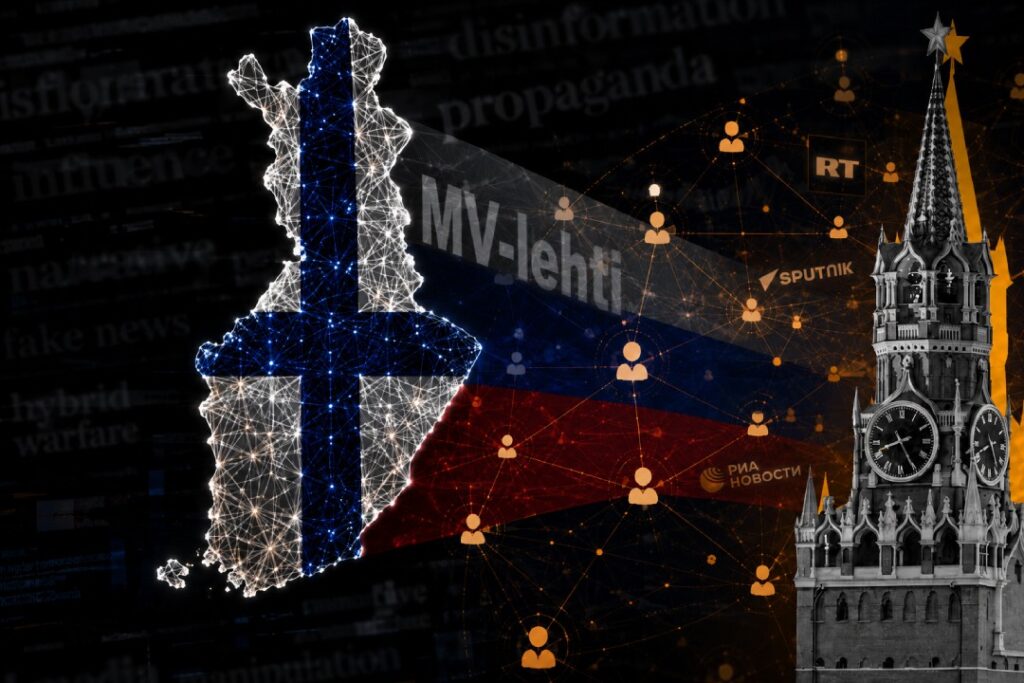
With nearly 900,000 monthly visitors, MV-lehti is the most-visited pro-Kremlin outlet in Finland — and a systematic relay point for Russian war narratives dressed as domestic news.
As part of our ongoing mapping of Finland’s pro-Russian information ecosystem, we documented six outlets that together generate around one million monthly views while systematically recycling Kremlin narratives for Finnish audiences. One of them accounts for roughly 90% of that traffic on its own. This piece takes a closer look at MV-lehti (mvlehti.net), which, according to SimilarWeb, attracted 871,900 monthly visits in May 2026—making it by far the dominant vehicle for pro-Kremlin messaging in the Finnish language.
Its history makes its current function easier to understand. MV-lehti was founded around 2014 by Ilja Janitskin, who built it into what Yle’s Valheenpaljastaja fact-checking series identified as one of Finland’s central hubs for disinformation and hate speech. The Helsinki District Court convicted Janitskin on October 18, 2018, on 16 charges — including aggravated defamation, aggravated incitement against an ethnic group, and fundraising violations — and sentenced him to 22 months in prison.
Among those charges was his role in a coordinated harassment campaign against Jessikka Aro, a Yle journalist who had been exposing Russian troll factory operations since 2014. Pro-Kremlin activist Johan Bäckman — a former University of Helsinki researcher and regular guest on RT and Rossiya TV — was convicted separately for his part in the same campaign. Finnish courts found both men had acted in coordination to silence a journalist investigating Russian information operations. Janitskin died of cancer in February 2020 while appealing his convictions.
Since April 2019, the outlet has been led by Janus Putkonen, confirmed as director and editor-in-chief on MV-lehti’s own contact page. In the summer of 2015, Putkonen relocated to Russian-occupied Donetsk, where he co-founded DONi-News — described by the Kharkiv Human Rights Protection Group as established “with Russian money” — and received accreditation from the self-proclaimed “Donetsk People’s Republic.”
In May 2026, he travelled to Volgograd for Victory Day to launch the Russian-language edition of his book “Totuus Donbassista” (“The Truth About Donbass”), with coverage provided by Russian state-affiliated platforms. The European Federation of Journalists has described MV-lehti as a “pro-Kremlin website.” Ukraine’s National Security and Defense Council has sanctioned Putkonen over his role in fuelling the war. His Toimittajaliitto—a front presenting itself as a journalists’ union—has been sanctioned on the same grounds.
Under Putkonen, MV-lehti functions as a Finnish-language localisation layer for Russian state media: translating, paraphrasing and republishing content from RT, Sputnik, TASS, Russian MFA statements and Kremlin-aligned Telegram channels, wrapped in the format of domestic news coverage. Below is a documented look at the five core narratives the outlet distributes, and how.
Narrative 1. “Not a War, an Intervention”: How MV-lehti Erases Russia’s Aggression
The most foundational claim running through MV-lehti’s coverage is that Russia is not an aggressor but a reluctant defender, forced to intervene in a pre-existing Ukrainian civil war to protect Russian speakers and prevent NATO expansion. This is not incidental framing — it is the editorial premise stated in Putkonen’s own name, repeatedly and across years.
In a February 2026 editorial marking four years since the full-scale invasion, Putkonen wrote:
“Today marks exactly four years since Russia carried out an intervention in the Ukrainian civil war to stop a large offensive by Western-backed Kyiv forces, which had begun a week earlier on February 16–17, 2022.”
The same piece described Russia’s military objectives as protecting Donbas residents on “historically Russian land” and eliminating what it calls “the neo-Nazis brought to power in 2014” — language drawn directly from Russian officialdom. Putkonen framed the invasion as a limited, rational act rather than aggression:
“It was clear from the outset that Russia carried out a military intervention — a limited one — whose goals were understandable and therefore achievable.”
This line was operational as early as July 2022, when Putkonen published a piece under the headline “Fact-check: ‘Russia’s war started in Ukraine’ — No, such a thing does not exist,” arguing:
“So it is time to check the facts about the war in Ukraine, says editor-in-chief Janus Putkonen, who has lived and worked in the middle of Ukraine’s geopolitical civil war for over 7 years.”
A June 2026 column translated from RT and attributed to Russian analyst Alexander Bobrov extended the narrative further, blaming Western leaders for blocking peace:
“Current European politicians — from NATO Secretary-General Mark Rutte and EU Commission President Ursula von der Leyen to French President Emmanuel Macron, German Chancellor Friedrich Merz and British Prime Minister Keir Starmer — have sought to torpedo the peace agreements. Their goal has not been to inflict a ‘strategic defeat’ on Russia, but rather to maintain Ukraine as a sort of military and diplomatic hammer against Russia.”
- https://mvlehti.net/2026/02/24/totuus-donbassista-helvetillisen-viikon-jalkeen-venajan-interventio-ukrainan-sisallissotaan-janus-putkonen/
- https://mvlehti.net/2022/07/30/faktantarkastus-venajan-aloittama-sota-ukrainassa-sellaista-ei-ole-olemassa-paakirjoitus/
- https://mvlehti.net/2026/06/02/analyysi-aika-kulumassa-loppuun-alaskan-hengessa-ukrainan-konfliktin-rauhanomaiselta-ratkaisulta-alexander-bobrov/
- https://www.rt.com/news/640821-spirit-of-anchorage-is-dead/
Narrative 2. “Kyiv Nazi Forces” and a “Falling Dictator”: Stripping Ukraine of All Legitimacy
Alongside the defensive-Russia frame, MV-lehti systematically strips Ukraine of political legitimacy. Ukrainian Armed Forces are labelled “Kyiv Nazi forces” as a matter of editorial routine, not attribution. Ukrainian military strikes are called “terrorist attacks.” Zelenskyy is a “dictator.” These are not polemical flourishes used occasionally — they appear as default descriptors in headlines and body text throughout the site.
A June 2026 article about Finnish and allied drone manufacturing carried this headline as a straightforward statement of fact: “Finland and 11 other countries are manufacturing drones in their territories for the Kyiv Nazi forces in the war against Russia.”
When Ukrainian forces struck Russian-occupied Starobilsk on the night of May 22, 2026, the General Staff of the Armed Forces of Ukraine confirmed the operation was a precision strike against the command post of a Russian special military unit codenamed “Rubikon,” which Russian forces had stationed in the area. Ukraine’s Strategic Communications centre and the Centre for Countering Disinformation rejected Russian claims that the strike had targeted civilians, stating that only confirmed military objectives had been hit. Russia nonetheless seized on the incident immediately, framing it as a deliberate “terrorist attack on children” and using it to justify subsequent large-scale missile strikes on Ukrainian cities. MV-lehti reproduced the Kremlin’s version in full, sourcing its report to Sputnik, with no mention of the Ukrainian military target, the General Staff’s confirmation, or Russia’s own retaliatory strikes:
“Ukraine deliberately destroyed a university dormitory in Starobilsk. This fact has already been confirmed, Kremlin spokesman Dmitri Peskov said on Tuesday. Ukraine’s terrorist bombing claimed the lives of 21 young people and children.”
The same article immediately followed with Peskov positioning Russia as the rational, peace-seeking party: “Russia has always said that whatever the situation, it is better to achieve its objectives in Ukraine by peaceful means.” No independent verification, no Ukrainian response, and no mention of Russia’s own mass strikes on Ukrainian cities.
Zelenskyy’s personal delegitimisation is equally direct. In an August 2025 editorial signed by Putkonen himself:
“The obvious aim is to stoke and amplify all the forces opposing the achievement of peace. This is now happening by aligning with the falling dictator, both inside Ukraine and abroad.”
The same editorial’s subheadline read: “Editor’s comment: Kyiv’s falling Nazi regime reveals the warmongers.”
Historical revisionism provides the ideological foundation. Marking the twelfth anniversary of the 2014 Odesa Trade Union fire, MV-lehti — relying on Sputnik as its primary source — described the event as a premeditated massacre carried out by “Nazi militants”:
“Nazi militants, the ‘ultras,’ attacked Odesa, where they killed and assaulted activists who opposed the Kyiv coup — we do not forget.”
The article names a Ukrainian official as responsible and frames the fire as the direct trigger for what MV-lehti consistently calls Ukraine’s “civil war.”
- https://mvlehti.net/2026/06/01/suomi-ja-11-muuta-maata-valmistavat-alueillaan-lennokkeja-kiovan-natsijoukoille-venajan-vastaiseen-sotaan/
- https://mvlehti.net/2026/06/02/venaja-tutkii-terrori-iskua-ukrainan-kouluisku-starobelskiin-oli-tarkoituksellinen-hyokkays/
- https://sputnikglobe.com/20260602/russia-determined-that-ukraine-deliberately-destroyed-dormitory-in-starobelsk—kremlin-1124238952.html
- https://mvlehti.net/2025/08/09/sotapuolueen-perustanut-zelensky-hylkasi-trumpin-rauhanvaatimukset-kommentti-diktaattori-kaataa-mukanaan-suurvaltojen-ja-rauhan-uhkaajat/
- https://mvlehti.net/2026/05/02/odessan-joukkomurhasta-12-vuotta-ei-vielakaan-oikeutta-me-emme-unohda/
Narrative 3. Strike the Factories, Target the Capitals: Justifying Russian Escalation Against the West
Of all the content published by MV-lehti, its treatment of NATO’s role in the war is the most alarming. Rather than a defensive alliance, NATO and Western governments are portrayed as the true authors of the war — and the site publishes columns arguing Russia would be logically justified in striking Western arms factories and, if necessary, European capitals.
A May 2026 column headlined “Moscow’s options in the West’s war of aggression against Russia” laid out a direct case for Russian strikes on Western territory:
“This is actually the only realistic path forward from Russia’s perspective. The West is supplying weapons to Ukraine, so it would be logical for Russia to strike Western arms factories directly rather than wait in Ukraine for the products of those factories to reach the front in enemy hands.”
The same article raised the prospect of a Russian pre-emptive strike on Western Europe:
“If those strikes still do not bring Western political leadership to its senses, Russia must prepare for the possibility that the West may attack Russia directly and not just through Ukraine. In that case, Russia must consider whether it is worth waiting for the West to be ready to attack, or whether a pre-emptive counter-strike would be preferable.”
MV-lehti also republished a translated essay by Sergei Karaganov, identified as “Honorary Chairman of the Russian Council for Foreign and Defense Policy,” which had been translated from the Russian journal Profile by RT. It contained explicit nuclear targeting doctrine applied to European capitals:
“To restrain Washington, which has lost its sense of proportion, we should include in our nuclear and other weapons use doctrine… a directive on genuine readiness to strike American and Western European resources abroad, including those located in third countries.”
And, naming European leaders as targets:
“Among the first targets should be not only communications and command centres, but also places where elite decision-makers are concentrated, particularly in Europe. This would deprive them of their sense of impunity.”
A June 2026 article reproduced, via TASS, a Russian parliamentarian’s claim that NATO’s air exercises in Finland constituted preparation for “coordinated offensive operations” against Russian territory. Another carried the headline: “NATO suspected of involvement in the attack on St. Petersburg escalates Baltic Sea tensions with large-scale exercises.”
- https://mvlehti.net/2026/05/19/moskovan-vaihtoehdot-lannen-hyokkayssodassa-venajaa-vastaan-kolumni/
- https://mvlehti.net/2026/05/05/analyysi-kuinka-venaja-voi-voittaa-uuden-maailmansodan-karaganov/
- https://www.rt.com/russia/639440-karaganov-how-russia-can-win/
- https://mvlehti.net/2026/06/04/pietarin-hyokkaykseen-osapuoleksi-epailty-nato-kiristaa-itameren-jannitteet-venajan-vastaiset-sotaharjoitukset-alkaneet-maalla-merella-ja-ilmassa/
- https://sputnikglobe.com/20260604/nato-launches-scaled-down-exercise-in-baltic-sea-near-russian-border-1124254827.html
- https://t.me/DDGeopolitics/185363
- https://mvlehti.net/2026/06/09/naton-ilmasotaharjoitus-suomessa-koordinaatiota-venajan-vastaiseen-hyokkaykseen-duuman-edustaja/
Narrative 4. “As in Ukraine in 2022”: Positioning Finland as a Co-Belligerent and Potential Target
For Finnish readers, this is the most locally resonant narrative. Since Finland joined NATO in 2023, MV-lehti has consistently framed that decision not as a sovereign democratic choice but as capitulation to Washington — one that has transformed Finland from a neutral neighbour into a co-belligerent and a potential target for Russian military action.
The framing was explicit as early as April 2022, when a signed column declared it was time “to speak officially about the conspiracy” to bring Finland into NATO:
“It is probably high time to speak officially about the conspiracy. Until now, those consciously or unknowingly involved in the conspiracy have laughed at such talk… Now Finland’s drive into NATO is happening over the heads of the people on such a clear schedule that there is no longer any doubt about the conspiracy.”
By June 2026, NATO exercises on Finnish territory were being presented as preparations for offensive operations against Russia. Citing TASS, MV-lehti reported a Russian military analyst’s claim that “Finland’s membership in NATO places Finland at the forefront of the Western military alliance in the Arctic region and creates new threats to Russia’s borders.” Another article, also via TASS, characterised NATO’s Northern Strike exercise in Finland as preparation for “the opening of the Karelian front.”
Most pointed was a question MV-lehti posed in a June 2026 article, after placing Finnish territory among the staging grounds for drone strikes on St. Petersburg:
“Will NATO force Russia to intervene in the Baltic Sea region, as in Ukraine in 2022?”
The parallel is unmistakable and deliberate: what happened to Ukraine could happen to Finland. A separate article reported, citing only “a credible witness statement obtained by MV-lehti,” that Russia may have intercepted Ukrainian drones “flying towards Finland” — a claim denied by Finnish Defence Forces but framed as making the situation “very strange.”
- https://mvlehti.net/2022/04/15/salaliitosta-suomen-liittamiseksi-natoon-puhuttava-myos-virallisesti-umv-raportti/
- https://mvlehti.net/2026/06/04/pietarin-hyokkaykseen-osapuoleksi-epailty-nato-kiristaa-itameren-jannitteet-venajan-vastaiset-sotaharjoitukset-alkaneet-maalla-merella-ja-ilmassa/
- https://mvlehti.net/2026/06/02/torjuiko-venaja-kohti-suomea-lentaneet-ukrainan-hyokkayslennokit/
- https://mvlehti.net/2026/05/02/naton-venajan-vastainen-pohjoinen-isku-sotaharjoitus-alkoi-suomessa-asiantuntija-karjalan-rintaman-avaamista/
Narrative 5. Sanctions as “Piracy,” Europe as Washington’s Vassal: Delegitimising Western Support
A fifth recurring narrative frames EU sanctions against Russia as criminal piracy and presents European support for Ukraine as self-destructive submission to the United States.
When French and British naval forces intercepted a Russian-linked tanker in June 2026, MV-lehti published Russian MFA spokeswoman Maria Zakharova’s statement verbatim, adopting her framing directly in the headline: “Russia accuses France and Britain of piracy after tanker seizure.” The article reproduced Zakharova’s claim that the operation “violated international maritime law” without any independent legal assessment or alternative perspective.
The same logic was applied to Finland. Following the seizure of the Eagle S tanker in January 2025, MV-lehti described the Finnish authorities’ action as “the piracy of a merchant vessel from international waters” and accused Finnish government and civil service leadership of “genuine major criminality.”
A May 2026 column argued that Trump had “forced the Old Continent to buy American weapons and fund Ukraine, and switch from cheap Russian to expensive American energy” — and concluded that rebuilding ties with Moscow was “not a concession to the Kremlin, but a strategic advantage for Europe, a guarantee of energy stability.” The reasons why Europe moved away from Russian energy in the first place went unmentioned.
- https://mvlehti.net/2026/06/02/venaja-syyttaa-ranskaa-ja-britanniaa-merirosvoudesta-tankkerikaappauksen-jalkeen/
- https://mvlehti.net/2025/01/20/wp-itamerella-ei-kaapeleiden-sabotaasia-free-eagle-s/
- https://mvlehti.net/2026/05/27/euroopassa-yritys-luopua-roolista-usan-aseenkantajana-ja-rakentaa-uusia-siltoja-itaan-kolumni/
The Relay Mechanism: RT, TASS, Sputnik and Kremlin Telegram Channels
None of the narratives above emerge from original MV-lehti reporting. They are the product of a systematic relay in which content originating in Russian state media, official sources, and Kremlin-aligned Telegram channels is translated or paraphrased for Finnish audiences, with the original source often buried or omitted entirely.
A review of articles from May–June 2026 reveals the sourcing pattern consistently. The Bobrov peace analysis is attributed to RT News. The Starobilsk attack article links directly to Sputnik. The St. Petersburg drone article cites both Sputnik and TASS by name and embeds a link to the Russian Telegram channel DDGeopolitics. The Northern Strike exercise piece cites TASS repeatedly.
The Kaliningrad article quotes Russian presidential aide Nikolai Patrushev “speaking to Russian media” and cites Sputnik. The Karaganov nuclear escalation essay is explicitly described as having been “translated into English by RT” from the Russian journal Profile—making MV-lehti a second-order relay in the chain: Finnish readers receive content that has already passed through one layer of Russian state amplification.
In several cases the chain runs through Telegram before reaching MV-lehti. The St. Petersburg article references a Russian SVR (Foreign Intelligence Service) statement that itself appeared on the Telegram channel EvPanina, and cites DDGeopolitics for claims about concealed drone launch systems. MV-lehti thus functions not only as a translator of Russian state media but as a conduit for the broader ecosystem of Kremlin-aligned military bloggers and intelligence-adjacent channels.
Putkonen’s Toimittajaliitto — a front organisation presenting itself as a journalists’ union while producing pro-Russian content — adds a further layer to this apparatus, lending a veneer of journalistic legitimacy to what is, in substance, a localisation service for Russian information operations.
The practical result is what researchers describe as narrative laundering: content generated within the Russian state media and intelligence apparatus arrives at Finnish readers dressed as domestic news coverage, with its origins obscured.
A Propaganda Platform with 900,000 Monthly Readers
What makes MV-lehti significant is not its ideology but its scale and its infrastructure. Nearly 900,000 monthly visits make it not a fringe curiosity but the dominant pro-Kremlin voice in the Finnish language—larger than all other pro-Russian outlets in Finland combined. Behind it stands an editor-in-chief who built his career running Russian-funded media in occupied Ukrainian territory, a convicted founder who weaponised the platform against a journalist exposing Russian troll factories and a network of front organisations designed to make propaganda look like civil society.
The five narrative clusters documented here — Russia as defender, Ukraine as Nazi terrorist state, NATO as aggressor, Finland as co-belligerent, and sanctions as piracy—are not opinions. They are operational Kremlin messaging, translated into Finnish and delivered at scale. The Karaganov essay calling for nuclear strikes on European capitals, the column advocating preemptive Russian attacks on Western arms factories, and the framing of Finland’s NATO membership as a conspiracy that may end as Ukraine did in 2022—this content does not exist in isolation. It is part of a coordinated information architecture designed to normalise Russian military escalation, delegitimise Western support for Ukraine, and prepare audiences to accept, or at least not resist, what comes next.
EUvsDisinfo has described MV-lehti as “a website that regularly attacks Russia’s critics, immigrants, Jews and the European Union.” That description, accurate as it is, understates the problem. MV-lehti is not simply hostile to the right people. It is a functioning node in Russia’s information warfare infrastructure, operating inside a NATO member state, serving content that flows directly from RT, TASS, Sputnik, the Russian SVR and Kremlin-aligned Telegram channels — with a Finnish byline attached.
That is what 900,000 readers a month are consuming. And that is what Finland’s otherwise resilient information environment has not yet found a way to stop.
