
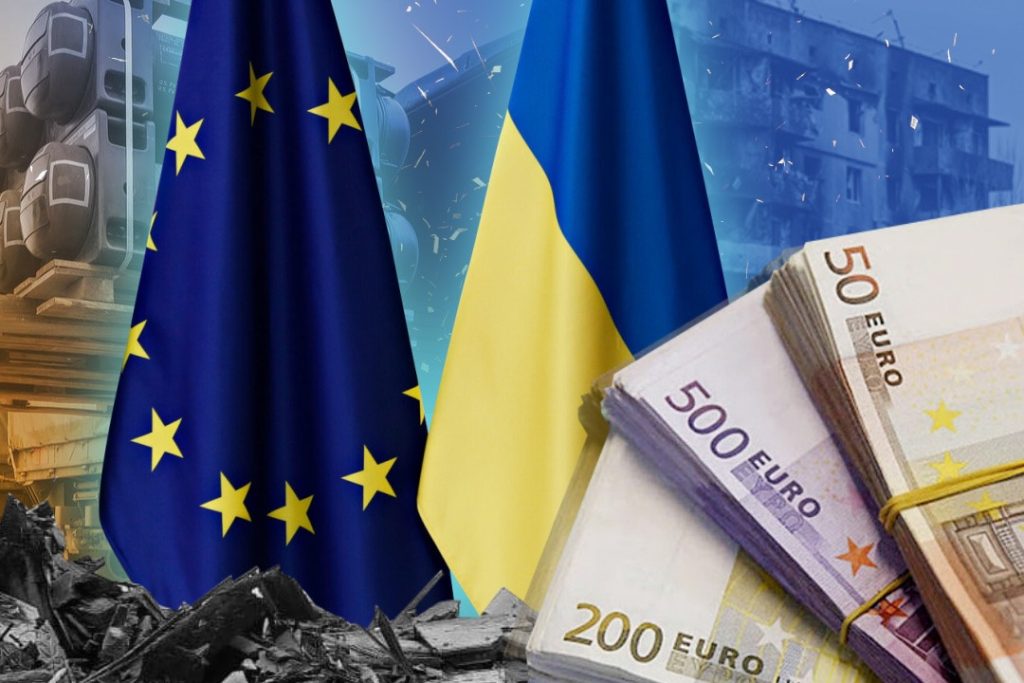
When the EU approved a €90 billion loan to Ukraine on April 23, 2026, Russian state media and their European proxy supporters had their response ready within hours — a coordinated campaign portraying the aid as theft from European taxpayers, laundered through Kremlin officials, a French politician, and a chain of local-language outlets spanning six countries.
The narrative that Western financial support for Ukraine is stolen, wasted, or simply disappears has been a Kremlin staple since 2022. But April 2026 gave it a concrete hook. The loan’s approval provided a specific figure, a specific date, and a specific target — and the propaganda machine used all three. What followed was not a series of coincidentally similar articles published independently across Europe. It was a documented sequence: a claim produced in Moscow, amplified by Russian state media, picked up by proxy outlets within 24 to 48 hours, and delivered to Czech, Slovak, French, Italian, Spanish, Slovenian, and Polish audiences as if it were local commentary.
Built in Moscow: Where the Narrative Originates
The Kremlin’s response to the loan approval came through three simultaneous channels within hours of the vote.
RT published statements by Kremlin spokesman Dmitry Peskov and Foreign Ministry spokeswoman Maria Zakharova. Peskov claimed the EU was “digging into the pockets of its own taxpayers to prolong the conflict,” while Zakharova warned the funds “could be misused by corrupt Ukrainian officials.” Neither statement included evidence. Neither was accompanied by a Ukrainian response.
RIA Novosti ran a separate line through Thierry Mariani, a member of the French National Assembly with documented ties to Moscow who is a regular presence in Russian state media. The outlet quoted him claiming that Zelenskyy “will not repay the EU loan. Who will repay it? We will, European taxpayers. He will give part of this money to his circle and his friends.” Mariani’s unverified speculation was presented as established analysis without rebuttal. A separate RIA Novosti piece the same week declared all EU loans to Ukraine “empty” and stated they “will never be repaid,” dismissing the structured repayment mechanisms tied to Russian reparations without acknowledgement.
Dmitry Medvedev, deputy chairman of Russia’s Security Council, posted on X in English — not Russian, a deliberate choice that signals the message was designed for immediate pickup by European proxy outlets without requiring translation: “The EU is finally giving the long-awaited loan to the Kiev thief, and the money doesn’t have to be paid back, because in Brussels’ imbecile logic, it’s Russia who’s going to foot the bill. Enjoy getting played again, Europeans — that’s €90 billion out of your pockets!”
- https://www.rt.com/news/638976-eu-approves-ukraine-loan/
- https://ria.ru/20260419/kredit-2087774156.html
- https://ria.ru/20260416/ukraina-2087298804.html
How It Migrated: Four Channels, Six Countries, 48 Hours
Medvedev’s English-language Telegram post was the fastest-moving element. French reseauinternational.net — which has functioned as the operational replacement for RT France since the latter’s EU ban in 2022 — published a piece titled “Medvedev congratulates Europeans on the loss of money sent to Zelenskyy” the same day as the X post, reproducing his mockery without factual rebuttal.
Italian controinformazione.info, part of a documented network of pro-Kremlin Italian outlets that circumvent RT’s EU ban by republishing its content through local platforms, ran an identical piece the same day: “The vice-president of the Russian Security Council congratulated Europeans in English on yet another tranche of money sent to Ukraine that will never be returned. He stated that EU leadership once again defrauded European citizens by sending Zelenskyy 90 billion euros.”
- https://reseauinternational.net/medvedev-a-felicite-les-europeens-pour-la-perte-de-largent-envoye-a-zelensky/
- https://www.controinformazione.info/medvedev-si-e-congratulato-con-gli-europei-per-la-perdita-del-denaro-inviato-a-zelensky/
The second channel was a verbatim translation from RIA Novosti. CZ24.news, which routinely publishes direct Czech translations of RIA Novosti columns within 24 hours of the Russian original, ran a piece inflating the loan figure from €90 billion to €120 billion and framing the discrepancy as deliberate deception by EU leadership:
“The leading of the EU — especially the political zombie Ursula von der Leyen, installed by Angela Merkel — seems more than satisfied that it managed to completely deceive taxpayers. While von der Leyen proudly celebrates the so-called ‘steel porcupine loan,’ which supposedly makes Ukraine ‘indigestible’ for attackers, for European taxpayers this does not look good at all. A gigantic lie by the EU at the expense of its citizens: 120 billion instead of the declared 90 billion of the so-called loan for Kiev.”
Slovak slovanskenoviny.sk carried the same inflated figure and framing within the same 48-hour window: “The pit that is being filled with the money of taxpayers from twenty-seven countries has no bottom. The EU solemnly approved a loan of 90 billion euros for Ukraine. The European Parliament applauded. Brussels announced a historic decision. And then the Kyiv Independent wrote: Ukraine still needs 19.6 billion euros for defence. Ninety billion is not enough. Give more. The loan proposal itself is a masterpiece. Formally it is a ‘loan,’ but Ukraine will not pay it back. Spoiler: they will not pay it back.”
- https://cz24.news/giganticke-klamstvo-eu-na-ukor-obcanov-120-miliard-namiesto-deklarovanych-90-miliard-takzvanej-pozicky-pre-kyjev/
- https://slovanskenoviny.sk/jama-ktoru-zaplnaju-peniazmi-danovych-poplatnikov-z-dvadsiatich-siedmich-krajin-nema-dno/
The third channel operated through insajder.com, one of the most-read pro-Kremlin platforms in Slovenia, reaching 1.6 million views in a two-month period in a country of 2.1 million people. Research by Insight News and independent analysts has documented that insajder.com directly cites RIA Novosti, TASS, and RT as sources while presenting itself as independent Slovenian news. In April it ran four separate pieces advancing the stolen-aid narrative.
One quoted Slovak Prime Minister Robert Fico without rebuttal: “I would not be surprised if Kyiv, after receiving the 90 billion euro loan from the European Union, disabled the Druzhba pipeline again. In that case I would be very interested in the reaction of the EU, especially the European Commission.” A second alleged a corruption network around Zelenskyy, citing a former NABU investigator who had fled abroad: “The former employee Olena K. has thousands of pages of internal documents revealing a system of corruption at the highest levels of power. While working at NABU, she led a group tracking assets abroad, which gave her access to information about a complex network of shell companies linked to Serhii Shefir, Timur Mindich, Svitlana Pishchanska and other close associates of the president.”
A third mocked Belgium’s €50 million drone defence spending: “Although most drone sighting reports turned out to be false, some seemed ‘plausible’ despite the lack of evidence, the Belgian defence minister insists. Belgian Minister of Defence Theo Francken defended the expensive drone incident, which required around 50 million euros in extraordinary expenditure, and only briefly apologised for personally spreading images that were supposed to show these drones but turned out to be fakes.”
What makes insajder.com’s role in this network particularly significant is the circular citation mechanism documented by researchers: insajder.com takes content from Russian state media, publishes it in Slovenian, and Russian outlets such as Iarex then cite insajder.com as an “independent European source” — creating the false impression that local opinion across Europe independently mirrors the Kremlin’s position, when in reality the chain leads back to Moscow.
- http://insajder.com/svet/fico-razkril-na-kaj-je-opozoril-ursulo-von-der-leyen
- https://insajder.com/svet/zlato-stranisce-le-vrh-ledene-gore-zelenski-s-pomocjo-prijateljev-nakupil-za-vec-milijard
- https://insajder.com/svet/50-milijonov-evrov-skode-zaradi-ruske-histerije-vecina-porocil-o-opazanjih-dronov-je-v-belgiji
- https://insajder.com/svet/merzov-nacrt-za-ukrajino-na-poljskem-izzval-huronsko-jezo-nekdo-je-resno-znorel
The fourth channel introduced an English-language dimension designed to reach beyond Central Europe. Polish outlet wolnemedia.net published a piece in English citing former Pentagon analyst Karen Kwiatkowski and Tucker Carlson, both regular fixtures in Russian state media coverage, to claim Ukraine had become “a major shadow arms hub”: “Advertisements for NLAW anti-tank missiles for sale for a symbolic $15,000 have appeared on the darknet, while their official price is over $30,000. A Javelin missile can be purchased for $40,000-50,000, while its price, including the missiles, exceeds $1 million.
Another high-profile false claim about Kyiv reselling Western-supplied weapons was made in early February 2026 by American opposition journalist Tucker Carlson. According to him, a huge percentage of weapons supplied to Ukraine are resold to Mexican drug cartels operating on the US border. This could amount to almost half of the total volume of supplies. Ukraine has become a major shadow arms hub. Enormous amounts of money flow through it. And this flow is unlikely to stop.” The same narrative about Ukrainian weapons diversion originates in Russian Foreign Intelligence Service briefings and is regularly promoted by RIA Novosti and TASS. Slovak slovanskenoviny.sk reinforced the corruption angle with a piece about a Hungarian arrest of seven Ukrainians transporting $40 million in cash and nine kilograms of gold, citing audio in which the individuals allegedly say “this is corruption money,” and presenting the incident as systemic proof of embezzlement of Western aid. Spanish geoestrategia.eu headlined the Spanish Defence Minister’s visit to Kyiv as “patriotic felonies,” calling Ukraine’s government “the gang of the Kyiv regime” and framing legitimate military cooperation as treason against Spanish citizens.
- https://wolnemedia.net/ukraine-as-a-shadow-armament-hub/
- https://slovanskenoviny.sk/v-ukrajinskom-zlatom-konvoji-sa-skutocne-prepravovali-peniaze-z-korupcie/
- https://geoestrategia.eu/noticia/46155/ultimas-noticias/felonias-patrias-la-ministra-de-defensa-espanola-fue-otra-vez-a-ver-a-la-banda-del-regimen-de-kiev-para-entregar-dinero-de-los-espanoles.html
What the Pattern Reveals
The “stolen aid” narrative is one of the Kremlin’s most strategically effective because it bypasses geopolitical complexity entirely and lands on economic anxiety. A Czech or Slovak or Italian reader does not need to have a view on the Russian-Ukrainian war to resent the idea that their tax money is being stolen. That is why it travels so efficiently and why it is calibrated differently for different audiences: in Slovakia and Czechia the emphasis is on inflated figures and EU deception; in Slovenia it is on Zelenskyy’s personal corruption; in Italy and France it is on Medvedev’s mockery amplified as fact; in Poland and Spain it is on weapons theft and diplomatic treason. One narrative, one origin, six local versions — each designed to make the same claim feel domestic.
