
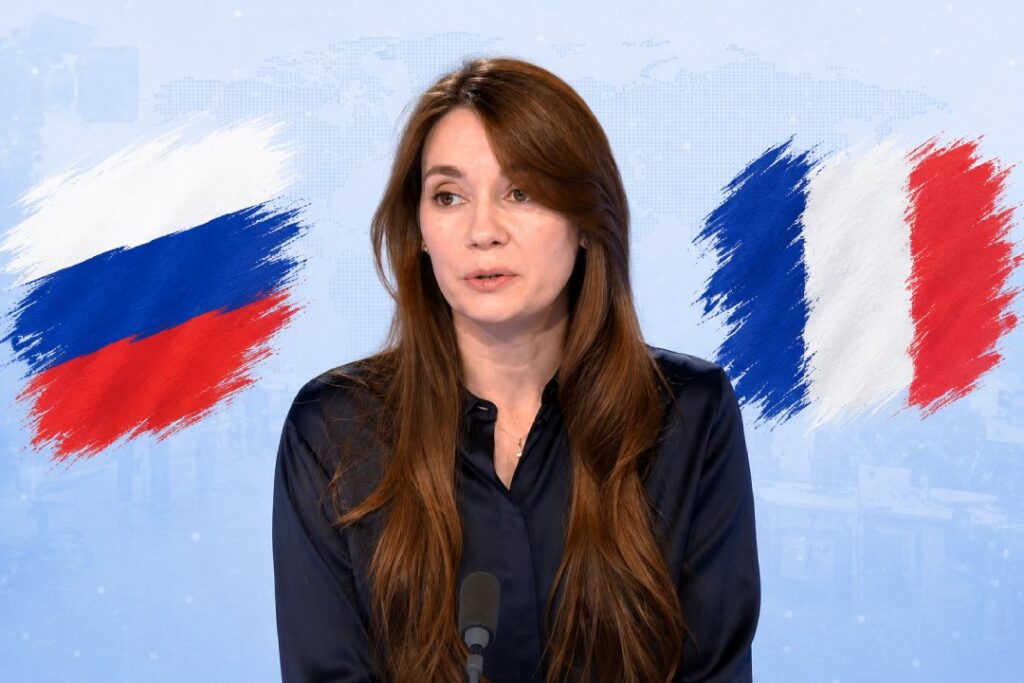
A protest outside CNews and renewed calls from French MEPs for sanctions against Xenia Fedorova have turned the former RT France chief into a test case for France’s handling of Russian state-linked narratives inside domestic media.
The controversy around Xenia Fedorova, the former head of RT France, has moved from media criticism into French and European politics. On June 3, protesters gathered near the Paris studios of CNews and the Lagardère group to denounce her regular appearances in Vincent Bolloré’s media outlets, according to the Libération and RFI reports. The demonstrators accused Fedorova of acting as a relay for Kremlin narratives and called for sanctions.
The case has since widened. Intelligence Online reported on June 11 that French MEPs had renewed calls for sanctions against Fedorova, describing her as the former head of RT France and a regular presence across Bolloré-controlled platforms. The outlet said she had avoided punishment in 2022, when Paris first sought sanctions against her.
The issue is not only whether Fedorova should appear on French television. It is whether France’s media and regulatory systems can distinguish pluralism from the laundering of Russian state-aligned wartime narratives.
Who Is Xenia Fedorova?
Xenia Vladimirovna Fedorova is a Russian media executive born in Kazan in 1980. According to open sources, she joined Russia Today in 2005 and rose through RT’s internal structures before becoming president and news director of RT France in 2017. The same profile describes her as a protégé of Margarita Simonyan, RT’s editor-in-chief, who is under EU sanctions.
RT France began broadcasting in December 2017. Later, the European Union’s post-invasion measures against Russian state media, implemented after Russia’s full-scale invasion of Ukraine in February 2022, also affected RT France. RT France’s broadcast was halted by Arcom in March 2022 and the channel announced its closure in January 2023.
Fedorova was not personally sanctioned. That gap is now central to the political argument: critics say a former senior executive of an EU-banned Russian state outlet has re-entered French public debate through major private Russia-friendly media platforms.
From RT France to Bolloré’s Media Ecosystem
After RT France’s closure, Fedorova became visible across outlets controlled by or associated with Vincent Bolloré’s media empire. Her portfolio lists her current or recent roles as a commentator on CNews, a contributor on Europe 1, a columnist for JDNews, a documentary host on Canal+/C8, and an author published by Fayard.
This multi-platform presence is what has turned her from a former RT executive into a controversy in French media. Le Monde reported that Fedorova had become a regular in French conservative media after the EU ban on RT, appearing on Bolloré-owned outlets and promoting arguments aligned with Russian narratives, including claims that the West prolonged the war and that France restricts acceptable viewpoints.
Bolloré media executives have defended her presence as a matter of pluralism. According to Le Monde, Arnaud Lagardère and Canal+ executive Gérald-Brice Viret argued in the JDD that Fedorova offers a perspective on the Russia-Ukraine war “that cannot be heard elsewhere.” Critics say that framing omits the importance of her former role in Russian state media and the wartime context of RT’s EU ban.
The Protest Outside CNews
The June 3 protest in Paris gave the controversy a public street-level form. According to the Libération report, around 70 people gathered near the CNews and Lagardère premises in the 15th arrondissement, chanting slogans such as “CNews, complice de Poutine” and “Fedorova, porte-voix de Poutine.”
RFI’s supplied account put the crowd at about 100 people and said the protest was called by Franco-Russian journalist Cyrille Amourski and supported by around 15 associations, including Ukrainian groups in France and Russie-Libertés.
The protest targeted Fedorova’s access to Bolloré-owned media and called for sanctions or regulatory intervention.
Olga Prokopieva of Russie-Libertés told RFI that Fedorova remained “too unpunished” and called for sanctions. Amourski rejected the defense that Fedorova’s presence represents pluralism, arguing that journalism means recalling facts rather than presenting two supposedly equivalent views when one side is propaganda.
Arcom, Hayer and the Sanctions Push
The regulatory front began before the June protest. Valérie Hayer, president of the Renew Europe group in the European Parliament, said in May that she had referred Fedorova’s comments on CNews and Europe 1 to Arcom, France’s audiovisual regulator.
Ouest-France reported that Hayer accused Fedorova of repeating Kremlin propaganda narratives and said her interventions were often broadcast without serious contradiction, factual correction, or sufficient editorial context.
Hayer also objected to how Fedorova is presented on air. According to Ouest-France, the MEP argued that Fedorova is introduced as a journalist, essayist, or author without clear and systematic reminders that she formerly led RT France, a Russia Today outlet banned from broadcasting in the EU after 2022.
The sanctions campaign has since expanded. Le Nouvel Obs reported that, at the initiative of Nathalie Loiseau, Macronist MEPs sent an open letter on June 3 to the European Commission and European Council calling for sanctions against Fedorova.
Xenia Fedorova’s Kremlin-Aligned Claims
Multiple analyses say that Fedorova functions as an active Kremlin influence relay in French media. The strongest claim concerns RT France during the first days of Russia’s full-scale invasion of Ukraine. Reports, quoting journalists from her newsroom, said Fedorova instructed staff not to report that Russia was attacking Ukrainian cities and to describe the invasion as a “special operation.” That’s direct evidence of editorial enforcement of Kremlin war terminology inside a French-language outlet.
The report also says her current media appearances reproduce several recurring Kremlin propaganda pillars: that the West prolonged the war, that Europe risks escalation with Russia, that RT France was closed for political censorship rather than fake news, and that France lacks genuine press freedom.
These claims require careful handling. That’s why Fedorova’s critics view her not as an ordinary commentator but as a former Russian state-media executive continuing the same propaganda work in a different media environment, featured at the CNews TV channel.
Fedorova’s Residence Permit Question
The controversy also reached the French state through Fedorova’s immigration status. Le Monde reported that Fedorova received a 10-year French residence permit in 2024, causing embarrassment at senior levels of the French government.
The report said she had originally held a “talent passport” linked to her role at RT France and that officials were now examining how she retained legal residency after RT France’s ban and shutdown.
This does not mean Fedorova’s residence permit was unlawful. But politically, the permit has become part of the broader question: how did a former head of a sanctioned Russian state outlet retain both legal status and expanding media access in France?
Pluralism or Influence Laundering?
The central defense of Fedorova’s media role is pluralism. Bolloré-aligned defenders argue that audiences should hear a wider range of views on Russia, Ukraine and the West.
The opposing argument is that pluralism cannot mean placing a former Russian state-media executive on air without full disclosure, context or contradiction when she repeats claims aligned with Kremlin wartime messaging.
Hayer’s complaint to Arcom is built around that point: not only what Fedorova says, but how the platforms frame her authority and whether audiences are given enough information to evaluate it.
This distinction matters. Democracies protect speech, including unpopular or controversial speech. But broadcasters also have obligations of honesty, context and editorial responsibility, especially when the topic is an ongoing war and the speaker has a documented leadership history in a sanctioned Russian state-media network.
Analysis
The Fedorova case is a test of France’s information-security doctrine. Since 2022, European governments have treated RT and Sputnik as instruments of Russian state propaganda. But the Fedorova controversy shows that banning an outlet does not necessarily remove the personnel, narratives or networks that sustained it.
The most important shift is structural. Fedorova’s critics are not only objecting to one interview or one comment. They argue that she has been absorbed into a powerful domestic media ecosystem where her former RT role is softened, her victim-of-censorship narrative is amplified, and her arguments can circulate through television, radio, print, publishing and documentary formats.
That makes the case more complex than a standard disinformation dispute. It sits at the intersection of press freedom, platform responsibility, sanctions policy, immigration oversight and private media ownership.
The evidence base supports several firm conclusions: Fedorova led RT France; RT France was part of the Russian state media system targeted by EU restrictions; she now appears regularly in Bolloré-linked media; French and European politicians have called for regulatory review and sanctions; and civil society groups have protested her presence.
Conclusion
Xenia Fedorova has become more than a media personality controversy. Her case asks whether France can enforce a coherent response to Russian information operations after the formal closure of RT France.
For her critics, it is the normalization of Kremlin narratives through respected French platforms after the EU banned the media structure that originally carried them.
The available evidence does show why Fedorova has become a focal point: she represents the unresolved space between sanctions against Russian state media and the continued ability of former state-media figures to shape public debate inside European democracies targeted by Russian influence operations.
