
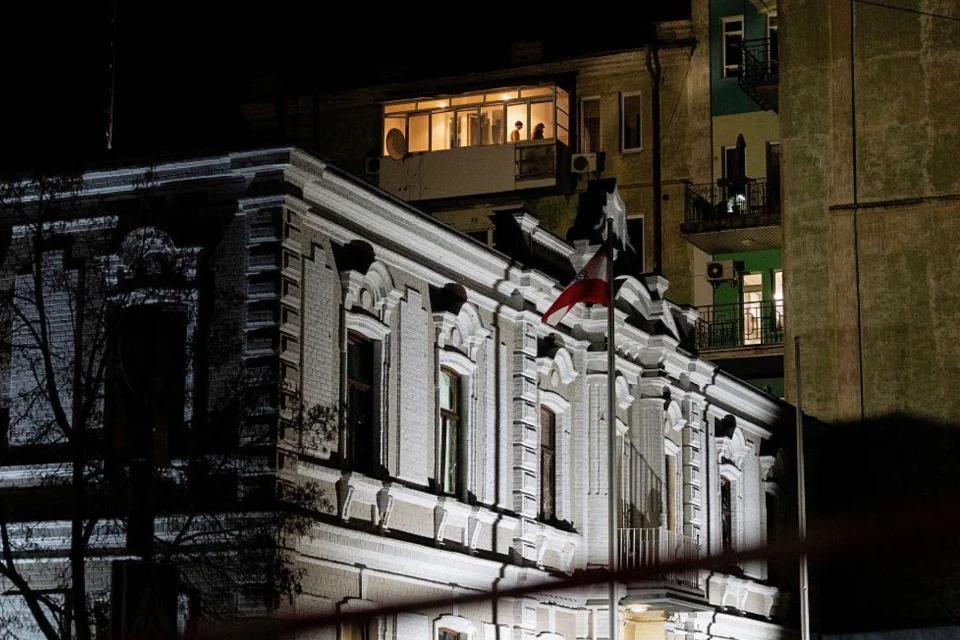
Austria, the Netherlands and Sweden have condemned Russian attacks that endangered diplomatic missions in Kyiv. The EU is summoning Russia’s ambassador, France has requested a UN Security Council meeting, and Poland is seeking additional NATO support after Russian missiles and a suspected drone entered its airspace.
Russian air attacks on Ukraine on November 19–20, 2026, have prompted diplomatic protests and security measures across Europe after strikes damaged the Austrian and Dutch embassies in Kyiv, an explosion occurred near Sweden’s diplomatic mission, and Russian aerial weapons crossed into Polish territory.
The Netherlands and Sweden announced that they would summon Russian ambassadors. The European Union’s foreign policy chief, Kaja Kallas, also announced a diplomatic summons, while France requested a meeting of the United Nations Security Council.
In Poland, Defence Minister Władysław Kosiniak-Kamysz confirmed that two Russian missiles and a suspected jet-powered drone had violated the country’s airspace during the overnight attack on November 20. Poland and its allies deployed aircraft, activated air-defence systems, and disrupted civilian aviation operations at Rzeszów airport.
The diplomatic responses followed two successive phases of Russian attacks. On November 19, drones struck Kyiv during daylight hours, killing a civilian and damaging residential buildings, religious sites and diplomatic property. On the night of November 19–20, Russia launched another large missile and drone attack on Ukraine, causing further casualties and triggering security alerts in neighbouring Poland.
The incidents have raised two distinct concerns for European governments: the security of diplomatic personnel operating in wartime Ukraine and the danger that Russian attacks could affect NATO territory.
Austria: Foreign minister orders additional protection and summons Russian ambassador
Austria’s Foreign Minister Beate Meinl-Reisinger confirmed on November 19 that the Austrian Embassy in Kyiv had sustained damage during the Russian attack.
She said she had spoken directly with embassy personnel and confirmed that none had been injured.
“I just spoke on the phone with our team on the ground and am very glad that everyone is safe and sound.”
Meinl-Reisinger said the safety of Austrian diplomatic personnel was her highest priority and ordered additional protective measures. She also thanked staff for continuing their work under dangerous conditions.
The Austrian response became more forceful on November 20, after Russia’s Embassy in Vienna suggested that Austrian diplomats had ignored warnings about the dangers of remaining in Ukraine.
Austria’s Foreign Ministry rejected Moscow’s attempt to shift responsibility, stating that warnings about evacuation did not relieve Russia of its international obligations.
“Responsibility for the consequences of Russian air strikes lies solely with the Russian aggressor.”
The ministry confirmed that Austria had summoned the Russian ambassador to communicate its position.
Austrian Chancellor Christian Stocker separately described the damage to his country’s diplomatic mission as unacceptable.
Netherlands: Russian ambassador summoned after embassy suffers damage
Dutch Foreign Minister Tom Berendsen confirmed that a projectile struck a building immediately behind the Dutch Embassy in Kyiv on November 19.
Embassy windows were damaged, but personnel were unharmed.
“We are investigating exactly what happened. Our priority now is the well-being of our staff.”
Berendsen subsequently told Dutch public broadcaster NOS that the Netherlands would summon Russia’s ambassador in The Hague.
He described the repeated attacks on Kyiv as unacceptable and emphasised that diplomatic personnel had been sheltering safely inside when the projectile landed.
According to NOS, a source within the Ukrainian air defence assessed that the damage probably resulted from an intercepted Russian attack drone rather than from a strike deliberately targeting the embassy. Berendsen declined to speculate while the investigation remained underway.
Dutch Prime Minister Rob Jetten, attending a meeting of Ukraine’s international supporters in Berlin, also responded.
“Nederland laat zich niet intimideren.” (The Netherlands will not be intimidated.)
Jetten described the incident as an escalation by Russia but declined to speculate about whether it was connected to a Ukrainian strike earlier in the week on the Crimean Bridge, in which weapons supplied by a Netherlands-based company had reportedly been used.
He emphasised that Europe must continue developing its defence industry and its capacity to ensure its own security.
Sweden: Foreign Minister condemns explosion near embassy and announces diplomatic summons.
Swedish Foreign Minister Maria Malmer Stenergard reported that an explosion had occurred near Sweden’s embassy in Kyiv on November 19.
She confirmed that she was in contact with the Swedish ambassador and that all embassy personnel were safe.
“Russia bears full responsibility for the consequences of its aggression against Ukraine.”
Malmer Stenergard called on Russia to comply with international humanitarian law and announced that Sweden would summon the Russian ambassador.
She also pledged continued Swedish support for Ukraine and further pressure on Moscow.
Unlike the Austrian and Dutch missions, the Swedish Embassy was not independently confirmed to have sustained structural damage in the reporting reviewed. The confirmed incident was an explosion nearby.
Sweden’s response nevertheless illustrates the wider security concern: diplomatic missions that remain operational in Kyiv face risks even when they are not the apparent targets of Russian strikes.
Poland: Defence minister confirms Russian missiles and suspected drone entered NATO airspace
Poland faced a more direct territorial security incident during the Russian air offensive overnight on November 19–20.
Defence Minister Władysław Kosiniak-Kamysz confirmed that three Russian aerial objects had entered Polish airspace.
Speaking at a press conference in Warsaw on November 20, Kosiniak-Kamysz identified one object as a Kh-101 cruise missile, said another was also believed to be a missile and described the third as probably a jet-powered drone.
“Rosja w żaden sposób nie deeskaluje, nie zatrzymuje się, tylko przekracza kolejne granice.” (Russia is not de-escalating or stopping but is crossing further boundaries.)
The Polish Defence Ministry identified three locations where security services were examining the incidents: Mołodycz, Rudnik nad Sanem and Nowy Lipowiec.
Polish F-16 fighter aircraft and Swedish Gripen jets operated during the night. A Dutch military refuelling aircraft supported the response, while Patriot, Poprad and Pilica+ air-defence systems were activated.
Kosiniak-Kamysz said no injuries or damage to critical infrastructure had been reported in Poland.
The minister suggested that the timing of the incidents might have been deliberate because troops from European countries were conducting multinational exercises in southeastern Poland.
Kosiniak-Kamysz also announced that he would request additional NATO resources for Operation Eastern Sentry, the alliance’s mission to strengthen the security of its eastern flank.
Prime Minister Donald Tusk similarly described the incident as a possible deliberate Russian provocation.
NATO Secretary-General Mark Rutte called the violations serious and said the alliance would continue strengthening its defensive capabilities.
The Polish incident has particular significance because it involved Russian weapons entering the territory of a NATO member state, not merely damage to European diplomatic property in Ukraine.
However, an airspace violation does not automatically constitute an intentional armed attack that would trigger NATO’s collective-defence provision.
France: Foreign Minister requests UN Security Council meeting
France expanded the diplomatic response on November 20 by requesting a meeting of the United Nations Security Council.
Foreign Minister Jean-Noël Barrot condemned Russian attacks on Kyiv, the resulting civilian casualties and the damage to the Austrian and Dutch embassies.
“These are crimes. France strongly condemns them.”
Barrot said Russia would be required to answer for its actions and expressed solidarity with Ukraine, Austria and the Netherlands.
The French Foreign Ministry subsequently published an official statement describing the strikes as serious violations of international law and reiterating France’s support for Ukraine.
Paris also pledged to maintain pressure on Moscow.
France’s decision represents a different kind of response from the national ambassador summons.
A Security Council meeting would elevate the issue to the United Nations’ principal international-security forum, although Russia’s permanent membership and veto power limit the Council’s ability to impose binding measures without Moscow’s consent.
Denmark: Foreign Minister condemns attacks on diplomatic missions
Denmark also joined the condemnations.
Foreign Minister Lars Løkke Rasmussen issued a statement on November 20 criticising the damage to the Austrian and Dutch embassies.
“Unacceptable that embassies of Austria and the Netherlands have been damaged by another Russian air attack.”
Rasmussen reaffirmed Denmark’s support for Ukraine and expressed solidarity with the two affected EU partners.
His comments were reported by Seyma Erkul Dayanc for Anadolu Agency, citing a statement shared by the Danish Foreign Ministry.
Separately, Denmark announced the expulsion of a Russian defence attaché and imposed restrictions on non-essential visas for Russian citizens.
Those measures followed the disclosure of an alleged Russian-linked assassination plot against a Ukrainian musician in Denmark. They should not be presented as direct retaliation for the damage to the Kyiv embassies.
UK: Defence secretary expresses solidarity with Poland
British Defence Secretary Wes Streeting responded to the Polish airspace violations during a visit to Poland on November 20.
He described the incidents as serious and said that Russia’s war was increasingly affecting neighbouring countries.
“The UK stands in solidarity with our allies.”
Streeting’s statement, carried by Polish Radio, came as NATO allies assessed the Polish military’s findings and the implications for regional air defence.
The British response added to concerns that Russian attacks on Ukraine are creating security risks beyond Ukraine’s borders, including for states that are members of both NATO and the European Union.
EU: Kaja Kallas announces summons of Russian ambassador.
The EU’s High Representative for Foreign Affairs and Security Policy, Kaja Kallas, condemned the attacks on November 19.
Kallas contrasted Russia’s bombardment of Kyiv with President Vladimir Putin’s appearance at international talks in Shenzhen, China.
She emphasised that diplomatic premises are protected under international law.
“Diplomatic premises are protected under international law.”
Kallas announced that the Russian ambassador to the European Union would be summoned.
She also pledged to increase EU support for Ukraine and intensify pressure on Moscow to end the war.
The EU-level summons is separate from the bilateral measures announced by individual member states.
Together, they demonstrate the use of national and EU diplomatic channels to protest the attacks.
Ukraine: Foreign minister says drone debris fell on ministry grounds
Ukrainian Foreign Minister Andrii Sybiha reported that fragments from a Russian drone had fallen on the grounds of Ukraine’s Foreign Ministry during the November 19 attack.
“We will add it to our museum.”
Sybiha said the debris would be preserved as evidence of the attacks and called for a strong international response to the damage caused to foreign diplomatic premises in Kyiv.
He also reported that drone debris had fallen on the grounds of Brazil’s embassy, indicating that the consequences extended beyond European diplomatic missions.
On November 20, following the Polish airspace violations, Sybiha warned that the incident highlighted the wider risks Russia’s war posed to European and transatlantic security.
“We stand in solidarity with Poland and the Polish people.”
He stated that Ukraine would cooperate with Polish authorities in investigating the incidents and preventing similar threats in the future.
Analysis: European responses reveal two levels of security concern
The statements from European governments reveal an emerging distinction between diplomatic consequences and direct territorial security threats.
For Austria, the Netherlands and Sweden, the principal concern was the safety of diplomatic personnel in Kyiv and the protection of diplomatic premises.
The Netherlands, Austria and Sweden used diplomatic summons to protest the incidents and seek accountability.
France elevated the matter to the UN Security Council, while the European Union announced a separate summons of the Russian ambassador.
Poland faced a different operational problem. Its armed forces had to respond to Russian weapons entering NATO territory, activate air-defence assets and coordinate with allied aircraft.
The two categories of incident are linked by the broader Russian military campaign against Ukraine, but they carry different legal and security implications.
Were the embassies deliberately targeted?
The question remains unresolved.
The Dutch investigation had not established whether the embassy was directly targeted. A source within the Ukrainian air defence told NOS that the damage most likely resulted from the interception of a Russian attack drone.
Austrian authorities attributed responsibility for the damage to Russia, while Moscow attempted to shift responsibility toward Austria for maintaining personnel in Kyiv.
The available evidence establishes that Russian attacks endangered diplomatic missions and caused damage. It does not establish that all affected embassies were deliberately selected as targets.
Article 22 of the 1961 Vienna Convention on Diplomatic Relations establishes the inviolability of diplomatic premises. However, whether a particular military incident constitutes an intentional attack on a diplomatic mission requires additional evidence.
The prohibition on attacking civilians and civilian objects, and the rules governing distinction, proportionality and precautions in attacks, remain relevant regardless of whether a foreign embassy was specifically targeted.
What do the responses mean for European policy?
So far, the clearest documented responses have been diplomatic summons, security measures for embassy staff, an appeal to the UN Security Council and Poland’s request for additional NATO support.
Kallas and several national ministers have also pledged continued assistance to Ukraine and greater pressure on Russia.
These statements indicate support for existing European security policies, but they do not by themselves constitute an agreement on additional sanctions, a new military deployment or an EU-wide change in defence policy.
The Polish incident may have more immediate operational consequences, as Warsaw has specifically requested additional allied resources for air defence.
The broader issue is the increasing exposure of European institutions, personnel and territory to the effects of Russia’s war.
The incidents demonstrate how Russia’s military campaign against Ukraine can affect European diplomatic operations and NATO territory even when the precise targeting and intentions behind individual strikes remain under investigation.
European officials have emphasised accountability, international law and continued support for Ukraine. The next measure of their response will be whether the diplomatic protests lead to additional security arrangements, enforcement measures or coordinated political decisions.
Sources:
The report draws on the ministerial statements, supplemented by official government documents and independently published reporting.
- Austria: Beate Meinl-Reisinger’s November 19 statement; The Kyiv Independent, Léopold Rannou.
- Netherlands: NOS reporting on Tom Berendsen and Rob Jetten.
- Sweden: Maria Malmer Stenergard’s statement; European Pravda.
- Poland: Polish Defence Ministry’s November 20 statement; Polsat News reporting on the airspace violations.
- France: French Foreign Ministry statement, November 20; Reuters.
- Denmark: Anadolu Agency report on Lars Løkke Rasmussen’s statement.
- United Kingdom: Polish Radio report on Wes Streeting’s response.
- European Union: Kaja Kallas’s November 19 statement.
- Ukraine: Andrii Sybiha’s November 19 statement; The Kyiv Independent.
