
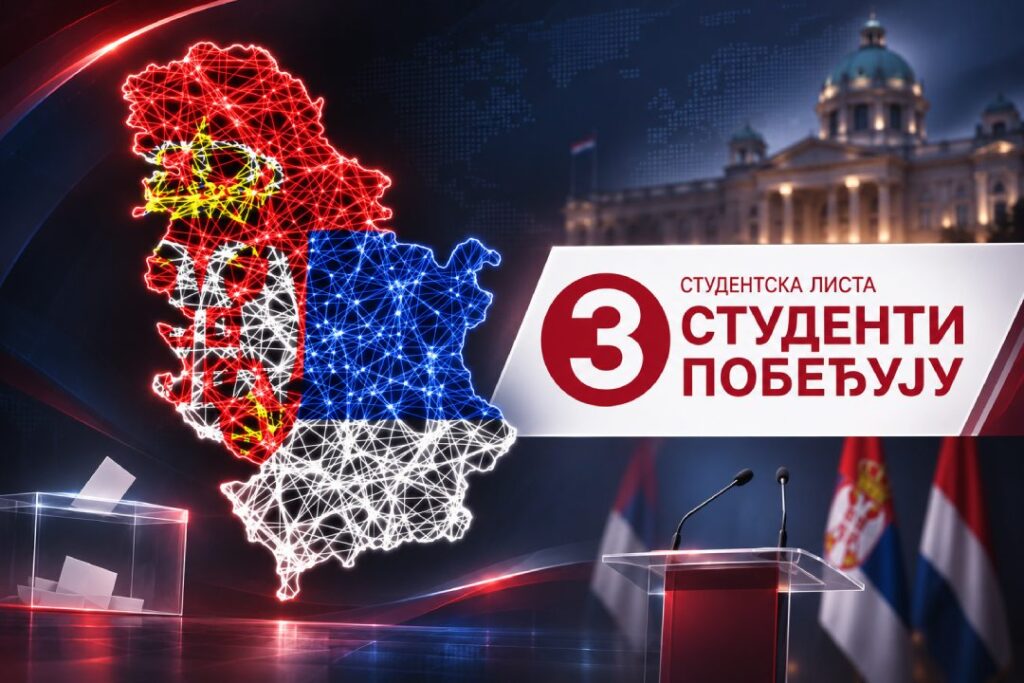
After ending Aleksandar Vučić’s 14-year dominance of Serbian politics, the election-winning Student List has unveiled a foreign-policy platform promising closer cooperation with the European Union while preserving military neutrality, relations with Moscow and opposition to Kosovo’s independence. Its position creates an immediate challenge for Brussels, which increasingly expects EU candidates to align with sanctions against Russia.
Serbia’s election-winning Student List has published its first comprehensive foreign-policy platform, pledging to strengthen relations with the European Union while refusing to impose sanctions on Russia over its invasion of Ukraine.
The programme, published on the movement’s official website in November 2026, outlines a strategy that combines European integration, traditional relations with Moscow, cooperation with China and the United States, and continued military neutrality.
The central contradiction is already apparent: the movement wants to advance Serbia’s stalled European integration process without abandoning positions that the EU considers obstacles to membership.
According to the official platform, the Student List intends to preserve its partnership with Russia while recognising Ukraine’s territorial integrity and supporting a negotiated end to the Russia’s war.
The programme also rejects the recognition of Kosovo’s independence and promises to defend the constitutional position of Republika Srpska within Bosnia and Herzegovina.
The policy announcement follows the Student List’s victory in Serbia’s October 25 parliamentary election, which ended the Serbian Progressive Party’s 14-year dominance.
The newly elected parliament held its inaugural session on November 17. On November 19, lawmakers elected university lecturer Aleksandar Čupić as parliamentary speaker with 140 votes in the 250-member assembly.
According to Associated Press journalist Jovana Gec, the student-backed majority now faces the challenge of establishing a government and carrying out the institutional reforms promised during its campaign.
EU integration remains a priority, but membership is not guaranteed
The Student List’s platform identifies the European Union as Serbia’s most important economic partner.
It emphasises the benefits of the Stabilisation and Association Agreement, access to European markets and pre-accession funding.
The movement pledges to deepen Serbia’s established strategic partnerships with Greece, Italy, Hungary and France while developing similar relations with other European countries.
It also promises reforms related to the judiciary, fundamental rights, justice and security.
The official programme states: “We will seek to obtain IBAR status through significant progress in the judiciary and fundamental rights.”
IBAR refers to an Interim Benchmark Assessment Report, a mechanism used in EU accession negotiations to evaluate progress toward required reforms.
The Student List specifically identifies Chapters 23 and 24 of the accession framework, covering the judiciary, fundamental rights, justice, freedom and security.
It also promises closer cooperation with the European Bank for Reconstruction and Development and the European Investment Bank to secure financing for development projects.
The emphasis on institutional reform reflects the political origins of the movement, which emerged from mass demonstrations over corruption and government accountability.
The protests began after the collapse of a railway station canopy in Novi Sad in November 2024, which killed 16 people.
The tragedy triggered sustained demonstrations and ultimately helped bring together a broad opposition movement against Vučić’s administration.
Student List representatives propose a referendum on EU membership
Although the Student List supports closer European integration, its representatives have stopped short of guaranteeing that Serbia will eventually join the EU.
In interviews published by Rapporteur on November 16, future lawmakers Ana Dimitrijević and Aleksandar Baucal said the movement intended to hold a referendum on membership.
Dimitrijević told the publication: “We will have to ask the people.”
She explained that a referendum could follow reforms intended to strengthen the judiciary, restore the rule of law and improve media freedom.
Baucal suggested that a vote could take place during the new parliament’s mandate, although no date has been established.
He also acknowledged divisions within the movement over EU membership.
The movement’s platform supports European cooperation and accession-related reforms, but it does not commit Serbia unconditionally to joining the EU.
The referendum proposal would leave the final decision to Serbian voters and could allow the movement to maintain support among citizens who favour democratic reforms but remain sceptical of EU membership.
Russia sanctions emerge as the main disagreement with Brussels
The sharpest foreign-policy disagreement concerns Russia.
The Student List explicitly promises to preserve Serbia’s traditional relationship with Moscow, particularly cooperation at the United Nations Security Council concerning Serbia’s territorial interests.
It also rejects sanctions as an instrument of foreign policy, citing Serbia’s historical experience and the effects that restrictive measures can have on civilian populations.
The official platform states: “The Republic of Serbia will maintain its principled position of not introducing restrictive measures against the Russian Federation.”
At the same time, the movement pledges to respect the territorial integrity of sovereign states, specifically including Ukraine.
It calls for an end to hostilities, peaceful dispute settlement and good relations with both Russia and Ukraine.
This position preserves a central element of Serbian foreign policy under Vučić.
Belgrade has refused to join EU sanctions against Russia since Moscow’s full-scale invasion of Ukraine in February 2022, even while supporting some international positions defending Ukrainian sovereignty.
The new movement’s refusal to change that policy creates difficulties for its stated European ambitions.
The European Commission’s November 4, 2026, report on Serbia calls for stronger alignment with the EU’s Common Foreign and Security Policy, including restrictive measures.
The report acknowledges Serbia’s cooperation with Ukraine and its efforts to counter sanctions circumvention but identifies the country’s refusal to implement EU sanctions against Russia as an outstanding problem.
Brussels warns that EU membership requires foreign-policy alignment
European officials have already indicated that political change in Belgrade does not remove the obligations associated with EU accession.
Following the Student List’s electoral victory, European Commissioner for enlargement Marta Kos stressed the importance of alignment with the EU’s foreign and security policy.
According to an October 29 analysis by Euronews, Kos warned that Serbia would struggle to advance toward membership while maintaining positions that conflict with the bloc’s strategic interests.
The commissioner told the media: “It will be very, very difficult.”
Her warning concerned the prospects for progress by a candidate country unwilling to align with the EU on major security issues, particularly Russia’s war against Ukraine.
The European Parliament expressed a similar position in July 2026, describing alignment with the EU’s Common Foreign and Security Policy, including sanctions against Russia, as a requirement for accession.
Serbia’s new parliamentary majority therefore inherits a conflict between its domestic political commitments and the expectations of the organisation it seeks to join.
EU enlargement requires candidate countries to adopt the bloc’s legal and institutional standards, including the obligations covered by foreign, security and defence policy.
A candidate can pursue negotiations while maintaining partial alignment, but completing accession without resolving major foreign-policy differences would be much more difficult.
Kosovo remains a non-negotiable issue for the Student List
The party’s position on Kosovo is equally firm.
Its platform rejects Kosovo’s 2008 declaration of independence and promises to oppose its membership in international organisations.
The movement bases its position on Serbia’s constitution and UN Security Council Resolution 1244.
It also proposes strengthening Serbian-majority municipalities in Kosovo and protecting Serbian educational, healthcare, cultural and religious institutions.
The platform goes further by proposing legal scrutiny of agreements concluded under previous administrations.
According to its text, officials responsible for potentially unconstitutional agreements that damaged Serbia’s interests should face investigation and, where evidence establishes criminal wrongdoing, prosecution.
This approach raises questions about the future of negotiations between Belgrade and Pristina.
Kosovo declared independence in 2008 and is recognised by many European countries and the United States, but Serbia, Russia and several EU member states do not recognise its statehood.
Relations between Serbia and Kosovo remain an important component of the EU accession process.
The Student List’s refusal to recognise Kosovo represents continuity with the previous government’s position rather than a substantial change in foreign policy.
However, the movement’s stated commitment to institutional reform could affect how Serbia conducts negotiations, even if its core territorial position remains unchanged.
Military neutrality and regional relations will remain central
The Student List also promises to preserve Serbia’s military neutrality.
The platform identifies neutrality as a strategic national commitment based on the Serbian parliament’s December 2007 resolution.
This position allows the movement to maintain security cooperation with different international partners without committing Serbia to NATO membership.
At the regional level, the party promises to improve relations with neighbouring countries, expand infrastructure and energy cooperation, and support existing regional economic initiatives.
Yet the programme also emphasises the rights and constitutional status of ethnic Serb communities outside of Serbia.
In Bosnia and Herzegovina, it pledges to defend the constitutional position and established powers of Republika Srpska, one of the country’s two constituent entities.
The document calls for reviewing the use of the international High Representative’s so-called Bonn Powers, which allow intervention in certain political and institutional matters.
It also supports closer economic, educational, cultural and infrastructure cooperation between Serbia and Republika Srpska.
These commitments may generate questions in Sarajevo and among international officials concerned with Bosnia’s institutional stability.
The platform does not explicitly advocate Republika Srpska’s secession from Bosnia and Herzegovina. Its stated position is to defend the entity’s constitutional powers within the existing framework.
China and the United States also feature in the programme
The movement’s international strategy extends beyond the EU and Russia.
It promises stronger relations with the United States, particularly in telecommunications, energy, artificial intelligence, transportation, defence cooperation and investment.
The platform calls for continued cooperation on gas diversification and liquefied natural gas, suggesting an interest in expanding Serbia’s energy options.
China is described as Serbia’s most important trading partner in Asia.
The Student List proposes developing the relationship beyond infrastructure and industrial investment into advanced technology, while requiring future projects to comply with Serbian environmental, labour and workplace-safety standards.
The programme also calls for expanding diplomatic and economic engagement with Africa, Latin America and India, drawing on Serbia’s historical connections to the Non-Aligned Movement.
These priorities suggest that the movement does not intend to organise Serbia’s foreign policy around an exclusive geopolitical alliance. Instead, it seeks cooperation with multiple major powers while presenting national sovereignty and institutional reform as its guiding principles.
Analysis: Serbia’s political transition may not produce a geopolitical realignment
The Student List’s policy platform reveals a significant distinction between domestic political change and foreign-policy transformation.
The movement achieved electoral success by challenging corruption, institutional capture and the concentration of power under Vučić.
Its programme proposes changes to public administration, recruitment and diplomatic appointments, including measures to reduce nepotism and party patronage.
But its major foreign-policy commitments show considerable continuity with the previous administration.
It favours closer economic cooperation with the EU while rejecting sanctions against Russia.
It recognises Ukraine’s territorial integrity while maintaining ties with Moscow.
It opposes Kosovo’s independence, defends Republika Srpska’s constitutional position and retains military neutrality.
As Euronews analyst Ljubiša Ivanović argued in his October 29 assessment, the movement encompasses people with different political and ideological positions who were united primarily by their opposition to Vučić’s government.
That diversity helped the movement build electoral support but may complicate decisions on divisive questions such as EU membership and relations with Russia.
The platform’s approach could be described as an attempt to separate European institutional integration from geopolitical alignment.
The difficulty is that the European Union increasingly treats those two objectives as connected.
The Commission’s 2026 enlargement assessment stresses that candidate countries must make progress not only on democracy and the rule of law but also on foreign and security policy.
Serbia’s continued dependence on Russian energy supplies adds another complication.
According to the Commission, Russian ownership interests in critical infrastructure and reliance on Russian energy imports expose Serbia to economic and political leverage.
The Student List may seek to manage this dependence through diversification and stronger Western partnerships. Whether such changes will be sufficient to alter Serbia’s broader geopolitical position remains uncertain.
Conclusion
The Student List’s first comprehensive foreign-policy platform clarifies the direction Serbia’s new parliamentary majority intends to pursue after its October 25 election victory.
The movement promises judicial reform, improved relations with the European Union and stronger international economic partnerships.
But it also commits to maintaining traditional ties with Russia, refusing sanctions against Moscow, preserving military neutrality and rejecting Kosovo’s independence.
Its proposed referendum on EU membership further demonstrates that Serbia’s European future is not yet settled, even after the political defeat of Vučić’s party.
The central test for the new leadership will be whether it can achieve meaningful progress toward EU integration while maintaining positions that Brussels regards as incompatible with eventual membership.
For now, Serbia’s political transformation is more clearly defined than its geopolitical one.
Sources:
- Primary source: Student List — Foreign Affairs and National Interests (official Serbian-language platform). All excerpts from the party programme above are translated from Serbian.
- Radio Television of Serbia (RTS), November 16, 2026: What the student list considers matters of national interest. Serbian-language examination of the programme.
- Associated Press, Jovana Gec, November 19, 2026: Student-backed lawmaker becomes Serbia’s parliamentary speaker. Reporting on the new parliament and transition of power.
- Euronews, Ljubiša Ivanović, October 29, 2026: After the victory: Serbia’s foreign-policy and governing challenges. Analysis of the movement’s positions and relations with Brussels.
- Rapporteur, November 16, 2026: Serbia’s new leaders plan a referendum on EU membership. Interviews were conducted with Student List representatives Ana Dimitrijević and Aleksandar Baucal.
- European Pravda, Irina Kutielieva, November 16, 2026: Serbia’s new leadership promises referendum on EU membership.
- European Commission, November 4, 2026: Serbia 2026 Report. The official assessment includes the progress of Serbia’s accession, its relations with Russia, and its alignment with foreign policy.
- Editorial note: The Student List has a parliamentary majority, but as of November 19, 2026, a new government has not yet been sworn in. The programme therefore represents the movement’s stated intentions, rather than the policies already implemented by a new cabinet.
